 Life & Style

Lotte, Phát Đạt combine strengths in Thu Thiem project
1.
|
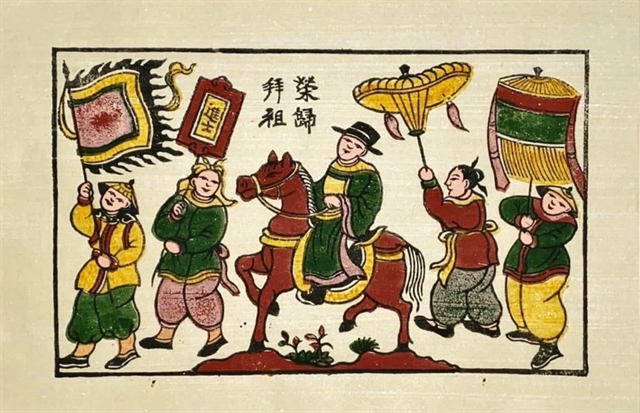
| Horse in Đông Hồ folk painting. |
HÀ NỘI — Horses have long been a familiar part of Vietnamese culture, accompanying people from daily life and farming to the battlefield, and often appearing alongside images of generals, deities, honour, and scholarly achievement.
As such, horses embody both intimacy and a sense of the sacred, symbolising nobility as much as closeness.
Horses are known for their endurance, intelligence, and loyalty, yet they are associated with impatience, arrogance, and unruliness. It is precisely this complexity that has allowed the image of horses to permeate Vietnamese life in a natural and deeply rooted way, enriching the nation’s spiritual and cultural landscape.
The horse in everyday language
Vietnamese idioms and proverbs frequently draw on the image of horses to describe human character. Notably, the Vietnamese language uses two different words – ngựa and mã – to refer to the same animal, each carrying distinct cultural connotations.
According to Dr Trần Văn Sáng of the Faculty of Literature and Communication at the University of Education under the University of Đà Nẵng, ngựa is a purely Vietnamese word, closely associated with southern origins and indigenous Vietnamese culture. Expressions using ngựa tend to depict character traits in a direct, earthy manner, such as ngựa quen đường cũ (a horse returns to familiar paths), thẳng như ruột ngựa (as straightforward as a horse’s gut), ngựa non háu đá (an inexperienced horse eager to kick), or the proverb đường dài mới biết ngựa hay (only a long road reveals a good horse).
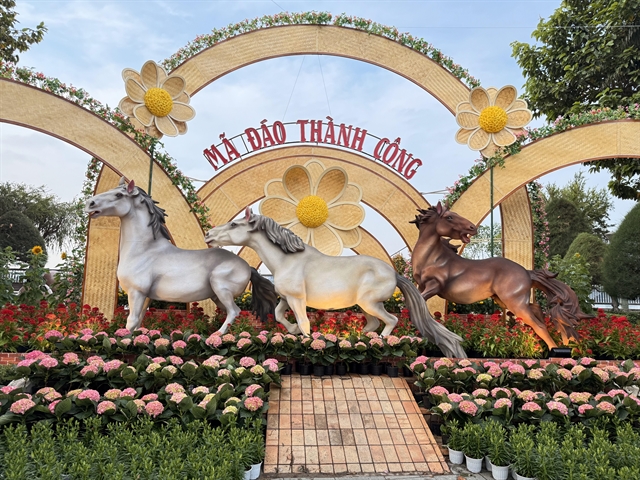
By contrast, mã is a Sino-Vietnamese term with northern origins. Sáng explains that in northern nomadic and dry-farming civilisations, horses were vital for long-distance travel and transport, and thus highly revered. This gave rise to refined and auspicious expressions such as tuấn mã (a fine, strong horse), long mã (a mythical creature with a dragon’s head and horse’s body symbolising peace and prosperity), or mã đáo thành công (a wish for success and a smooth beginning).
Many expressions using ‘mã’ entered Vietnamese through cultural exchange with the North, including thiên lý mã (a steed that can travel a thousand miles), phi mã (runaway, as in “runaway inflation”), or đơn thương độc mã (facing challenges alone).
Another Sino-Vietnamese term referring to the horse is ngọ. In traditional East Asian folk beliefs, one interpretation holds that the position of Ngo in the 12 zodiac animals – at the midpoint – corresponds to the middle of the day, from 11am to 1pm, known as the Ngọ hour.
These linguistic layers reflect how core cultural archetypes are selectively adapted and reinterpreted, creating distinctive symbolic meanings within the Vietnamese language and culture.
A companion in ethnic minority life
While for the Kinh majority today the horse largely survives in language and symbolism, in many ethnic minority regions it remains an essential part of daily labour and production. In mountainous terrain, horses still replace vehicles and machinery, carrying people and goods across rugged paths in the northern mountainous region, the Central Highlands, and parts of southern Việt Nam.
|
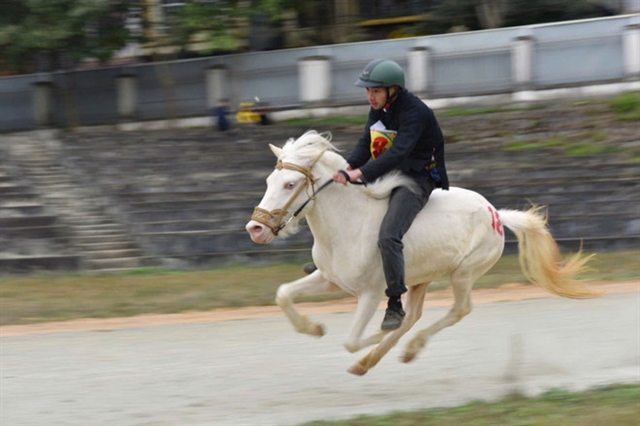
| Bắc Hà horse racing. — VNA/VNS Photo |
In the Central Highlands, horses are prized for their remarkable memory and endurance. Researcher Đặng Minh Tâm notes that local horses can remember routes after only a few trips and navigate villages independently. Though small in stature, they excel in mountainous terrain, helping young men build physical resilience by walking alongside them.
Among the Nùng Din people in Mường Khương (Lào Cai Province), the ritual dance of paper horses is performed during important ceremonies, including funerals, symbolising gratitude toward the deceased and belief in the horse as a guide to the afterlife. For the Mông and other groups, horses have historically been companions not only in transport but also in communal defence and warfare.
Today, horse racing festivals in places such as Bắc Hà (Lào Cai Province) and Tam Đường (Lai Châu Province) have become vibrant cultural events, attracting large crowds and international visitors, especially during the Lunar New Year season. — VNA/VNS
Life & Style
 Life & Style
 Life & Style
 Life & Style
 Life & Style
 Life & Style
 Life & Style
 Life & Style
 Life & Style
 Life & Style
 Life & Style
 Life & Style
 Life & Style
 Life & Style
 Life & Style