 Life & Style
Vietnamese PM pays courtesy visits to Cambodian King, Queen Mother
1.
|
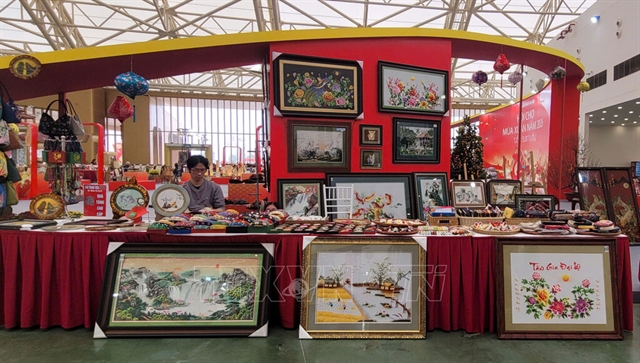
| Hand embroidery paintings are among most wanted products at the Spring Fair 2026 due to its traditional values and people's hard work. VNA/VNS Photos |
Hà Nội — Among thousands of eye-catching products at the National Spring Fair, hand-embroidered paintings from the long-established craft village of Chương Dương Commune stood out and drew strong public interest.
Chương Dương Commune, formerly in Thường Tín District, has long been known for its villagers’ embroidery skills. The craft has been passed down and refined from generation to generation in many families in Đào Xá, Khoái Nội and Từ Vân.
Artisan Đỗ Văn Sơn of the Đỗ Văn Sơn Workshop from Đào Xá brought many works featuring Vietnamese culture and natural beauty to the fair.
After researching customers’ demand for Tết, Sơn and his artisans highlighted the theme of the horse in their paintings alongside rural landscapes, peach and apricot blossoms.
Beyond decoration, the artworks also carry feng shui meaning, conveying auspicious messages such as 'Plain Sailing,' 'Success comes with perseverance,' 'May all your wishes come true' and 'Wealth, Honour and Good Fortune.'
In addition to wall paintings, visitors to the booth could also find other products, such as embroidered bags, tablecloths and hand-embroidered brocade paintings, that meet a wide range of Tết decoration needs.
Sơn said the number of visitors to his booth this year was higher than at previous fairs. It was an encouraging sign for him and other artisans in Chương Dương, as handcrafted embroidery continued to attract attention, with many young people showing interest in newly designed products.
“Horse paintings are the most wanted products as it is not only the zodiac animal of the year but also a symbol of prosperity, good fortune and success,” Sơn told Việt Nam News.
|
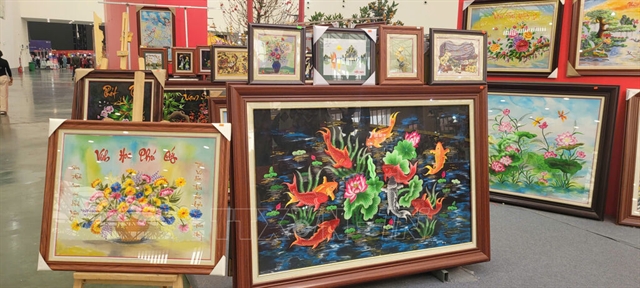
| Many embroidery painting available at the Spring Fair 2026. |
Bùi Văn Đăng and his wife found themselves torn between a painting of racing horses and one of blooming roses before deciding to buy both, saying they offered 'a great combination of fine art and craftsmanship. Both paintings are vivid and feature meaningful themes.'
Đăng said the new pieces would become further additions to his collection, which already includes paintings of peacocks, golden fish, landscapes and calligraphy.
Sơn said what sets Đào Xá hand-embroidered paintings apart is the blend of painted backgrounds and traditional embroidery techniques, a process that demands patience and precision.
To complete a piece, artisans must go through several stages, including sketching the pattern, stretching the fabric, adjusting the design and selecting suitable thread colours. Depending on the complexity of the composition and details, finishing a single work can take up to a month.
However, skill is only part of the process. The most difficult step is dyeing and blending the threads.
“The embroiderers must combine many different shades to create variations in light and dark tones, depth and distance, giving the artwork a visual effect similar to a painted work,” Sơn said.
“Furthermore, it is a tough job that not everyone can do as it requires carefulness, meticulousness, diligence and creativity. It takes a worker many years of practice to develop advanced embroidery skills and a high level of attention to detail, along with artistic flair.”
Next to Sơn’s booth was that of the Xuân Nguyên workshop from Khoái Nội Village. Artisan couple Lê Văn Nguyên and Lê Thị Xuân have been embroidering for dozens of years, as the craft is a family tradition.
Their hand-embroidered paintings, noted for their fine detail, formed a small exhibition at the fair.
Nguyên said that in addition to preserving traditional techniques, he has adapted to market demand. His products are adjusted flexibly. At present, his workshop focuses on paintings featuring Hà Nội as the main theme, which are popular with international tourists as souvenirs.
He also produces many landscape and floral paintings of the homeland as well as cross-stitch embroidery, among other works, as gifts for special occasions.
.jpg)
|
| Artisan Lê Thị Xuân demonstrates hand embroidery at the National Spring Fair. — Photo vov.vn |
Embroiderers from Quất Động were also proud of their craft. At their booth, visitors could learn about the village’s history and the efforts being made to preserve and promote embroidery.
According to historical records, the village was the birthplace of the renowned figure Lê Công Hành.
In the 17th century, during a diplomatic mission to China, he learned the art of embroidery and later passed on his refined techniques to local people.
From Quất Động, the craft gradually spread across the country. To commemorate his contributions, villagers built the Ngũ Xá Temple to honour him as the founder of Vietnamese embroidery.
At first, the products mainly served the aristocracy, the royal court and sacred spaces. Over time, embroidery made notable technical advances, moving from five basic colours and relatively simple methods to a broader colour palette, improved thread-matching techniques and more sophisticated skills, transforming it from a simple craft into a distinctive art form.
At its height, embroidery was the pride of the village, with many works gaining nationwide recognition.
For many years, hand embroiderers in the village have struggled as export orders declined, forcing them to turn to the domestic market.
A limited market and slow consumer demand have led to low incomes for embroiderers. This has prompted many workers to leave in search of more stable jobs.
There is now a serious shortage of successors, as young people are no longer interested in pursuing traditional embroidery.
However, Sơn said the appearance of hand embroidery at the Spring Fair was meant to show the community the vitality and beauty of this traditional craft, which is still being preserved and developed.
He also said he hoped the artisans’ efforts would inspire more people to get involved and help promote the value of this national heritage. — VNS
Life & Style
 Life & Style
 Life & Style
 Life & Style
 Life & Style
 Life & Style
 Life & Style
 Life & Style
.jfif) Life & Style
Life & Style
 Life & Style
 Life & Style
 Life & Style
 Life & Style
 Life & Style
 Life & Style