 Brandinfo
UK Royal Navy’s patrol vessel pays second visit to HCM City
1.
CPG Consultants, a subsidiary of CPG Corporation, is the design firm for Phú Quốc International Airport. The project is led by Steven Thor, Executive Vice President (Global Atelier Collective) at CPG Consultants. He has more than 30 years of experience in international design and has worked on multiple award-winning developments, including large-scale infrastructure projects across several countries.
 |
| Steven Thor, Executive Vice President (Global Atelier Collective) at CPG Consultants |
Widely regarded as a benchmark for airports around the world, Singapore’s Changi Airport has long set standards in design, efficiency, and passenger experience. Having been involved in various phases of Changi Airport’s development – Terminals 1, 2, and 3 – over the decades, CPG brings valuable aviation and urban development expertise to the Phú Quốc International Airport project.
Drawing on this experience, CPG has shaped Phú Quốc Terminal with a modern design mindset, focusing on operational efficiency, sustainability, and long-term scalability.
Beyond being merely an infrastructure project, it is envisioned as a driving force to integrate Phú Quốc Island more deeply into the regional and global aviation map, supporting the goal of developing Phú Quốc into a national and international economic and integrated tourism-service hub, in line with the Government’s development orientation.
Why did CPG Singapore and Sun Group choose the Phoenix as the design inspiration for the Terminal of Phú Quốc International Airport?
The Phoenix is an appropriate choice as the design inspiration for the passenger terminal of Phú Quốc International Airport because it is a sacred symbol, particularly in Vietnamese culture.
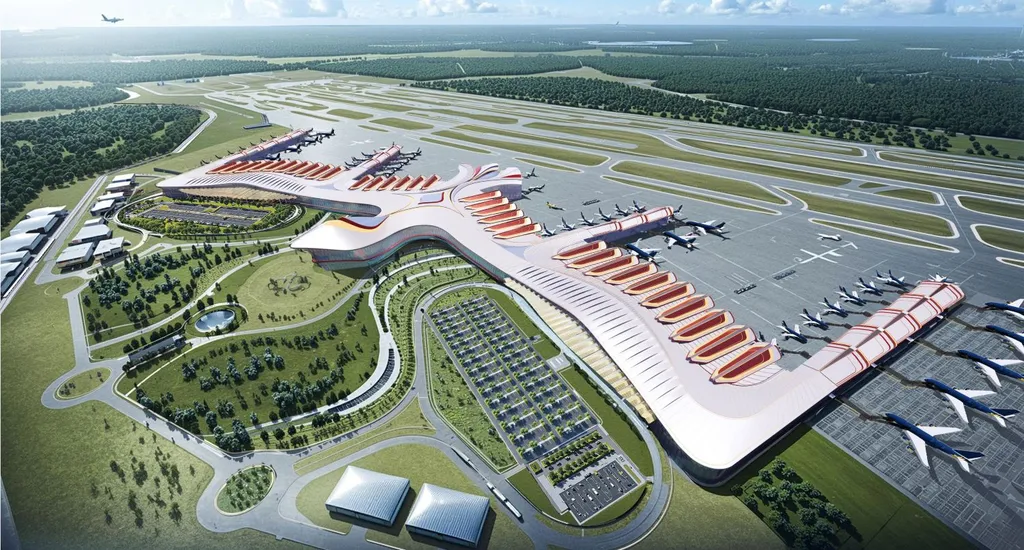 |
| Terminal T2 draws inspiration from the Phoenix |
The Phoenix represents transformation, strength, eternity, and prosperity, resonating with the aspirations of the Government and the Vietnamese people for economic growth and improved living standards. The symbol also reflects the ambition of the investor, Sun Group, to develop Phú Quốc into a new global destination with best-in-class infrastructure.
How has the image of the Phoenix – symbolising rebirth and prosperity – been translated by CPG Singapore into architectural language and spatial organisation for a modern airport terminal?
The Phoenix image has been translated into architectural language and spatial organisation through the terminal’s façade and roof structure. The elevated roof tip creates the image of a Phoenix spreading its wings and soaring into the sky, while the sun-shading system is shaped like layers of feathers, allowing natural light to penetrate deep into the interior.
Natural light will illuminate the nearly 36-metre-high main hall and open up expansive views, creating a bright, open interior space that enables passengers to immediately appreciate the natural beauty and identity of Phú Quốc from the moment they arrive. This is a design approach that most fully expresses the beauty of the island.
Beyond its symbolic value, what outstanding functionalities have been integrated into the design of Phú Quốc Terminal to enhance operational efficiency, such as boarding bridges, apron layout, and passenger movement experience?
The airport is designed to embody Sun Group’s vision of a world-class international airport while incorporating consultancy and guidance from Changi Airport International. Accordingly, the airport’s design is implemented by leading global aviation and operations experts from Global Atelier Collective (GAC) and CPG Airport Studio, both of which are design studios within CPG Consultants (Singapore).
Advanced baggage handling systems are integrated, with security screening conducted before passengers enter the arrival hall. As a result, passengers can proceed directly to the departure gate area without additional checks, creating a seamless and intuitive journey. The terminal also applies biometric passport control systems to significantly shorten processing times.
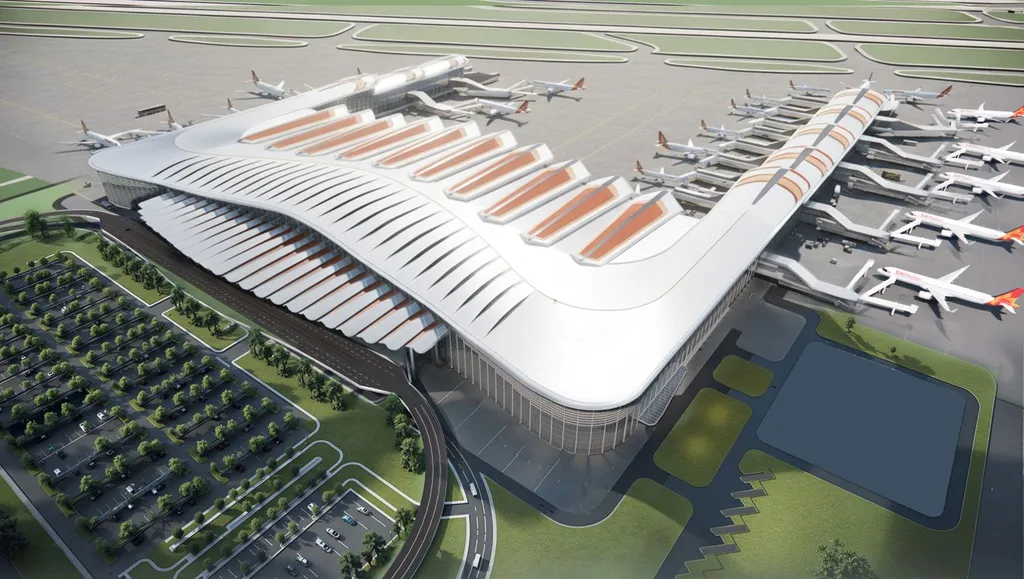 |
| The apron is equipped with flexible passenger boarding bridges capable of serving both narrow-body and wide-body aircraft |
The check-in area is designed with a forward-looking approach, with approximately 60 per cent self check-in counters, while the remaining 40 per cent can be fully converted to self check-in in later phases. Fixed boarding gates are designed for high-capacity operations, allowing multiple passenger flows to board simultaneously. Notably, the passenger boarding bridge system is designed to accommodate two narrow-body aircraft at the same time or one wide-body aircraft, aligning with the terminal’s long-term growth strategy.
CPG has left its mark on many international airports. For the Phú Quốc project, what global excellence does CPG aim to embed into this gateway of Pearl Island?
Phú Quốc possesses a harmonious beauty of sea, sky, and land. This natural relationship is directly reflected in the airport’s materials and colour design. The terminal is designed with multiple levels corresponding to the natural layers of the island. The departure level symbolises the sky with bright colour tones, the central level represents the island landscape with warm tones, and the arrival level evokes the sea with cool tones. In this way, a spatial story of Phú Quốc is told through the language of natural colours.
The airport design has been carefully studied based on the island’s tropical climate, characterised by distinct rainy and dry seasons. The structure and façade are engineered to withstand strong winds, while landscaped areas are protected from heavy rain and intense sunlight.
Despite climatic impacts, the façade remains open in design to maximise natural light and outward views, maintaining continuous visual connectivity between the terminal and the island landscape.
How does CPG view the role of Phú Quốc Terminal within the aviation and tourism network of Southeast Asia?
Phú Quốc is forecast to attract a strong increase in visitors in the coming years, in line with its orientation as an international destination. By applying advanced technologies equivalent to Changi Airport and other world-class airports, Phú Quốc Airport will be ready to operate with comparable efficiency, service quality, and passenger experience, creating a solid foundation for the island to integrate more deeply into the regional and global aviation network.
With the current construction speed to serve APEC 2027, how do you assess the capacity of Sun Group as well as Việt Nam’s design and construction teams? Can this speed create a milestone in international airport construction?
The project commenced in 2025, and within just 11 months progressed from concept stage to the construction of the highest structural levels, achieving a construction speed nearly twice the original projection. This pace reflects the strong capacity of Sun Group as well as Việt Nam’s design and construction teams, and demonstrates the potential to set a new record in delivering a large-scale international airport within a short timeframe.
Although Phú Quốc remains a relatively new destination on the global tourism map, this airport is expected to become a key driver for long-term prosperous development, with expansion and operational capacity to serve up to 50 million passengers by 2050.
Brandinfo
 Brandinfo
 Brandinfo
 Brandinfo
 Brandinfo
 Brandinfo
 Brandinfo
 Brandinfo
 Brandinfo
 Brandinfo
 Brandinfo
 Brandinfo
 Brandinfo
 Brandinfo
 Brandinfo