 Life & Style


Gia Lai Province steps up technology use in education
1.
 |
| A traditional art performance in Ô Diên Commune, Hà Nội — VNA/VNS Photo Tuyết Mai |
HÀ NỘI — Since the Politburo's issuance of Resolution No. 80-NQ/TW on the development of Vietnamese culture in January 2026, Hà Nội has been moving to translate cultural development goals into practical action, with tourism emerging as one of the key areas expected to benefit.
Hà Nội possesses rich cultural resources. It is home to 6,489 relic sites, 1,793 items of intangible cultural heritage, six UNESCO-recognised heritage elements, 351 national treasures, and 1,350 traditional craft villages and craft-based communities. The capital also preserves the Old Quarter, pre-1954 French architectural works, monuments and reliefs of significant historical and artistic value.
Hà Nội also benefits from a concentration of universities, research institutes, diplomatic missions, international organisations and major cultural institutions. A relatively extensive grassroots network of cultural facilities, with 4,374 community houses of culture, further strengthens its foundation.
Yet despite this abundance, much of Hà Nội's cultural wealth has yet to be converted into a strong economic resource.
Tourist arrivals have risen sharply in recent years, but many heritage-based tourism products remain fragmented and lack distinctive identity. High-value destinations such as Hương Pagoda and Thầy Pagoda are still largely dependent on seasonal festivals while many other periods of the year remain underutilised.
Even in central areas, heritage spaces such as the Old Quarter, West Lake and the wider urban core have not yet been developed through integrated visitor experiences or linked product chains. Craft village tourism, agricultural tourism and cultural industries also remain scattered, with no clearly defined ecosystem.
Local authorities say the main constraints include the lack of distinctive product strategies, limited integration between preservation and commercial use, and insufficient application of technology and social resources.
Hà Nội's action plan sets concrete targets for 2030. These include ensuring that 95 per cent of grassroots cultural institutions operate effectively, 100 per cent of students have access to arts and heritage education, all national and special national relics are digitised and available on digital platforms, and cultural industries contribute around 9 per cent of the city’s gross regional domestic product.
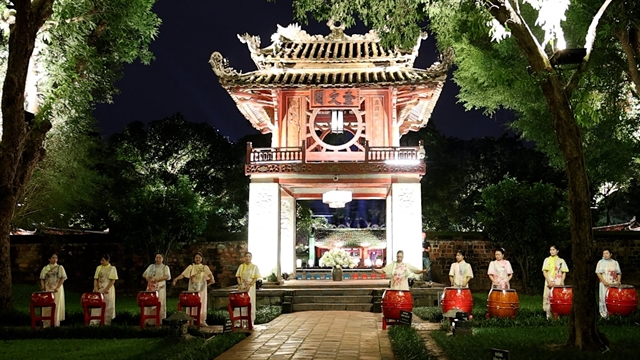
Digital transformation has been identified as a breakthrough area. The city plans to develop shared digital cultural databases, virtual tours, digital exhibitions and automatic interpretation systems at key heritage sites. Pilot projects are under way at the Temple of Literature, Hỏa Lò Prison Relic, Hà Nội Museum, Hà Nội Library and Thăng Long Water Puppet Theatre. Digitalisation is also being expanded at Thang Long Imperial Citadel and Cổ Loa Citadel through GIS, 3D, virtual reality and augmented reality technologies.
Notably, Hà Nội has set a target for open digital cultural data to reach 70 per cent, while revenue from the digital cultural sector is expected to account for 30 per cent of the city’s cultural economy. This signals a shift from digital archiving towards using data as a development resource.
The city is also promoting a broader creative ecosystem in which businesses serve as a driving force while residents remain both participants and beneficiaries.
Besides, traditional arts such as chèo, cải lương, puppetry and drama are being revived and linked with tourism products.
As a member of the UNESCO Creative Cities Network, Hà Nội welcomed nearly 30 million visitors in 2025 and more than 12 million in the first four months of 2026. Night-time economy activities, culinary tourism and creative spaces are increasingly becoming urban highlights.
Recent pilot models combining tourism, culture and craft villages in Bát Tràng, Sơn Tây, Sóc Sơn and Ba Vì have shown encouraging results, shifting activities from simple sightseeing to deeper experiences.
Experts say unlocking Hà Nội's full potential will require stronger planning, better destination management, investment in heritage restoration, more innovative tour design and wider digital promotion.
Taken together, Hà Nội's implementation of Resolution 80 is gradually moving from policy direction to concrete action. The challenge ahead is not only to preserve cultural values but also to organise and utilise them more effectively so that culture can become a genuine engine of tourism growth and sustainable urban development. — VNA/VNS
Life & Style
 Life & Style
 Life & Style
 Life & Style
 Life & Style
 Life & Style
 Life & Style
 Life & Style
 Life & Style
 Life & Style
 Life & Style
 Life & Style
 Life & Style
 Life & Style
 Life & Style