 Life & Style
Vietnamese Prime Minister meets Cambodian National Assembly President
1.
|
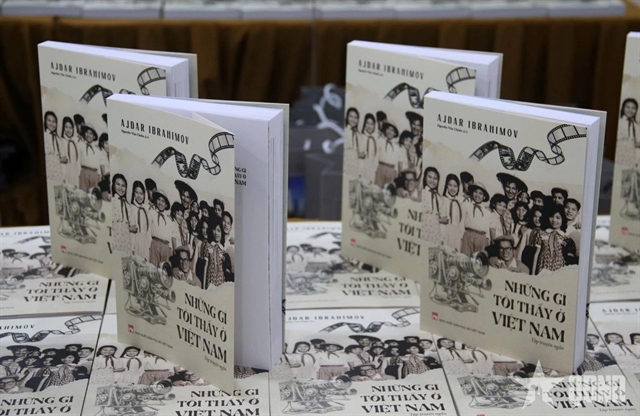
| The Vietnamese language edition of ‘What I Saw in Vietnam’ by Ajdar Ibrahimov. — Photo congluan.vn |
HÀ NỘI — A collection of short stories about Việt Nam by the distinguished Azerbaijani film director, screenwriter and writer Ajdar Ibrahimov (1919–1993), who played a formative role in the development of revolutionary Vietnamese cinema, has been released in Hà Nội.
Titled What I Saw in Vietnam, the volume was first published in the former USSR in 1968. It comprises 25 short stories, memoirs and diary entries that recount Ibrahimov’s experiences while living and working in Việt Nam between 1959 and 1962.
His writing offers vivid and authentic portrayals of daily life, the spirit of resistance and the Vietnamese people’s enduring desire for peace. This marks the first time one of his works on Việt Nam has been translated and published in Vietnamese.
Ibrahimov’s influence on early Vietnamese cinema was profound. Con Chim Vành Khuyên (The Flowerpecker), a film he helped guide Vietnamese students in creating, received an award at the Karlovy Vary International Film Festival in 1962, bringing Vietnamese cinema to the attention of international audiences.
Speaking at Tuesday’s book launch jointly held by the State Committee for Work with the Diaspora of the Republic of Azerbaijan, the Embassy of the Republic of Azerbaijan in Việt Nam and the Việt Nam Film Institute (VFI), VFI Director Lê Thị Hà expressed deep appreciation for Azerbaijan’s commitment to cultural exchange.
“The launch of this book is not only culturally significant, but also helps strengthen the friendship between Việt Nam and Azerbaijan,” she noted.
|
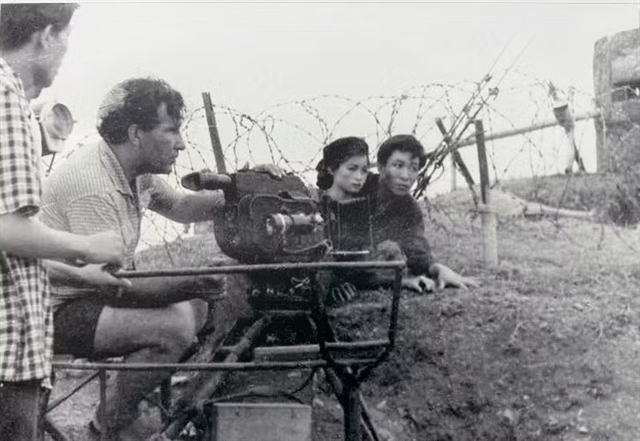
| Ajdar Ibrahimov works with students of the National Film School on a film set. — Photo courtesy of VFI |
Reflecting on Ibrahimov’s contributions, Hà said that cinema serves as a “distinctive language” capable of preserving history and capturing a nation’s defining moments through the eyes of filmmakers both within and beyond its borders.
Chairman of the State Committee for Work with the Diaspora of the Republic of Azerbaijan Fuad Muradov said that the collection continues the cultural dialogue between Việt Nam and Azerbaijan, while also embodying the author’s profound affection for the country.
In 1959, at the invitation of President Hồ Chí Minh and under the direction of the Soviet Ministry of Culture, Ibrahimov arrived in Việt Nam when the country’s film industry was still in its infancy.
Drawing on the rigorous training he received at the All‑Union State Institute of Cinematography – alma mater to many of world cinema’s most influential figures – and on his extensive experience directing, writing and producing films in Turkmenistan and Azerbaijan, he helped establish the National Film School (now the Hanoi Academy of Theatre and Cinema).
Ibrahimov personally selected and trained its first cohort of students, shaping the artistic foundations and creative mindset of Việt Nam’s pioneering generation of filmmakers.
His impact resonated across subsequent generations, including for celebrated actress Trà Giang. His teaching, which prioritised emotional depth over technical flourish, played a defining role in shaping the distinctive acting style of Vietnamese cinema for decades.
|
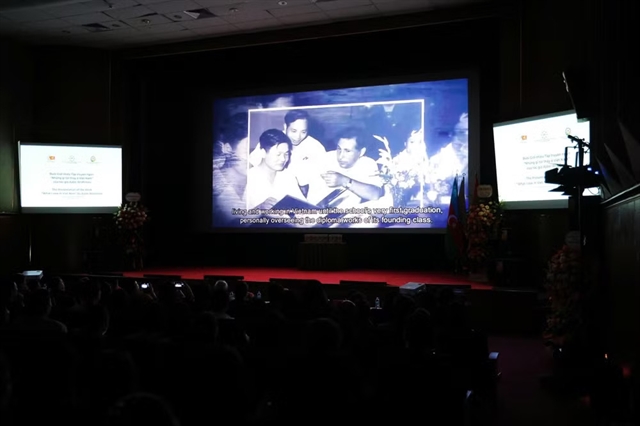
| During Tuesday’s event, attendees watched documentary footage about Ajdar Ibrahimov. — Photo congluan.vn |
After leaving Việt Nam, Ibrahimov continued teaching in Moscow and produced several works on Việt Nam. In recognition of his outstanding contributions, he was honoured with the titles People’s Artist of the former USSR and People’s Artist of Azerbaijan, and was awarded Việt Nam’s Order of Labour.
In addition to What I Saw in Vietnam, Ibrahimov authored other works on the country, including The Blazing Sun and The Cinematic Art of the Resilient Vietnam, which are expected to be translated and introduced to Vietnamese readers in the near future.
During Tuesday’s event, attendees also viewed documentary footage about Ibrahimov, while an exhibition of archival photographs offered further insight into his life and career. — VNS
Life & Style
 Life & Style
 Life & Style
 Life & Style
 Life & Style
 Life & Style
 Life & Style
 Life & Style
 Life & Style
 Life & Style
 Life & Style
 Life & Style
 Life & Style
 Life & Style
 Life & Style