 Environment
Belgian Prime Minister hosts welcome ceremony for Việt Nam’s top leader
1.
|
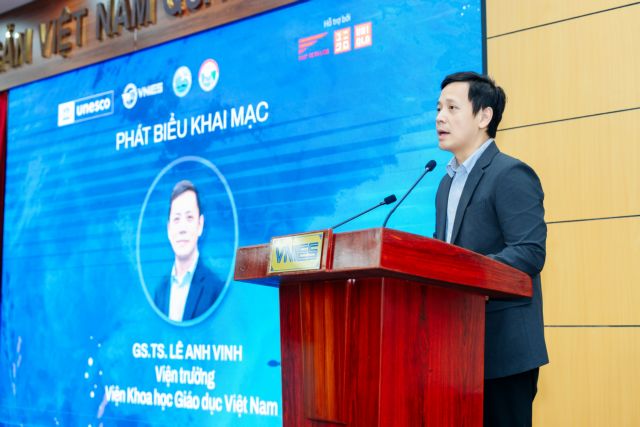
| Lê Anh Vinh, General Director of the Việt Nam National Institute of Educational Sciences, speaks at the conference reviewing the outcomes of the Our Ocean Conservation Project in Việt Nam for the 2024–26 period. Photos courtesy of UNESCO |
HÀ NỘI — The UNESCO Office in Việt Nam, in collaboration with the Việt Nam National Institute of Educational Sciences (VNIES), on Wednesday reviewed the outcomes of the Our Ocean Conservation Project in Việt Nam for the 2024–26 period.
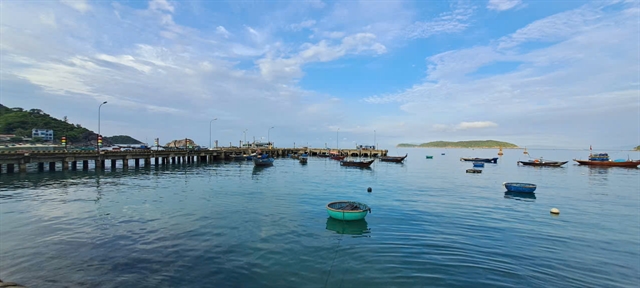
The project was implemented in two UNESCO biosphere reserves, the Cù Lao Chàm–Hội An World Biosphere Reserve in Đà Nẵng and the Cần Giờ Mangrove Biosphere Reserve in HCM City.
At the heart of the initiative was the development of ocean conservation educational materials for primary and lower-secondary students, teachers and local communities, alongside support for integrating ocean conservation themes into school teaching and learning activities.
Through age-appropriate learning resources, teacher training, experiential learning programmes in biosphere reserves and support for student-led initiatives, the project helped translate ocean knowledge into concrete community action.
After two years of implementation, more than 10,000 students participated in a series of school-based activities aimed at generating ideas for ocean conservation, producing over 100 practical initiatives. A total of 580 lessons incorporating ocean conservation content were delivered, engaging more than 3,500 students.
Meanwhile, 70 teachers received specialised training to integrate ocean conservation education into school activities, laying the groundwork for the project's long-term sustainability.
Speaking at the workshop, Lê Anh Vinh, General Director of the Việt Nam National Institute of Educational Sciences, said the project had completed all planned activities, from baseline assessments and the development of educational materials to teacher training, pilot teaching programmes and community outreach efforts.
According to Vinh, one of the project's most significant achievements was the creation of a comprehensive set of ocean conservation educational resources for primary and lower-secondary students, teachers and communities.
Based on field studies conducted in biosphere reserves and schools, project experts identified opportunities to integrate ocean conservation topics into existing subjects rather than creating a separate course. This approach reduced pressure on teachers and students while maintaining educational effectiveness.
"It is an innovative approach that allows marine and ocean environmental protection topics to be naturally embedded within teaching activities and aligned with the current general education curriculum," Vinh said.
|
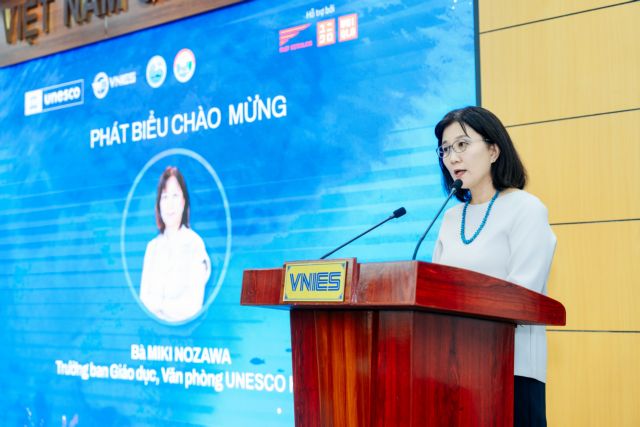
| Miki Nozawa, Head of Education at the UNESCO Office in Hà Nội, speaks at the event. |
Beyond curriculum development, the project organised a series of teacher-training programmes at biosphere reserves, including Cù Lao Chàm and Cần Giờ. Through field-based activities, teachers gained access to scientific knowledge, conservation experiences and practical methods for organising environmental education linked to local ecosystems.
During the implementation period, 20 primary and lower-secondary schools in the two localities piloted integrated ocean conservation lessons. Initial results showed strong engagement from both teachers and students, helping raise awareness of marine ecosystems, biodiversity and environmental stewardship.
Alongside school-based activities, the project expanded community outreach through a range of initiatives, including the nationwide painting contest Draw the Future of the Ocean – Draw Your Future, which attracted more than 7,000 entries from students across the country.
Other activities included the organisation of a Blue Ocean Day, panel discussions and exchanges with environmental experts, social activists and social media influencers.
Vinh emphasised that the project's greatest value lay not only in its educational resources or innovative teaching models but also in its ability to connect stakeholders effectively, including government agencies, schools, international organisations, biosphere reserves and local communities.
"This partnership provides a strong foundation for expanding ocean conservation education in the years ahead," he said.
Miki Nozawa, Head of Education at the UNESCO Office in Hà Nội, told the workshop that the world's oceans are facing increasingly severe challenges, including pollution, biodiversity loss and the impacts of climate change.
In this context, she said, education plays a crucial role in equipping younger generations with the knowledge, skills and sense of responsibility needed to address global environmental challenges.
According to UNESCO, the project's defining strength in Việt Nam was its multi-stakeholder approach. By bringing together scientists, policymakers, educators, biosphere reserves and local communities, students were able to connect scientific knowledge with real-world experiences and develop practical initiatives to protect marine environments.
UNESCO reaffirmed its commitment to working alongside partners in Việt Nam to expand ocean literacy and conservation education programmes, empowering young people to become responsible global citizens and contribute to a sustainable future for both the oceans and the planet.
Participants at the workshop noted that the project's achievements represent more than the conclusion of a successful implementation phase. They also provide a foundation for scaling up ocean conservation education models to other localities across the country, helping foster greater environmental awareness and action within communities nationwide. — VNS
Environment
 Environment
 Environment
 Environment
 Environment
 Environment
 Environment
 Environment
 Environment
 Environment
 Environment
 Environment
 Environment
 Environment
 Environment