 Environment

Việt Nam, Switzerland to turn education, sci-tech, innovation into cooperation focus
1.
|
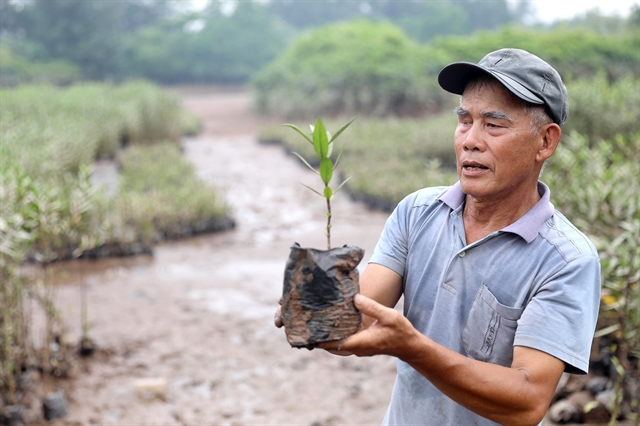
| Vũ Văn Tưởng inspects a seedling before planting it along the coastline. — VNA/VNS Photo |
HƯNG YÊN — Forty years ago, the land behind the sea dike in Đồng Châu Commune in the northern province of Hưng Yên was nothing but mud and open water, scoured twice daily by the tide and battered year-round by wind off the Gulf of Tonkin.
Today it is nearly three kilometres of dense casuarina, sonneratia and mangrove forest. At nearly 70 years old, the man responsible for most of it is still out there most mornings, wading through the mud at low tide to plant another seedling.
Vũ Văn Tưởng was 19 when he was drafted in August 1978 and sent to the southwestern region to fight in the border war against the Khmer Rouge. Within months, he was hit by shrapnel and lost the use of one eye.
Tưởng was treated at a military hospital and then sent to convalesce in what was then Thái Bình Province, where a medical board rated him 81 per cent disabled. He came back to his village in 1984, severely wounded and, by his own account, determined not to be defined by it.
"As long as I have strength, I have to work, and live a life that's useful," he said of the philosophy that shaped everything that followed.
That resolve found its outlet the following year, when local authorities began leasing out tracts of barren coastal land. Most people considered the mudflats worthless – regularly flooded, lashed by waves, hostile to almost anything that tried to grow there.
Tưởng saw an opportunity instead. He borrowed money from family and friends, took on a 15-hectare contract and began planting casuarina, sonneratia and mangrove trees.
The early years were closer to a losing battle than a farming venture. Seedlings that had just taken root were ripped out by waves or killed off by salt water; entire plots had to be replanted again and again.
There was no way to transport saplings except by rented boat, and the trips were themselves dangerous.
"The whole stretch from the dike out to the sea was nothing but water and mud – I had to wade over a kilometre through it just to plant," Tưởng recalled.
"There was one time the waves got so rough the boat nearly capsized, and I had to throw my arms around the mast just to stay alive."
It was failure, repeated many times over, that eventually taught him what he needed to know: which species tolerated salt best, which held soil most effectively, which could withstand direct wave action, and, critically, the rhythm of the tides that would either nurture or destroy a new planting.
Once he had that knowledge, survival rates for his seedlings climbed to more than 80 per cent.
The payoff wasn't only ecological. The forest Tưởng built now functions as a living seawall, absorbing wave energy, holding the shoreline in place and protecting the dike behind it, while also becoming a nursery for local marine life.
Trần Văn Kiều, a resident of Đồng Châu, credits the mangroves with transforming the local mud-crab harvest. A few hours' work under the tree canopy each morning nets him roughly six kilogrammes of crab, selling for up to VNĐ400,000 (US$15) a kilogramme.
"Without this forest, making a living here would be a lot harder," he said.
Tưởng's expertise kept expanding. By 2006, he had mastered propagation of a fast-growing, cold-hardy mangrove variety imported from Myanmar, one that keeps its leaves through winter and resists pests, and word spread quickly.
Growers and reforestation projects from other provinces and cities began ordering seedlings from him. Around the same time, the provincial agriculture department asked him to lead restoration of a separate stretch of coastline nearby.
|
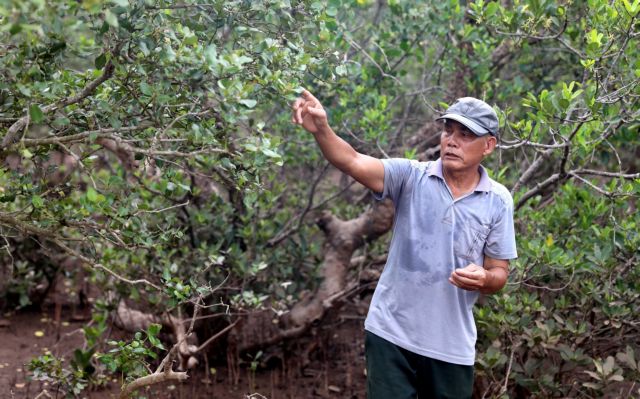
| Vũ Văn Tưởng points to mature sonneratia and mangrove trees he planted years earlier. — VNA/VNS Photo |
He tested the ground first by planting grass, reasoning that if grass could take root, trees could follow, and then spent weeks sleeping at the site rather than going home, staying until the new plantings had taken hold.
The project succeeded, and it drew in further domestic and international reforestation efforts along the coast, nearly all of which Tưởng has since had a hand in planting or maintaining.
The operation he built is now a genuine local business as well as an ecological project. His family grows and sells about 70,000 seedlings a year, generating over VNĐ300 million ($11,400) in annual profit and providing steady work for seven people from the surrounding villages.
He has also become the guardian of the coastline he planted, serving as head of the local forest protection team and overseeing more than 200 hectares of coastal forest across the commune.
Nguyễn Thanh Nhàn of the local Veterans' Association, who worked alongside Tưởng for years, called him a model for the community – a man who, despite a severe disability, never stopped finding ways to build value for his family and his neighbours.
That record has drawn national recognition. In 2019, Tưởng was chosen as a provincial delegate to a national conference honouring outstanding disabled veterans and received a commendation from the Prime Minister.
A second honour followed in 2024, when the Minister of Agriculture and Rural Development singled him out for his role in the national drive to plant one billion trees between 2021 and 2023.
Tưởng shows no sign of stopping. Nearly 70 now, he still tracks the tides and wades out to tend new growth whenever his health allows. For him, planting trees is never just about the shoreline. It is proof, four decades running, that his wounds never get the final word. — VNS
Environment
 Environment
 Environment
 Environment
 Environment
 Environment
 Environment
 Environment
 Environment
 Environment
 Environment
 Environment
 Environment
 Environment
 Environment