 Environment

Cambodian media give heavy coverage to Vietnamese PM’s visit
1.
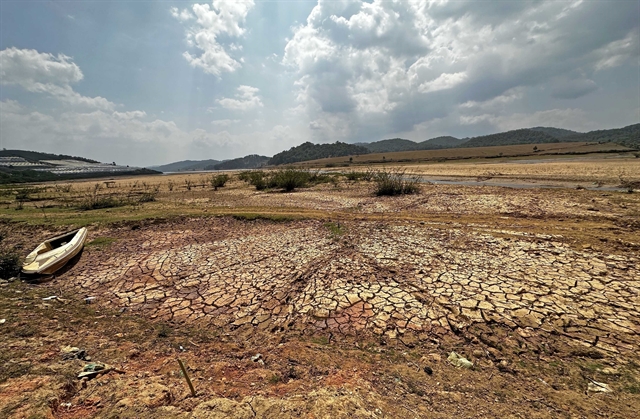 |
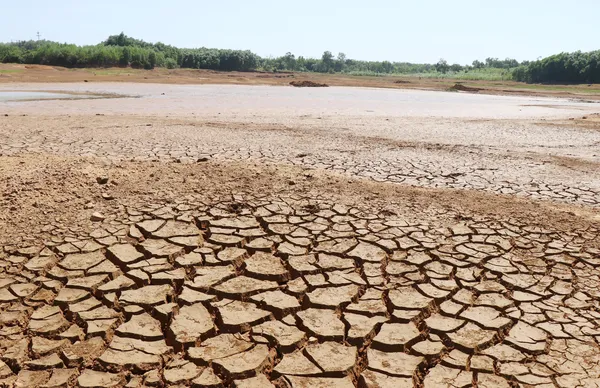
| The largest reservoir in the Central Highlands province of Lâm Đồng dries up completely during the peak of the 2024 dry season. — VNA/VNS Photo Nguyễn Dũng |
HÀ NỘI — A newly-released forecast on the 2026-27 El Niño phenomenon has warned that the climate event could threaten around 350,000 hectares of winter-spring rice in the Mekong Delta and pose risks to the country's energy security through reduced water availability for hydropower generation, particularly on the Đà River system.
The report, titled '2026-27 El Niño Forecast: Preliminary Assessment of Potential Impacts and a Proposed Impact-Based Forecasting Framework for Disaster Risk Management', was prepared by the Department of Meteorology and Hydrology in coordination with agencies under the Ministry of Agriculture and Environment and submitted to the Prime Minister early this week.
While El Niño is generally associated with adverse impacts, the report also revealed that lower agricultural output in parts of the world, particularly Southeast Asia and other major agricultural exporters, could tighten global supplies and push up prices for certain commodities.
"This could create opportunities for Việt Nam to increase the export value of rice, coffee, pepper and tropical fruit, provided it can secure adequate water supplies, sustain production and maintain export capacity," the report said.
Against a backdrop of record-high global average temperatures, the 2026-27 El Niño has officially developed and is intensifying rapidly.
Leading international forecasts indicate there is a more than 95 per cent probability that the phenomenon will persist throughout the second half of 2026 and continue into 2027.
It is expected to reach moderate to strong intensity, with the possibility that it could strengthen into a very strong event.
For Việt Nam, El Niño is likely to increase the risk of prolonged heatwaves, below-average seasonal rainfall and declining water resources, potentially triggering severe drought and saltwater intrusion, particularly along the south-central coast, the Central Highlands and the Mekong Delta.
The report outlines two planning scenarios, a 'high-risk' and a 'very high-risk' scenario, based on the intensity and duration of El Niño, as well as actual water resource conditions.
The scenarios are intended as planning tools to help relevant ministries and local authorities review and strengthen preparedness measures well in advance of potential climate-related risks.
The department also said that El Niño should not be viewed solely as a driver of drought and salinity intrusion.
Although overall rainfall is expected to decline, climate change could still produce unusually powerful storms, intense downpours, flash floods, landslides and urban flooding even during an El Niño period.
Two-way coordination
From a technical perspective, the report recommends identifying key datasets both within and outside the ministry’s management while strengthening two-way coordination among relevant agencies.
Under the proposed framework, the department would provide weather and hydrological forecasts and warnings, while sectoral agencies and local authorities would supply specialised data, verify on-the-ground conditions and report actual impacts.
“Local authorities are expected to play a particularly important role by providing and validating information on exposed assets, vulnerability levels and observed impacts,” the report said.
The data required include water availability, reservoir storage and water supply infrastructure; agricultural areas at risk of water shortages; regions vulnerable to saltwater intrusion; residential areas, critical infrastructure and vulnerable population groups; locally applied warning thresholds; and documented impacts together with response measures already implemented.
Such feedback would not only help assess the accuracy of forecasts, warning coverage and risk assessments, but also provide a basis for refining indicators, thresholds, hazard maps and communication methods in future research.
To put an impact-based warning system into operation, the department proposes reviewing the legal framework, responsibilities and authority of all stakeholders, from forecasting agencies and disaster risk managers to sectoral authorities, data providers and emergency response organisations.
The system should be designed around users' practical needs by clearly identifying which impacts require priority warnings, the geographical coverage, forecast lead times and how the information will support specific decision-making.
At the same time, a comprehensive assessment should be conducted of existing data on hazards, exposure, vulnerability, response capacity and recorded losses.
This would help identify existing resources, remaining gaps and opportunities for data sharing, providing the basis for developing appropriate impact thresholds, warning levels, information products and verification mechanisms tailored to Việt Nam's conditions.
The report also recommends piloting the system in selected hazard-prone areas or priority sectors where data are relatively complete, user demand is well established and agencies are willing to cooperate, before scaling it up nationwide.
Previous El Niño events
Mai Văn Khiêm, director of the National Centre for Hydro-Meteorological Forecasting, told Sức khỏe & Đời sống (Health and Life) newspaper that strong El Niño events typically result in fewer storms over the East Sea (internationally known as the South China Sea), with the typhoon season starting later, ending earlier and following less predictable tracks.
El Niño also brings above-average temperatures, prolonged heatwaves and significantly lower rainfall, particularly in central and southern Việt Nam.
River flows can fall sharply, heightening the risks of drought, water shortages and depleted reservoir levels.
During the 2015–16 El Niño, reduced Mekong River flows combined with severe saltwater intrusion caused widespread disruption to domestic water supplies, agriculture and aquaculture in the Mekong Delta.
By comparison, although salinity intrusion remained severe in 2023–24, losses were considerably lower thanks to improved forecasting and earlier response measures.
Water resources, agriculture and energy remain the sectors most vulnerable to El Niño, as reduced water availability affects crop production and hydropower generation.
Khiêm said the scale of impacts would depend not only on El Niño's intensity but also on global temperatures, rainfall distribution, reservoir operations, transboundary river flows, particularly from the Mekong, and the effectiveness of forecasting and disaster preparedness.
“If the 2026–27 El Niño strengthens into a very strong event and persists until mid-2027, drought, water shortages, hydropower shortages and saltwater intrusion in the Mekong Delta could be more severe than in previous El Niño episodes,” he said.
However, he said that this is a risk scenario rather than a definitive forecast, adding that conditions will need to be monitored continuously as the event develops.
Historical El Niño events should serve only as reference points, as actual impacts will depend on prevailing water conditions, reservoir management and response capacity. — VNS
Environment
 Environment
 Environment
 Environment
 Environment
 Environment
 Environment
 Environment
 Environment
 Environment
 Environment
 Environment
 Environment
 Environment
 Environment