 Society

A bookstore truck on the road
1.
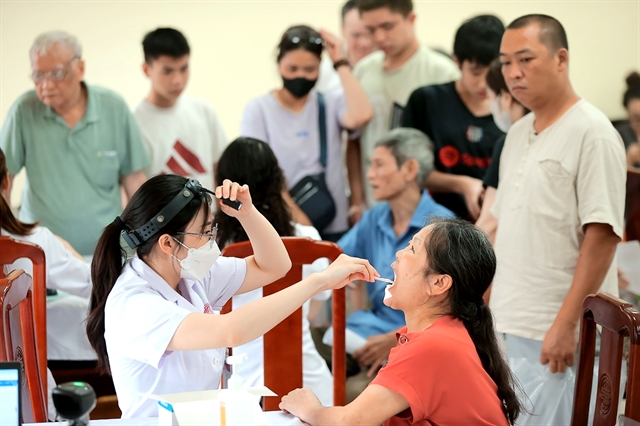 |
| A doctors examnine for an elderly woman in Ba Đình Ward's Health Station in Hà Nội on Wednesday. — VNA/VNS Photo Minh Quyết |
HÀ NỘI — Seventy-seven-year-old Trần Bích Nga, a resident of Vĩnh Thanh Commune in Hà Nội, completed her health check on Wednesday morning as part of the city's free periodic health screening and disease detection programme, which was rolled out simultaneously across the capital on the same day (July 1).
Nga said the policy introduced by the Party, the State and the city authorities was very meaningful in promoting public healthcare, particularly for older people and children.
"The programme helps us prevent and detect illnesses early so that treatment can begin sooner, reducing the financial burden that often comes when diseases are only discovered at an advanced stage," she said.
Nga is among 9.2 million Hà Nội residents eligible for free health examinations under the initiative.
Ngô Quốc Lộc, Director of the commune’s Health Station, said more than 30 doctors and healthcare workers from Đông Anh General Hospital have been deployed to support the programme at the commune.
By 9am on Wednesday, more than 100 residents had already undergone health checks.
Under the implementation plan, the health station is initially prioritising elderly people, persons with disabilities, poor and near-poor households, people who have rendered meritorious service to the revolution, patients with chronic illnesses, residents living in disadvantaged areas, children under six, as well as self-employed workers and small traders.
"All reception arrangements, facilities and staffing have been carefully prepared to ensure the programme runs smoothly," he said.
At Mê Linh Commune’s Health Station, Deputy Director Hạ Thị Hương said examinations began at 7am on Wednesday, with the facility capable of serving around 400 residents a day.
Invitation letters outlining the contents of the examinations had been delivered to residents in advance, she said.
In addition to general health checks, participants are also receiving laboratory tests and X-ray examinations with support from doctors at Mê Linh General Hospital.
At the General Clinic at No. 50 Hàng Bún Street, in Ba Đình Ward, 68-year-old Trần Thị Sạ, who lives in Hàng Bún Alley, arrived early on Wednesday morning, with an invitation letter delivered by her neighbourhood residential group two days earlier, to take part in the free medical examination.
Having lived with joint disease and several underlying medical conditions for years, Sạ said she immediately rearranged her schedule to attend on the first day after learning about the programme, despite expecting large crowds.
"I believe this is a very meaningful policy that demonstrates the Party's and the State's concern for people's health,” she said.
The doctors carried out very thorough examinations and provided careful advice.
“During today's check-up, they found that my eyesight had deteriorated and recommended that I undergo specialist examinations so treatment can begin as soon as possible," she added.
Tiêu Ngọc Chiến, Director of Ba Đình Ward’s Health Station, said the station is working with Saint Paul General Hospital to provide health checks for around 600 residents on Wednesday and Thursday.
Residents are receiving a comprehensive range of services, including blood pressure checks, blood and urine tests, X-rays and examinations across multiple medical specialties.
Towards comprehensive health management
Under Hà Nội’s plan, all residents living in the city who hold permanent residence or have been registered as temporary residents for at least 12 months, with their status verified through the VNeID digital identification application, are eligible for the programme.
The city has divided participants into five priority groups to facilitate implementation.
During the first phase, beginning on July 1, health screenings are being conducted at 49 locations, with priority given to nearly 1.7 million people in Group One, comprising elderly residents, people with disabilities, poor and near-poor households, individuals with recognised contributions to the revolution, people with chronic diseases and those living in disadvantaged areas.
The city is also providing examinations for children under six and more than two million people in Group Five, which includes self-employed workers and small-scale traders.
Special priority is being given to residents in 16 communes and wards along the Red River, namely Hồng Hà, Ô Diên, Thượng Cát, Đông Ngạc, Phú Thượng, Lĩnh Nam, Thanh Trì, Nam Phủ, Hồng Vân, Mê Linh, Thiên Lộc, Vĩnh Thanh, Đông Anh, Bồ Đề, Long Biên and Bát Tràng.
The city’s Department of Health has mobilised numerous hospitals and general clinics to deploy doctors, nurses and medical equipment to commune- and ward-level health stations to ensure the programme is implemented consistently across the city.
Participating facilities include Thanh Nhàn Hospital, Đức Giang Hospital, Saint Paul General Hospital, Hòe Nhai Hospital, Hà Nội Geriatric Hospital, Đông Anh General Hospital, Gia Lâm General Hospital, Thường Tín General Hospital, Mê Linh General Hospital and many other healthcare providers.
Alongside strengthening medical staffing, the department has instructed local authorities to urgently review and compile lists of eligible residents and issue invitation letters, ensuring no eligible beneficiaries are overlooked or listed more than once.
Primary healthcare staff have also received specialised training on periodic health examinations, disease screening and the updating of examination results to residents' electronic health records, laying the foundation for long-term health management.
Nguyễn Trọng Diện, Director of the capital department of health, said the citywide rollout of the free periodic health examination programme marks the launch of Hà Nôij's largest-ever universal healthcare initiative.
With coordinated preparations by the health sector and local authorities, the programme is expected not only to facilitate early disease detection and improve treatment outcomes, but also to bring healthcare services closer to the public.
Through the initiative, every resident of the capital will gradually benefit from proactive, comprehensive and lifelong health management based on electronic health records, contributing to improved quality of life and sustainable social welfare. — VNS
Society
 Society
 Society
 Society
 Society
 Society
 Society
 Society
 Society
 Society
 Society
 Society
 Society
 Society
 Society