 Politics & Law

HCM City refines master plan to preserve traditional crafts, rural livelihoods
1.
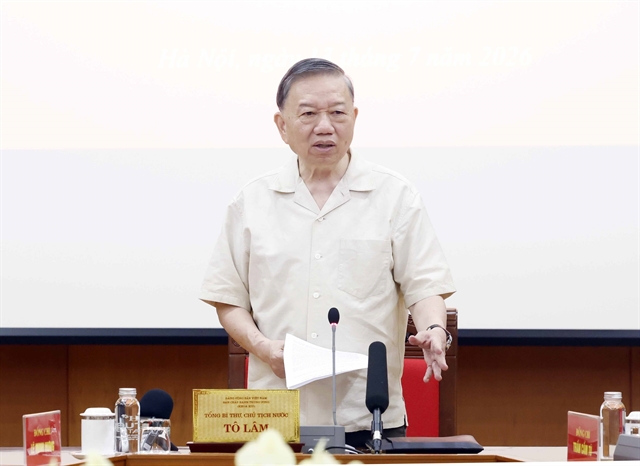 |
| Party General Secretary and State President Tô Lâm speaks at the meeting of the Central Steering Committee on the Development of Vietnamese Culture on Monday in Hà Nội. VNA/VNS Photo |
HÀ NỘI — Party General Secretary and State President Tô Lâm has urged the Central Steering Committee on the Development of Vietnamese Culture to continue discovering breakthroughs to unleash the creativity of the entire nation during the remainder of 2026.
The top leader said over the next six months he wants to see improved institutions and the effective mobilisation, allocation and utilisation of all available resources to create a solid foundation for cultural development.
Addressing the committee's second meeting on culture development on Monday in Hà Nội, General Secretary and President Lâm said current realities had exposed four major gaps that must be fully recognised and addressed without delay.
These include the limited appeal and influence of positive cultural values in the digital environment compared with the rapid growth of digital platforms and online content; the country's insufficient capacity to transform cultural heritage into digital data resources, knowledge, intellectual property and national creative assets; the limited competitiveness of Vietnamese cultural products; and shortcomings in the institutional framework and ecosystem for developing cultural industries.
Citing the Politburo’s Resolution No 80 on the development of Vietnamese culture, he said culture must no longer be regarded as merely one sector of development but as the spiritual foundation of society.
He called for three major shifts in thinking to reshape Vietnamese culture in the new era: moving from managing culture to enabling its development; expanding cultural development from traditional physical spaces into both physical and digital environments; and shifting from a preservation-centred approach to one that balances conservation with innovation and sustainable development.
To lay a strong foundation for long-term cultural development, he instructed the committee to accelerate institutional reforms in the second half of the year, to unlock society's creative potential and mobilise resources for culture more effectively.
The leader also directed a comprehensive review and revision of all cultural development strategies, master plans and action programmes to meet the demands of the new era. He singled out the Việt Nam Cultural Development Strategy to 2035, with a vision to 2045, as a priority to ensure cultural advancement goes hand in hand with socio-economic development.
He called for broader participation from communities, businesses and social organisations, alongside stronger mobilisation of both public and private resources, to build an advanced Vietnamese culture that is deeply rooted in national identity while possessing strong competitiveness and wide-ranging influence.
Strengthening cultural sovereignty in the digital space is now an urgent task to enhance the attractiveness, reach and protection of Vietnamese cultural values, he said.
The Government Party Committee was tasked with developing and launching a national digital cultural space initiative, while refining policies to support digital platforms, communication channels and content ecosystems that reflect Vietnamese identity. It was also instructed to establish partnerships among the State, businesses, social organisations and creative communities to produce and distribute high-quality, engaging cultural products capable of competing in the digital marketplace.
The top leader called for targeted commissioning and investment mechanisms for artistic and cultural works with high artistic value, broad public appeal, educational significance and the potential to gain international recognition.
The Party Central Committee’s Commission for Information, Education and Mass Mobilisation was instructed to work with relevant agencies to strengthen public awareness of Vietnamese cultural values and modernise communication efforts, particularly on digital platforms, so that national values, cultural identity, family values and standards of conduct resonate more effectively with the public, especially younger generations.
The steering committee should conduct regular reviews in which success is measured not only by the volume of cultural heritage that has been digitised but also by whether the public recognises, accesses and embraces those values, with the ultimate goal of fostering a healthy digital cultural environment by 2030, he said.
He also called for transforming cultural heritage and cultural capital into knowledge, intellectual property, creative products and strategic resources for education, science and technology, cultural industries and innovation. Resolution No 80 sets the goal of digitising all nationally recognised and specially designated national cultural heritage sites and assets.
He stressed that heritage data must be standardised, traceable, searchable and interoperable to enable sharing and reuse. Rather than remaining in isolated databases, such data should serve governance, education, research, tourism, cultural industries and artificial intelligence development, beginning with the establishment of core national datasets.
According to the leader, each key locality should concentrate on a limited number of priority sectors and no more than three flagship projects, each with clearly defined products, lead enterprises, financing plans, target markets, intellectual property outputs and measurable contributions to regional economic growth, employment, exports or tourism.
General Secretary and President Lâm concluded by urging all relevant agencies to maintain a strong sense of responsibility and swiftly translate Resolution No 80 into concrete actions, to make culture a true spiritual foundation, a source of national strength and a key driver of Việt Nam's development in the new era. — VNS
Politics & Law
 Politics & Law
 Politics & Law
 Politics & Law
 Politics & Law
 Politics & Law
 Politics & Law
 Politics & Law
 Politics & Law
 Politics & Law
 Politics & Law
 Politics & Law
 Politics & Law
 Politics & Law
 Politics & Law