 Economy
Lotte, Phát Đạt combine strengths in Thu Thiem project
1.
|
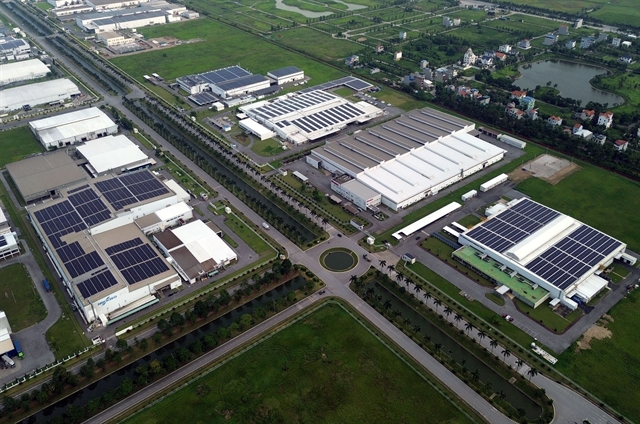
| Solar power has helped many businesses in Phố Nối Industrial Park, Hưng Yên Province, secure a stable electricity supply for production. VNA/VNS Photo Trần Việt |
HCM CITY — Experts agree that artificial intelligence (AI) enables businesses to better harness data, optimise processes and make decisions faster, while green transformation focuses on using energy, raw materials and other resources more efficiently.
When the two trends are combined, businesses can not only create greater value but also reduce costs, resource consumption and emissions.
At the National Productivity and Quality Forum 2026, recently held in HCM City, experts said AI is changing the way businesses manage and operate.
Combined with the Internet of Things (IoT), big data, cloud computing and automation, AI can support data analysis, demand forecasting, supply chain optimisation, error detection and the reduction of repetitive tasks. However, technology only delivers productivity gains when it is integrated into business processes and backed by appropriate management capacity, data systems and human resources.
In one example, the application of IoT for traceability, AI for data analysis, robotics and automated control systems at a seafood company was found to have cut production costs by about 50 per cent while increasing productivity. The case demonstrates how data is becoming a new resource for businesses to optimise their operations.

|
| An AI-powered robot developed by a Vietnamese company is showcased at AI Day 2026 in Hà Nội. VNA/VNS Photo Thanh Tùng |
AI helps businesses use data more effectively, green transformation focuses on using fewer resources to create the same or greater value. Energy savings, reduced use of input materials, water reuse, recovery of waste heat and a shift to renewable energy can all help cut both costs and emissions.
At Crystal Martin Vietnam Co., Ltd., a rooftop solar power system comprising 3,960 panels with a total capacity of more than 3,000 kWp supplies about 15 per cent of the factory's electricity demand, equivalent to approximately 2,802 MWh a year, and saves the company more than US$226,000. The company also recovers waste heat from air compressors to heat water, further reducing its energy consumption.
Importantly, AI and green transformation should not be implemented as two separate programmes. Data from energy systems can be analysed by AI to forecast consumption and detect anomalies, while production data can help identify processes that waste materials. Management systems can also link productivity targets with environmental goals.
According to experts, the biggest challenge is not whether businesses can purchase technology, but whether they have the capacity to absorb it and turn it into tangible results. Digital and green transformation need to go hand in hand with process standardisation, workforce training, data governance and a culture of continuous improvement.
|
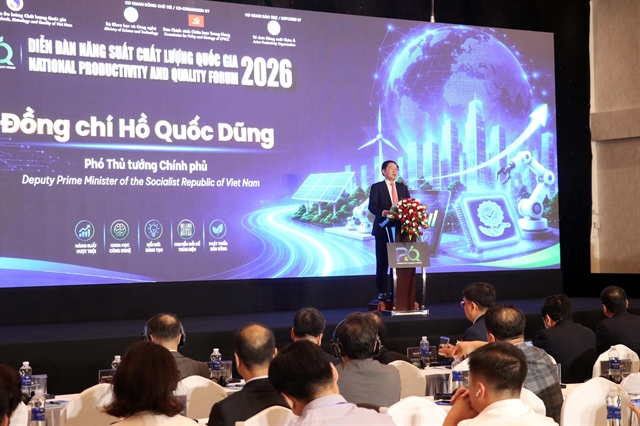
| Deputy Prime Minister Hồ Quốc Dũng speaks at the National Productivity and Quality Forum 2026 in HCM City. VNA/VNS Photo |
Speaking at the National Productivity and Quality Forum 2026, Deputy Prime Minister Hồ Quốc Dũng stressed that digital transformation and AI must be integrated into production lines and management processes, with a focus on businesses' capacity to absorb and master technology, particularly small and medium-sized enterprises.
The Deputy PM called for each economic group and general corporation to develop its own productivity programme, with measurable targets and the capacity to create spillover effects across its supply chain, in line with the requirements of Resolution No. 79-NQ/TW on the development of the State economy.
As ESG, Net Zero and resource efficiency requirements increasingly become factors determining competitiveness, AI and green transformation are emerging as complementary forces: AI enables businesses to work smarter, while green transformation helps them operate more efficiently and sustainably.
When the two approaches are connected, productivity is measured not only by output, but also by the amount of value generated from each unit of energy, raw materials and other resources used. — VNS
Economy
 Economy
 Economy
 Economy
 Economy
 Economy
 Economy
 Economy
 Economy
 Economy
 Economy
 Economy
 Economy
 Economy
 Economy




