 Economy


Wood industry looks to home market for new growth
1.
|
|
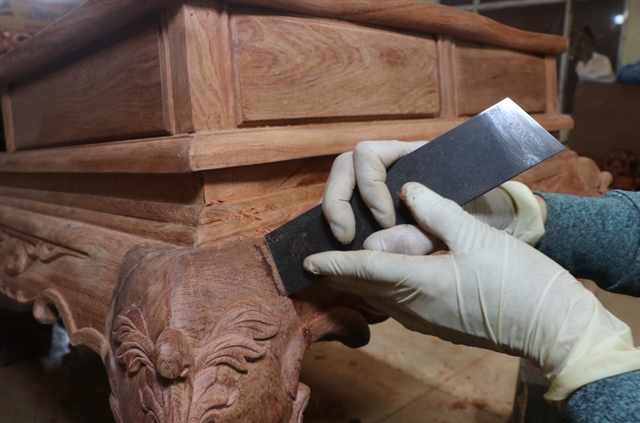
| Production at Đồng Kỵ Woodcraft Village in Bắc Ninh Province. The domestic market could become an important growth driver for the wood industry. — VNA/VNS Photo Thanh Thương |
HÀ NỘI — The wood industry is looking to its domestic market of more than 100 million people for a new source of growth beyond exports, as rising demand for housing, construction and living spaces creates opportunities.
However, turning that potential into sustainable long-term growth will require a more transparent domestic market, with greater emphasis on legal timber, product quality, standards and consumer demand, experts said at a conference held by the HCM City Handicraft and Wood Industry Association (HAWA), the Vietnam Timber and Forest Product Association (VIFOREST) and Forest Trends on October 2.
The domestic market could become an important growth driver for the wood industry, said Ngô Sỹ Hoài, VIFOREST’s general secretary.
Average Vietnamese spending on wood products and furniture is currently around US$50 per person, he said, estimating that if the market grows by 7-9 per cent annually, its value could reach around $7-7.7 billion and potentially $7.7-8 billion a year by 2030.
The domestic market should not be viewed simply as a lifeline when exports face difficulties, but as a long-term market where companies can build brands, develop products and increase value added, he said.
Nguyễn Hoài Bảo, vice chairman of HAWA, said Việt Nam's wood industry had demonstrated its manufacturing capacity and ability to meet demanding international market requirements with an export of $17.2 billion in 2025. In the first eight months of 2026, exports reached nearly $11.7 billion.
Those figures showed that Vietnamese companies had accumulated experience in manufacturing, management and compliance with international standards, Bảo said. The challenge was to make greater use of those capabilities in the domestic market.
Legal timber
Despite its potential, Việt Nam's domestic wood market remains fragmented, with a large number of household producers and small businesses.
Information on timber origin, product quality, durability, moisture levels, emissions and formaldehyde content is not always fully disclosed, while the market also lacks comprehensive statistical data, established brands and consistent after-sales services.
Legal timber should become the minimum standard for the domestic market, according to Hoài.
Companies should develop business models suited to different market segments, expand digitalisation and multi-channel sales, and compete through product quality, services, warranties, repairs and after-sales support, he said.
Clear disclosure of timber origin would also help build consumer confidence and encourage the use of legal timber, Hoài added.
Public procurement could provide another source of demand. Purchases of wooden furniture and fittings for schools, government offices and public projects should include requirements on legal timber and sustainable forest management, he added.
Nguyễn Minh Cương, chief executive of Minh Long Wood JSC, Vietnamese companies should build their competitive advantage around Vietnamese identity, culture, knowledge and people.
Understanding domestic consumers will not only help companies develop the local market but also provide a foundation for creating products capable of competing internationally.
Cương also highlighted the need for clearer technical regulations and standards for wood and furniture products.
Wood products are strongly affected by temperature, humidity and environmental conditions, while Việt Nam's climate varies significantly between regions, he said. Products therefore need to be assessed against standards suited to actual conditions of use.
Another challenge is the shift in raw materials and production methods in traditional craft villages.
Võ Quang Hà, chairman of the HCM City Wood and Construction Association, said Việt Nam initially lacked sufficient domestic plantation timber, forcing companies to rely on imported wood for processing.
During its work with craft villages in northern Vietnam, the company saw significant potential in the domestic market and the need to bring Vietnamese wood products closer to local consumers, Hà said.
Natural forest timber, however, still accounts for a significant share of wood used in domestic distribution systems, he said, adding that changing traditional production and trading practices in craft villages would take time.
The transition would require support for craft villages in technology, production space and equipment, he said.
Hà also pointed to biomass energy as an area with potential for domestic demand.
Việt Nam is currently one of the world's major wood-pellet exporters. In 2025, the country exported about 8.5 million tonnes of wood pellets worth $1.25 billion, while domestic consumption remained limited, he said.
As Vietnam transitions towards cleaner energy, wood pellets and other biomass products could become part of the country's renewable energy mix, Hà said. — VNS
Economy
 Economy
 Economy
 Economy
 Economy
 Economy
 Economy
 Economy
 Economy
 Economy
 Economy
 Economy
 Economy
 Economy
 Economy