 Economy



OPPO Find X10 Series Launches Globally with True-to-Life Imaging and All-Round Flagship Upgrades
1.
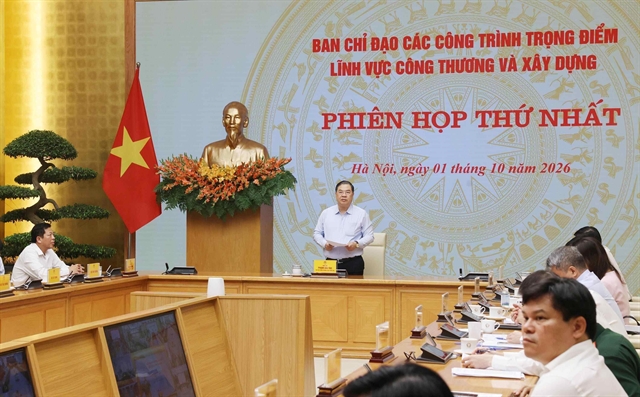 |
| Permanent Deputy Prime Minister Phạm Gia Túc spoke at the first meeting of the Steering Committee for key projects in the industry, trade and construction sectors on October 1. VNA/VNS Photo |
HÀ NỘI — Deputy Prime Minister Phạm Gia Túc has called for faster progress on key projects in the industry, trade and construction sectors while stressing that quality must be maintained in the pursuit of faster completion.
Speaking at the first meeting of the Steering Committee for key projects in the industry, trade and construction sectors on October 1, the Deputy PM said the projects play an important role in promoting growth, developing production, strengthening infrastructure capacity, ensuring energy security and improving the competitiveness of the economy.
He said the industry, trade and construction sectors were critical to achieving the target of double-digit economic growth in 2026 and subsequent years.
The Steering Ccommittee aims to strengthen inter-sectoral coordination to remove bottlenecks and ensure that projects are implemented on schedule, with quality, safety and efficiency, while preventing losses and waste.
Túc called for greater use of information technology to monitor and update project progress, with a system to gradually be developed to track and supervise key projects. The system should provide complete, accurate and timely information, flag projects at risk of delays in implementation or disbursement, and help authorities address emerging problems promptly.
On construction material supplies, the Deputy Prime Minister said the country as a whole did not face a shortage, but there were localised shortages in some localities and at key projects.
He said he was due to sign a decision on October 1 to coordinate construction materials nationwide and balance supply and asked the ministries of Construction, Industry and Trade, and Finance to compile a list of difficulties, obstacles and commitments on project disbursement progress for inclusion in the Government's September 2026 meeting resolution.
The ministries were also asked to review key projects that are behind schedule for follow-up, inspection and supervision, as well as to assess the fulfilment of key performance indicators (KPIs) by heads of agencies.
Behind schedule
According to a report presented by Deputy Minister of Construction Bùi Xuân Dũng, the construction sector currently has 55 projects and 124 sub-projects under monitoring and supervision. Many have been completed and put into operation or are under construction, while some remain behind schedule.
Of the 61 projects and sub-projects under construction, 19 are behind schedule. Among projects in the investment preparation or investor and contractor selection stages, seven are behind schedule.
For projects scheduled for completion in 2026, the managing agencies have assessed that 14 projects and sub-projects can be completed as planned. However, the Ministry of Construction said 25 projects and sub-projects had disbursement rates below 20 per cent, including six with no disbursement.
The meeting also reviewed the progress of several projects. Of which, the Ring Road 4 project in the Hanoi Capital Region has a disbursement rate of 21.2 per cent. Hà Nội authorities took responsibility for the slow disbursement and said the project's completion was expected to be pushed back to 2027, with technical opening scheduled for early 2028, about two years later than originally planned.
In the energy sector, Deputy Minister of Industry and Trade Trương Thanh Hoài said key projects were at different stages, ranging from investment preparation and investor selection to construction, with progress varying among project groups.
Of the 18 LNG power projects on the monitoring list, 16 have selected investors, including two that have started construction and 14 that are completing investment preparation procedures. The two projects that have yet to select investors are Nghi Sơn LNG and Long Sơn LNG.
Minister of Industry and Trade Lê Mạnh Hùng said the 18 projects have a combined capacity of more than 20,000 MW, but only Hiệp Phước LNG is currently assessed as capable of meeting the schedule. Most of the remaining projects are facing difficulties in investment preparation and in completing the necessary conditions for implementation.
Of the 16 hydropower plant projects that have selected investors, two are under construction and 14 are completing investment preparation procedures.
Some transmission grid projects continue to face difficulties related to land procedures, conversion of forest-use purposes, route alignment agreements and site clearance.
Bottlenecks
According to reports from the ministries of Construction and Industry and Trade, as well as comments at the meeting, site clearance, land issues, investment procedures and resources remain common difficulties across both sectors, alongside project-specific problems.
For transport projects, construction materials remain a challenge in terms of both supply capacity and price fluctuations, in addition to site clearance and construction organisation. In some cases, identified material reserves are sufficient to meet demand, but actual daily supply capacity is only about 30 per cent.
Minister of Construction Trần Hồng Minh said average construction material prices had risen by about 18-20 per cent, while cost contingencies for many projects were around 10 per cent. Delays by some local authorities in updating material prices had also affected price application and payment for completed work.
In the energy sector, difficulties are concentrated in investment preparation and implementation, land issues, site clearance, financing arrangements, power purchase agreements and related conditions. For gas-to-power chains, a delay in one component can affect the entire chain.
Lê Mạnh Hùng said the actual ability of each project to meet its schedule should be reviewed to provide a basis for calculating an appropriate power supply plan.
Leaders of several ministries, agencies and localities also called for more efficient use of resources, accurate assessment of project progress and clearer accountability for implementation.
Deputy Minister of Finance Tạ Anh Tuấn said the target of disbursing 100 per cent of the 2026 capital plan remained challenging. The Ministry of Finance called on ministries, agencies and localities to proactively reallocate capital within their authority. VNS
Economy
 Economy
 Economy
 Economy
 Economy
 Economy
 Economy
 Economy
 Economy
 Economy
 Economy
 Economy
 Economy
 Economy
 Economy