 Economy


OPPO Find X10 Series Launches Globally with True-to-Life Imaging and All-Round Flagship Upgrades
1.

|
| Some 64 per cent said AI had increased their revenue, by an average of 15 per cent, while 78 per cent expect AI-driven growth over the next year. — Photos courtesy of AWS |
By Vũ Hoa
HÀ NỘI — Việt Nam’s businesses are increasingly moving from experimenting with artificial intelligence (AI) to using it for measurable business results, with about 245,000 enterprises now adopting AI, according to a new study released by Eric Yeo, AWS's Country General Manager for Malaysia, Việt Nam, Indochina.
The Unlocking Việt Nam’s AI Potential 2026 report, conducted by independent research firm Strand Partners and released at AWS Cloud and AI Day Hà Nội, found that 26 per cent of Vietnamese businesses have adopted AI, up from 18 per cent a year earlier.
The study surveyed 1,000 business leaders and 1,000 members of the public across Việt Nam.
Among AI adopters, 73 per cent said AI plays a critical or important role in their overall business strategy, while 72 per cent reported productivity gains, up from 66 per cent last year.
Some 64 per cent said AI had increased their revenue, by an average of 15 per cent, while 78 per cent expect AI-driven growth over the next year.
|
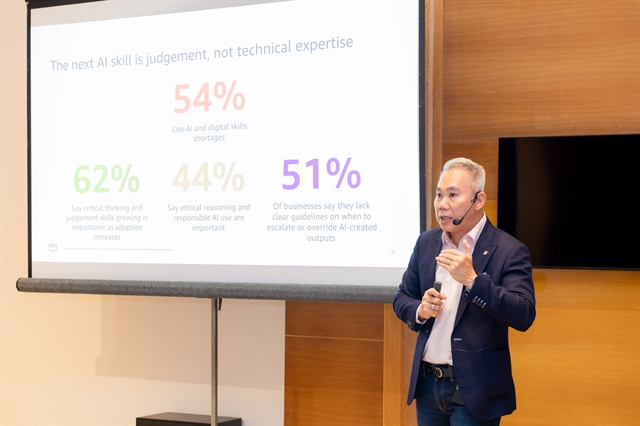
| Eric Yeo, AWS's Country General Manager for Malaysia, Việt Nam, Indochina shared the report's findings. |
"The findings show that AI adoption is gaining momentum, although most businesses remain at an early stage. About 61 per cent of adopters are still experimenting with AI, while 71 per cent said their AI investment had either broken even or delivered a positive return," Yeo added.
From experimentation to implementation
The financial services sector is among the strongest AI adopters, with 41 per cent of businesses using the technology, compared with 26 per cent across all sectors. Some 79 per cent of financial-sector adopters reported productivity gains.
In healthcare, AI adoption stands at 23 per cent, with 69 per cent of adopters reporting productivity improvements.
Techcom Securities Joint Stock Company (TCBS) illustrates how AI is being integrated into business operations.
More than 460 TCBS employees now use Kiro, an agentic AI-powered software development environment from AWS. The company said the technology has reduced development time by nearly 25 per cent, while 70 per cent of AI-generated code passed first-round reviews.
TCBS also delivered three major capabilities in a single quarter, including Việt Nam’s first fully online IPO subscription service.
Healthcare technology company OmiGroup has developed OmiKG on AWS, an AI-powered research tool designed to trace the root causes of chronic diseases.
In a controlled research evaluation, OmiKG identified 15 of 17 molecular mechanisms associated with Type-2 diabetes, compared with one identified by each of two alternative AI approaches.
Agentic AI emerges
The report also points to the emergence of agentic AI, which can perform tasks and take actions rather than simply respond to prompts.
About 38 per cent of businesses surveyed said they had heard of agentic AI. Of these, 8 per cent had embedded AI agents into core workflows, while 19 per cent were experimenting with or piloting them.
Among businesses using agentic AI, 81 per cent reported productivity gains. Some 68 per cent said the technology had improved operational efficiency or productivity, while 61 per cent reported faster decision-making and execution and 49 per cent improved operational scalability.
Việt Nam-based voice intelligence company NoteX is using AWS services including Amazon Bedrock and Amazon SageMaker to train and deploy its own voice models.
The company has reduced AI processing costs and latency by 30 per cent and reached more than one million users across Việt Nam and over 20 countries in its first year.
Its Saydi platform provides two-way voice translation and can identify different speakers in Vietnamese, English and Japanese conversations. NoteX also uses the AWS Local Zone in Hà Nội to address data residency requirements for regulated industries.
Startups target global markets
AI-native startups are also showing strong growth. According to the study, cloud-first AI-native startups reported average annual revenue growth of 147 per cent over the past year.
They were 4.8 times more likely to generate more than US$1 million in annual revenue, while 96 per cent expect AI to drive revenue growth in the coming year.
Diaflow, an enterprise AI agent orchestration service founded by a Việt Nam-based team, has more than 40,000 users, with 75 per cent in the US.
Built on Amazon Bedrock, the platform handles AI-agent orchestration and governance while allowing customers to use different frontier AI models. Its users have executed more than 100 million AI tasks to date.
The report identifies strategy and governance, ROI measurement and skills as three key foundations for the next phase of AI adoption.
Some 23 per cent of AI-adopting businesses now have a formal and comprehensive AI strategy, nearly double the 12 per cent recorded in 2025.
However, only 13 per cent have a clearly defined and consistently applied framework for measuring AI ROI, while 46 per cent lack reliable ways to measure returns.
"Skills remain another major challenge, with 54 per cent of businesses identifying shortages of digital and AI skills as barriers to adoption and expansion," he added.
The skills required are also changing. About 62 per cent of business leaders believe critical thinking and judgement will be crucial for an AI-enabled workforce, while 57 per cent expect the ability to interpret, validate and challenge AI-generated outputs to become more important over the next five years.
About 87 per cent of employers said reskilling existing employees was important to their AI strategies. Meanwhile, 26 per cent of employees had received some form of training over the past year, up from 19 per cent in 2025.
The report recommends that businesses accelerate the transition from pilots to wider deployment, establish clearer methods for measuring ROI, strengthen cloud and infrastructure capacity, develop AI literacy and human judgement, and share lessons from sectors further ahead in adoption.
AWS said it has trained more than 157,000 people in Việt Nam in cloud and AI skills, while its AWS Study Group community has grown to 54,000 members.
The findings point to a new phase in Việt Nam’s AI journey, in which the focus is shifting from whether businesses should adopt AI to how they can scale applications that deliver measurable business impact. — VNS
Economy
 Economy
 Economy
 Economy
 Economy
 Economy
 Economy
 Economy
 Economy
 Economy
 Economy
 Economy
 Economy
 Economy
 Economy