 Economy


Việt Nam sets four priorities for APEC Finance Ministers’ Meeting in 2027
1.
|
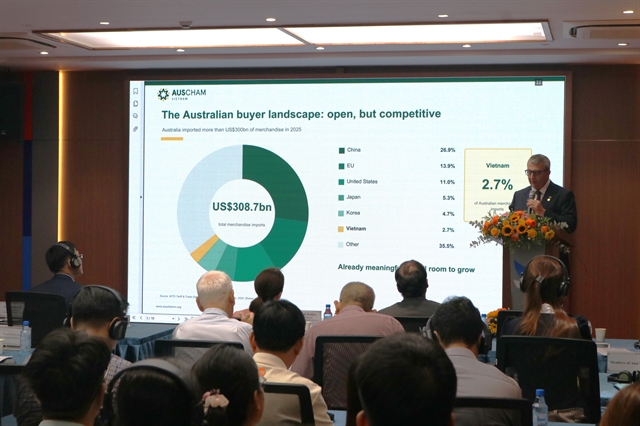
| Việt Nam and Australia are promoting co-operation in many sectors, with huge room for growth. — VNS Photo Hồng Linh |
HCM CITY — Việt Nam held just 2.7 per cent of Australia's US$309 billion import market in 2025 despite an 88 per cent export surge between 2020 and 2025, leaving significant room for expansion, according to the President of Australian Chamber of Commerce in Việt Nam (AusCham) Sam Conroy.
During a seminar on Wednesday on enhancing market access and market expansion between Việt Nam and Australia, experts shared insights on the Australian market, highlighting legal compliance requirements for Vietnamese exporters and strategies for optimising logistics costs.
The AusCham president mentioned that Australia is a high-income economy with strong household purchasing power and a sophisticated consumer base.
As of March 2026, Australia's population is approximately 27.9 million people, one-third of whom were born overseas. This multicultural profile is highly relevant for Vietnamese exporters as they showcase multicultural demand and mainstream acceptance of Asian products.
In addition, Australian consumers have strong brand loyalty and only switch for clear winners.
Surveys show Australian consumers prioritise value over price and increasingly expect convenient, omnichannel digital shopping where products are easy to find, compare and receive.
“Việt Nam does not need to win the Australian market by being the cheapest supplier. Việt Nam can win by offering the right combination of quality, value, convenience, sustainability, and ultimately trust,”
Sam also pointed out that the Việt Nam goods are already building a stronger position in Australia.
In 2025, bilateral trade between Việt Nam and Australia reached around $14 billion, in which the country exported around $6.8 billion of goods to Australia, and imported arround $7.2 billion.
The two economies are increasingly complementary rather than competing. Australia supplies Việt Nam with energy, minerals, raw materials and production inputs, while Việt Nam supplies manufactured goods, electronics, consumer products, food and increasingly higher-value products.
Regarding Australian buyers' expectations, he emphasised six top priorities from Việt Nam’ exporters, which are "quality, value, reliability, compliance, communication and evidence".
Australian partners are also increasingly demanding full, verifiable evidence of standards, inspection certifications and green certificates from Vietnamese businesses.
He also noted that the next wave of business opportunities will focus on five sectors, including higher-value food (processed, convenient, organic, Halal and authentic Asian products), electronics and advanced manufacturing, building materials and furniture, and supply-chain diversification.
Matt Lourey, chairman of Alitium and a member of AusCham, said Vietnamese businesses should clarify legal responsibilities with Australian importers before receiving orders. They should also set up product-specific compliance maps and conduct trial exports with full documentation before scaling up.
Chandler So, managing director of GEODIS Vietnam Co Ltd, said a large geographical distance means that international transportation costs account for a significant proportion of the cost of goods sold in the Australian market.
He highlighted that businesses should consider logistics as a competitive lever, not just a cost line, as costs from this sector often account for 15-30 per cent of retail prices depending on the industry.
Australia's large area and dispersed population result in high domestic transportation costs, especially outside major cities. Businesses could need a domestic third-party logistics (3PL) partner with an extensive network to ensure delivery capability in regional and rural areas.
Furthermore, the retail and supermarket sector in Australia requires strict delivery windows. Businesses should consider the model of satellite warehouses or cross-docking near consumption centres to reduce time and costs.
On managing common risks in cross-border trade, he recommended that Vietnamese businesses pre-book vessel space four to six weeks ahead and maintain bonded safety stock to protect service levels in peak season, deploy IoT sensors throughout transit, and conduct pre-trip inspections. — VNS
Economy
 Economy
 Economy
 Economy
 Economy
 Economy
 Economy
 Economy
 Economy
 Economy
 Economy
 Economy
 Economy
 Economy
 Economy