 Economy



Việt Nam, Denmark issue joint statement on establishment of Comprehensive Strategic Partnership
1.
|
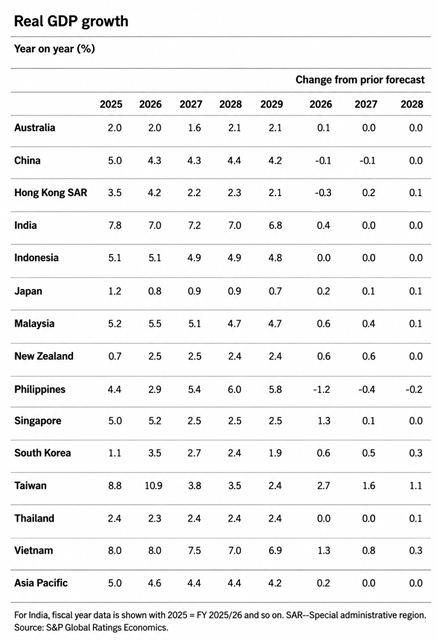
| S&P Global Ratings’ real GDP growth forecasts for Việt Nam and selected Asia-Pacific economies for 2025–29. — Photo courtesy of S&P Global Ratings |
HÀ NỘI — S&P Global Ratings has raised its forecast for Việt Nam’s economic growth in 2026 to 8 per cent, 1.3 percentage points higher than its previous projection, adding to a series of upgrades by international financial institutions as strong exports, manufacturing and domestic demand support the economy.
The latest forecast comes after Việt Nam recorded a 8.18 per cent GDP growth in the first half of 2026. The stronger-than-expected growth was supported by industry and construction up 9.8 per cent, services up 8.1 per cent, final consumption up 8.2 per cent and exports of goods and services up 20.2 per cent.
Other international institutions have also become more positive about Việt Nam’s outlook.
Standard Chartered maintains its 9.5 per cent growth forecast for 2026, while UOB has raised its projection to 8.5 per cent. The Asian Development Bank (ADB), in its September outlook, upgraded its forecast to 7.8 per cent, from 7.2 per cent previously, and raised its 2027 forecast to 7.6 per cent.
Stronger regional backdrop
The improved outlook for Việt Nam comes against a broadly resilient Asia-Pacific economy, where exports and domestic demand are helping offset geopolitical and energy-related risks.
S&P has raised its forecast for Asia-Pacific GDP growth to 4.6 per cent in 2026, up 0.2 percentage points from its previous projection, and expects growth of 4.4 per cent in 2027. It said the region had maintained economic momentum in the first half of the year, despite a moderation in quarter-on-quarter growth in the second quarter.
A major source of strength is the global investment boom in artificial intelligence, which has boosted demand for technology products and benefited Asian exporters integrated into global supply chains.
ADB similarly expects developing Asia and the Pacific to grow 5 per cent in 2026, with private investment, government stimulus and strong technology exports driven by the global AI investment cycle helping offset higher trade and energy costs. Growth in developing Southeast Asia has been upgraded to 4.7 per cent, with Việt Nam recording the largest upgrade in the subregion.
The regional picture, however, remains uneven. S&P forecasts India to grow 7 per cent in its current fiscal year, while China is expected to expand 4.3 per cent in both 2026 and 2027.
Risks remain
The stronger growth outlook does not eliminate external risks. S&P said higher energy prices, tighter US monetary policy and a possible slowdown in AI-related investment could affect the region.
Much of the initial AI investment has been concentrated among a relatively small group of US hyperscalers, creating a potential vulnerability if their investment plans change. However, the growing share of AI-related exports from Taiwan (China) and South Korea going to destinations outside the US suggests the investment cycle may be broadening.
Inflation is another factor to watch. S&P forecasts Việt Nam’s average CPI inflation at 4.7 per cent in 2026, before easing to 3.6 per cent in 2027. ADB’s latest forecast is somewhat lower at 4.3 per cent for 2026.

|
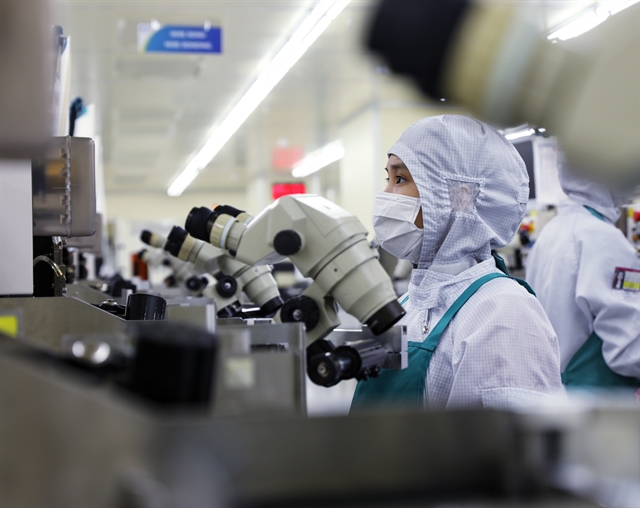
| A worker checks garments at a textile factory in Việt Nam. Export remains a key driver of the country’s export growth. — VNA/VNS Photo |
S&P said inflation across Asia-Pacific had risen because of higher energy prices but remained generally manageable. In Việt Nam, inflation remained within the target range but was moving higher amid energy and food price pressures.
Data of the National Statistics Office under the Ministry of Financed showed CPI rose 4.45 per cent on average in the first eight months of 2026, while core inflation increased 4.24 per cent. August CPI rose 4.89 per cent year-on-year.
ADB has also highlighted the need to manage inflation and financial stability as rapid growth increases pressure on domestic credit. It said maintaining macroeconomic stability, improving public investment efficiency, deepening capital markets and strengthening productivity would be important to sustain high-quality growth.
The convergence of forecasts from S&P, Standard Chartered, UOB and ADB points to stronger international confidence in Việt Nam’s near-term growth momentum, while also highlighting the need to ensure that rapid expansion is supported by sufficient investment capacity, financial stability and productivity gains. — VNS
Economy
 Economy
.jpg) Economy
Economy
 Economy
 Economy
 Economy
 Economy
 Economy
 Economy
 Economy
 Economy
 Economy
 Economy
 Economy
 Economy