 Economy


Việt Nam, Denmark elevate ties to Comprehensive Strategic Partnership
1.
 |
| Parcels and goods packages are making up more than 90 per cent of Việt Nam's postal service revenue. — Photo vietnampost.vn |
HÀ NỘI — The postal market has undergone a major transformation over the past 15 years, with parcel volumes rising more than twelvefold and goods packages now accounting for over 90 per cent of total postal items.
A draft revised Postal Law is seeking to update the legal framework to reflect these changes and develop postal networks into essential infrastructure for e-commerce and the digital economy.
The proposed legislation was presented at a regular press briefing of the Ministry of Science and Technology on September 30 by Lê Văn Chung, a representative of the ministry's Department of Posts.
The draft comprises eight chapters and 52 articles, retaining provisions from the 2010 Postal Law while adding rules addressing the rapid development of e-commerce, the digital economy and growing demand for parcel delivery.
The need for a new framework is reflected in the scale of the market.
Việt Nam handled about 360 million postal items in 2010, compared with approximately 4.1 billion in 2025, while postal service revenue reached around VNĐ87 trillion (US$3.3 billion). Traditional letters now account for less than 10 per cent of total volume, with parcels and goods packages making up more than 90 per cent.
"This development has not only changed the scale of the market, but also changed how services are organised and provided, thereby requiring innovation in the State management of postal services," Chung said.
One major element of the draft is a clearer definition of postal services and their boundaries with transport, warehousing and logistics.
Postal services would be organised and operated through a postal network, covering acceptance, sorting, transportation and delivery, together with other activities directly associated with individual postal items during service provision.
The services would be identified by the individual handling of items, their identification and traceability, except where identification is not required under regulations, and delivery to an agreed address or location. Independent freight transport, warehousing and logistics activities without these characteristics would fall outside the scope of the Postal Law.
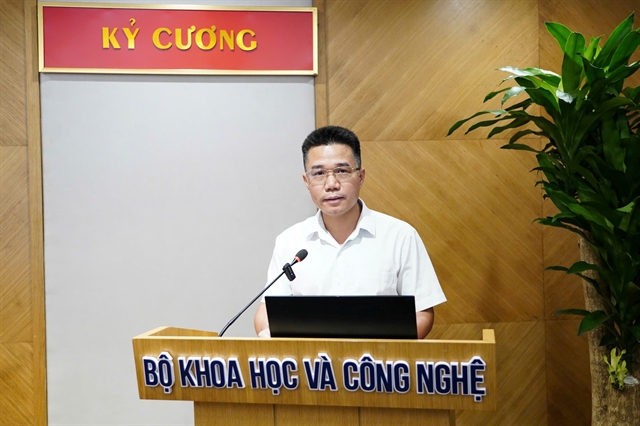 |
| Lê Văn Chung, a representative of the Department of Posts under the Ministry of Science and Technology. — Photo courtesy of MOST |
The draft also seeks to establish postal networks as essential infrastructure serving e-commerce and the digital economy.
Postal enterprises would be classified as network operators or non-network operators, allowing different conditions, rights and obligations to be applied according to their operating models.
Non-network operators could use the networks or network components of network operators under agreements and would be encouraged to develop their own capacity to become network operators.
Responsibility within the service chain would also be clarified. The postal enterprise that signs a contract with a customer would remain responsible for service provision and compensation for damages, including when it hires, cooperates with or uses another operator's postal network.
For market entry, the draft proposes replacing the licensing mechanism with electronic registration for postal service provision.
Competent authorities would check the completeness of registration dossiers rather than assess their substantive content, while enterprises would be responsible for the accuracy and truthfulness of their declarations and for meeting business conditions throughout their operations.
The draft would also expand universal postal services from letters to parcels and goods packages, responding to rising e-commerce demand. It proposes ensuring access nationwide, particularly in remote, border and island areas, at uniform charges that would not exceed the average price of comparable commercial services.
Another focus is digital postal management. Each postal item would be assigned an identification code for tracking, while enterprises would collect valid sender contact information, classify items according to risk levels and apply corresponding control measures.
The creation, collection, use, connection, storage and protection of postal data would have to comply with laws on data, personal data protection and cybersecurity.
The proposed framework also addresses continuity during natural disasters, epidemics and emergencies. Network-operating postal enterprises could be mobilised to maintain services and the circulation of essential letters and parcels, with reasonable and legitimate costs arising from such mobilisation to be compensated.
The Department of Posts said the draft law is expected to be submitted to the National Assembly for consideration and approval at the second session of the 16th National Assembly. — VNS
Economy
 Economy
.jpg) Economy
Economy
 Economy
 Economy
 Economy
 Economy
 Economy
 Economy
 Economy
 Economy
 Economy
 Economy
 Economy
 Economy