 Economy


Lawmakers stress importance of removing bottlenecks to develop digital economy
1.
|
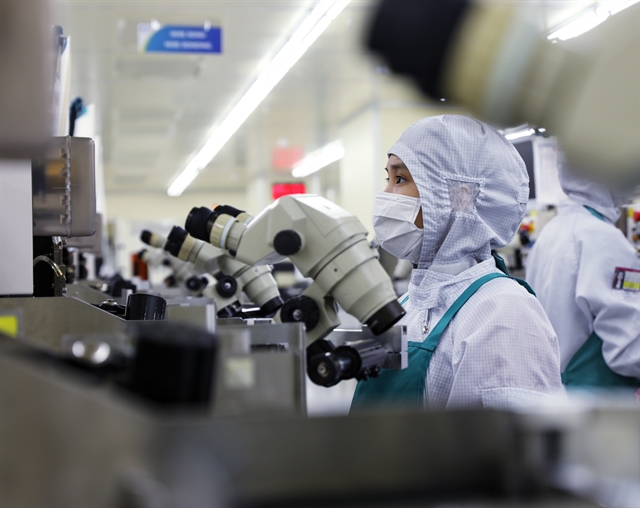
| Production at a Hana Micron Vina plant in Bắc Ninh's Vân Trung Industrial Park. — VNA/VNS Photo Danh Lam |
HÀ NỘI — The northern province of Bắc Ninh is seeking to move higher in the semiconductor supply chain by improving infrastructure, skilled labour and policies to attract investment in chip design, research and development (R&D) and core technology.
According to the provincial Department of Science and Technology, Bắc Ninh has thus far attracted US$2.74 billion worth of investment in 33 semiconductor projects, including six involving semiconductors and semiconductor materials and 27 producing equipment and components.
Among the major projects is Amkor Technology Vietnam, which has invested $1.6 billion in Yên Phong 2-C Industrial Park and now employs more than 2,000 people. The plant is raising capacity to about 3.6 billion products a year.
Amkor Technology’s output in Việt Nam has doubled from a year earlier, the company said, adding that it plans to continue expanding its production capacity in Bắc Ninh.
Hana Micron Vina is also increasing production in Bắc Ninh, with total investment of $669 million. The company manufactures, tests and packages semiconductor products.
Other projects include Micro Commercial Components, Synergie Cad, FPT and several companies supplying equipment and components to the semiconductor industry.
Bắc Ninh has built a sizeable electronics manufacturing base, with about 1,282 electronics companies employing nearly 482,000 workers. However, most semiconductor projects in the province are currently concentrated in manufacturing, packaging, testing and supporting industries.
Meanwhile, higher value activities, such as integrated circuit design, R&D and production of core technology and semiconductor materials, remain modest.
Vũ Phương Thảo, deputy director of the provincial Department of Finance, said Bắc Ninh is still at an early stage of participation in the global semiconductor value chain.
"The semiconductor industry in the province is currently concentrated mainly in packaging and testing, while the number of chip design engineers, semiconductor specialists and R&D personnel remains insufficient to meet demand," she said.
The province's semiconductor development strategy is going beyond attracting investment to focusing on creating conditions for companies to invest in stages with more advanced technology, specialised skills and infrastructure.
Bắc Ninh's strategy is also aligned with Politburo’s Resolution 57-NQ/TW on breakthroughs in science and technology, innovation and digital transformation, which calls for the development of strategic technologies such as semiconductors.
Preparations
|
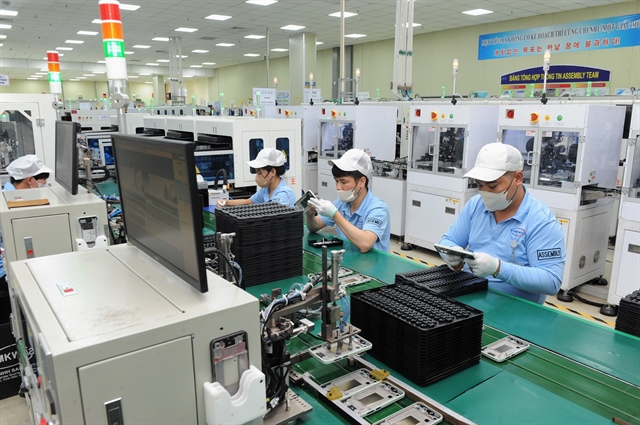
| Production at electronics company Samkwang Vina in Quang Châu Industrial Park. — VNA/VNS Photo Việt Hùng |
Under a plan to develop the semiconductor industry by 2030 issued late last year, Bắc Ninh aims to become a leading semiconductor industrial centre in the northern region and to deepen its participation in regional and global semiconductor production chains.
By 2030, the province hopes to attract three to five major technology groups to invest in factories and research and development centres, while encouraging existing investors to expand production.
The province also aims to have at least one to two semiconductor design companies, one to two chip manufacturing plants and five semiconductor packaging and testing facilities, while developing a number of specialised semiconductor products for selected industries.
It targets annual electronics industry revenue of more than $60 billion, of which the semiconductor industry is expected to contribute $3 billion.
By 2050, the province aims to have at least 30 chip design companies, three chip fabrication plants and 25 packaging and testing plants. The province also plans to train 30,000 workers for the semiconductor industry by 2030.
To achieve these targets, infrastructure development is a priority.
Bắc Ninh currently has 39 industrial parks, of which 23 have been established and are operating, while 16 are undergoing site clearance or project development.
However, Deputy Head of the provincial Management Board of Industrial Parks Nguyễn Xuân Ngọc said that semiconductor projects require more stringent infrastructure standards, including stable power supplies, ultra-pure water, high-speed telecommunications, data centres, environmental treatment systems and high-standard logistics.
Bắc Ninh does not yet have an industrial park whose infrastructure is fully dedicated to semiconductor manufacturing, he said.
The province is thus considering developing new industrial parks, preparing cleared land and investing in integrated power, water, telecommunications, data centres and fire safety and wastewater treatment systems. Logistics infrastructure is also being planned in connection with airports, seaports and regional logistics centres.
Appropriate infrastructure will allow Bắc Ninh to attract high-tech projects in segments with greater added value, Ngọc noted.
|
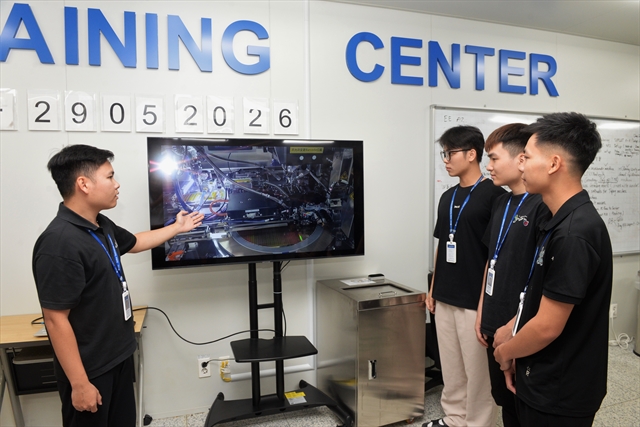
| Training workers at Amkor Technology Vietnam in Bắc Ninh. — VNA/VNS Photo Việt Hùng |
Bắc Ninh is also focusing on developing talent in the semiconductor industry, as the province still lacks a specialised workforce, particularly chip design engineers, technology specialists, technicians and R&D personnel.
The province issued Resolution 113/2025/NQ-HĐND on December 10, 2025 to support vocational training and workers in semiconductors, artificial intelligence and the digital industry through 2030.
On June 26, the province also adopted Resolution 11/2026/NQ-HĐND on attracting, training and developing skilled workers in the same timeframe.
Nguyễn Tiến Hưng, deputy director of the national semiconductor chip prototyping support centre under the Authority of ICT Industry, said that stronger links between Government, universities and businesses are needed to develop personnel for the semiconductor industry.
Training programmes should be closely aligned with recruitment needs, while policies should also be introduced to attract engineers and specialists from Việt Nam and abroad, he said.
Alongside workforce development, Bắc Ninh is seeking to increase the participation of domestic companies in the semiconductor value chain.
The province plans to help local companies improve technological capabilities and production standards, as well as strengthening their ability to participate in the supply chains of major corporations.
Bắc Ninh is also accelerating administrative reforms to create favourable conditions for investors and attract high-tech investment. — VNS
Economy
 Economy
 Economy
 Economy
 Economy
 Economy
 Economy
 Economy
 Economy
 Economy
 Economy
 Economy
 Economy
 Economy
 Economy