 Society

Polish PM Donald Tusk to pay official visit to Việt Nam
1.
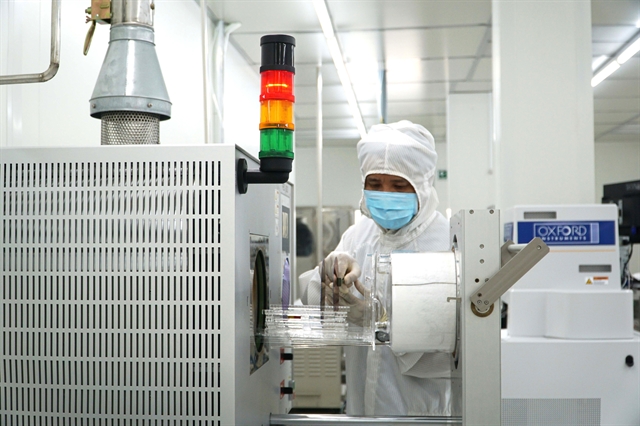 |
| A technician conducts experiments in semiconductor microchip fabrication at Saigon Hi-tech Park's Reseach and Development Centre, known as the SHTP Labs, in HCM City. The centre is among the beneficiaries of a scheme to develop excellent reseach centres with international standards under the Politburo's Resolution 57, which guides Việt Nam's breakthroughs in science and technology development, innovation and digital transformation. — VNA/VNS Photo Thu Hoài |
HCM CITY — Concentrating resources where they are needed is one of the directions set out in the Politburo's Resolution 57 on national technology development, which aims to boost Việt Nam's capacity for the research and development of new strategic technologies that will help solve problems in different sectors.
The direction is being translated into action by HCM City and Đà Nẵng City, with long-term funding for research institutions and financial support for enterprises to incentivise sustained research and the application of strategic technological solutions.
Supporting technological solutions through to maturity, rather than stopping at the initial research stage, and lowering initial resource barriers are key features of this approach.
HCM City has taken advantage of a scheme it launched in 2023 to actualise the direction, known as the Centre of Excellence (CoE) scheme, which provides financial resources for at least five years for research organisations working on technologies that have the potential to make them leaders in their respective fields.
Among the beneficiaries are the Institute for Advanced Materials Technology (AMTI) under the Vietnam National University, HCM City, and the Research and Development Centre at the Saigon Hi-tech Park, known as the SHTP Labs.
AMTI received VNĐ85 billion (US$3.3 million) to implement advanced materials research programmes aimed at generating international publications and patents, as well as practical applications in energy, the environment and healthcare.
According to Dr Đoàn Lê Hoàng Tân, AMTI deputy director, the five-year investment plan provides significant resources for scientists to conduct research, enabling projects to reach completion and move towards technology transfer.
"This strategy helps us to gradually master advanced material technologies and apply them to real-world scenarios," he said.
SHTP Labs received nearly VNĐ96 billion ($3.7 million) in funding to advance research in digital and green transformation, over the next five years.
The centre's director, Dr Trịnh Xuân Thắng, said the funding would help the centre focus on mastering semiconductor fabrication and sensor manufacturing technology, while integrating artificial intelligence (AI) and the Internet of Things (IoT) to create smart sensor networks.
"We will also continue researching green materials, functional foods and fuel cells, areas that have the potential to deliver positive environmental impacts," he said.
While HCM City focuses on building research capabilities and establishing leading centres, the central city of Đà Nẵng is creating opportunities for enterprises to participate in the technology development process.
Under Resolution No. 33/2026/NQ-HĐND of the Đà Nẵng People's Council, enterprises can receive financial support of up to 50 per cent of equipment procurement costs for projects involving strategic technologies such as semiconductors, AI, IoT, digital twin technology and robotics.
For projects involving technology transfer contracts, the level of support can cover up to 70 per cent of the costs.
The support is capped at VNĐ3 billion (about $116,000) per enterprise annually, with a limit of two projects per enterprise.
Lê Thị Thục, deputy director of Đà Nẵng's Department of Science and Technology, said that the support mechanism aims to incentivise businesses to increase investment in strategic technological products and services.
"When businesses receive partial financial support for research, testing, technology transfer and investment, it lowers the initial financial barriers, enabling businesses to undertake projects that require significant capital and lengthy research periods," she said.
"In the long term, the policy is expected to yield results by fostering the creation of practical products, enhancing business competitiveness and generating a market for research and innovation activities." — VNS
Society
 Society
 Society
 Society
 Society
 Society
 Society
 Society
 Society
 Society
 Society
 Society
 Society
 Society
 Society