 Society
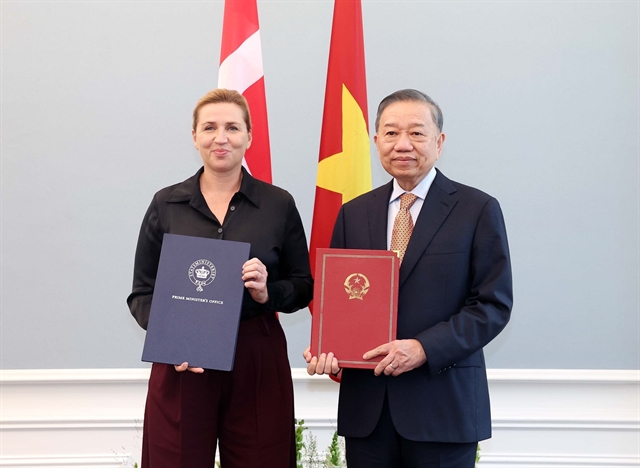
Việt Nam, Denmark issue joint statement on establishment of Comprehensive Strategic Partnership
1.
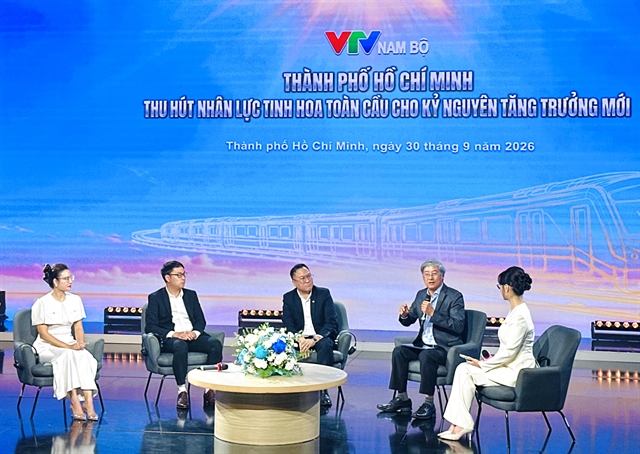 |
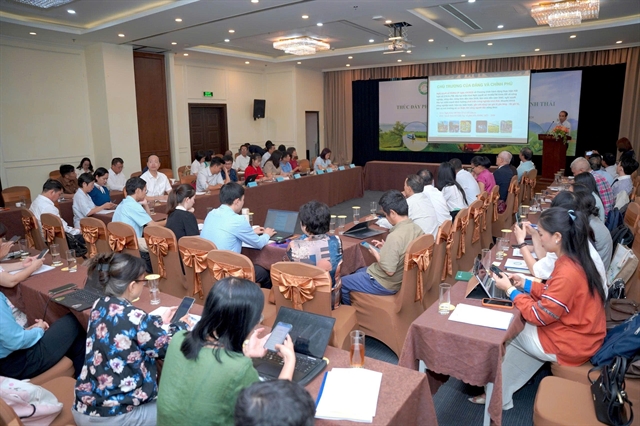
| Experts and business leaders discuss strategic solutions to attract and retain high-skilled international talent during a panel discussion at a seminar held in HCM City on September 30. — VNS Photos Nguyễn Diệp |
HCM CITY — HCM City is restructuring its investment strategy to build a high-quality talent ecosystem and retain top-tier international professionals for its new growth era, municipal officials and industry experts said at a seminar on September 30.
With theme “HCM City: Attracting elite international workforce for the new growth era”, the event was hosted by the Vietnam Television Centre in the southern region.
It focused on strategic solutions to attract high-skilled labour to propel the city’s economic transition towards high technology, sustainability and global competitiveness.
As the southern metropolis shifts towards high-tech manufacturing, digital economy, semiconductors, artificial intelligence (AI), research and development (R&D), and high-value logistics, regional competition has transformed from attracting capital to securing elite human resources.
City officials said that foreign direct investment (FDI) inflows must be accompanied by international experts, scientists and senior executives capable of managing advanced technology transfers.
HCM City attracted more than US$17.2 billion in total FDI between January 1 and September 19, representing a more than four-fold increase year-on-year and surpassing its full-year target by 56.6 per cent.
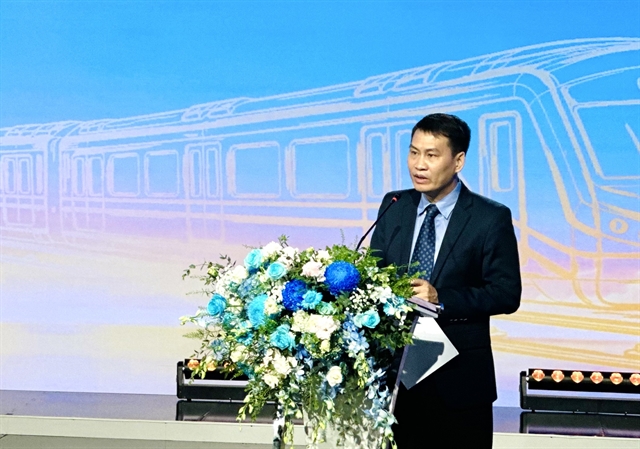 |
| Quách Ngọc Tuấn, deputy director of the HCM City Department of Finance, speaks at a seminar on attracting elite international workforce for the city’s new growth era in HCM City on September 30. |
Quách Ngọc Tuấn, deputy director of the city’s Department of Finance, said this strong inflow reflects heightened international confidence in local deep-water ports, digital infrastructure, AI and high-tech urban developments.
Recent administrative restructurings and the Politburo’s key resolutions have established an institutional framework to optimise FDI distribution across three main economic poles: the central financial district, the northern eco-industrial and tech hub, and the south-eastern maritime economy zone.
“Global competition to attract FDI is no longer a race for cheap labour or tax incentives, but a test of institutional quality, innovation capacity, infrastructure and human capital,” Tuấn said, adding that the city’s core task is engineering a comprehensive talent ecosystem.
Supporting families to retain talent
Yang Kai Yong (Dương Khai Dũng), permanent chairman of the China Business Association - HCM City Branch and general director of Sepzone - Linh Trung, said retaining global experts requires supporting their entire families rather than simply offering job opportunities.
Drawing from nearly two decades of living in the city, Dũng said Chinese citizens account for roughly 64,000, or 38.1 per cent, of the city’s 168,000 foreign residents.
“The decision of elite talent to stay long-term is a holistic family choice. It hinges on an integrated ecosystem spanning international education, healthcare, quality housing, seamless transport, cultural integration and clear career progression,” Dũng said.
He said operational hurdles faced by foreign enterprises, including shortages of versatile personnel, complex work permit procedures, and fragmented administrative support.
He proposed establishing a “one-stop” service mechanism, streamlining visa processes, and building a knowledge-transfer pipeline where foreign experts train local engineers through university partnerships and joint R&D initiatives.
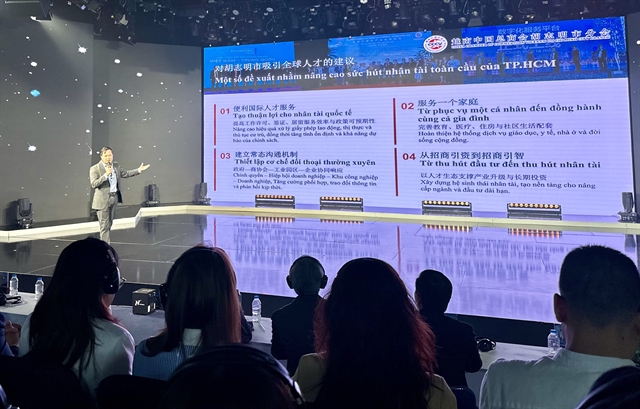 |
| Yang Kai Yong, permanent chairman of the China Business Association - HCM City Branch, presents recommendations on building a talent ecosystem at a seminar in HCM City on September 30. |
Spatial planning and global workforce dynamics
Integrated urban planning remains critical to bridging spatial mismatches between emerging industrial centres and residential infrastructure.
While new employment centres are moving towards northern growth poles connecting Thủ Đức and Bình Dương into an innovation hub, suitable housing and social amenities remain concentrated in older central districts, creating long daily commutes that deter top professionals.
Phạm Bình An, deputy director of the HCM City Institute for Development Studies, said that housing for foreign experts requires synchronised master planning linking residences with workplaces, public transit, international schools, healthcare facilities and green spaces.
He said the city’s master plan through 2040, with a vision towards 2060, integrates Transit-Oriented Development models and “all-in-one” urban centres to minimise commute times and environmental pressures.
Highlighting rapid labour market shifts, Võ Thị Bích Thủy, operations director of ManpowerGroup Vietnam, said demand for high-skilled talent in semiconductors, AI, and automation continues to outpace local supply, forcing the city to compete globally for cross-border talent.
“Recruitment priorities among global enterprises have fundamentally changed. Companies are shifting from filling technical gaps to hiring transformational leaders who can navigate digital transformation, change management, and AI integration.”
With proactive regulatory mechanisms and stronger public-private training partnerships, the city is well-positioned to establish itself as a prominent regional hub for high-tech talent within the next decade, she added. — VNS
Society
 Society
 Society
 Society
 Society
 Society
 Society
 Society
 Society
 Society
 Society
 Society
 Society
 Society
 Society