 Society

Solcis launches open compliance layer for AI agents on NVIDIA OpenShell
1.

|
| Vĩnh Long Province leaders visit a community digital technology team supporting residents with administrative procedures in Phước Mỹ Trung Commune. — VNA/VNS Photo |
VĨNH LONG — Vĩnh Long Province has identified science and technology, innovation and digital transformation as key drivers of its growth model and is stepping up implementation of the Politburo’s Resolution No. 57 issued in December 2024.
The provincial Party Committee said that the implementation must go beyond technology applications and infrastructure investment to generate tangible socio-economic value and economic growth.
Trần Văn Lâu, Secretary of the provincial Party Committee, has instructed Party committees, authorities and leaders at all levels to review, standardise and effectively connect shared data across the system.
Concrete results and practical benefits for residents and businesses would be the key measures of implementation, he said.
To turn the resolution into specific actions, the province Steering Committee for Resolution No. 57 issued Plan No. 05-KH/BCĐ on July 22, launching a 100-day campaign to address digital transformation bottlenecks.
Under the direction of Chairman of Vĩnh Long People’s Committee Trần Trí Quang, the province’s real-time monitoring system has recorded 149 targets for implementing Resolution No. 57.
Of these, 85 have been achieved already.
The Cửu Long (Mekong) Delta province is also monitoring 309 applied science research tasks and projects.
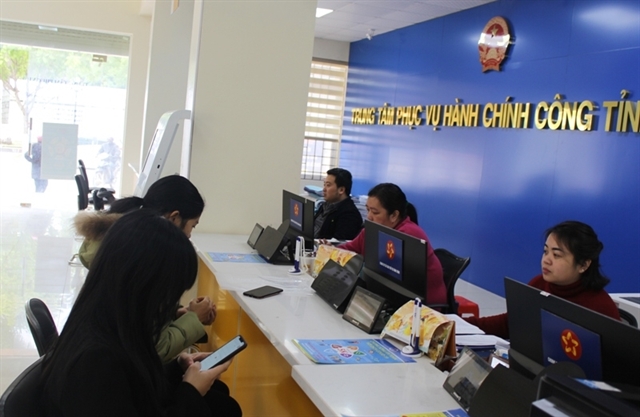
Digital administrative reform has seen considerable progress.
By the end of September, the province had received 693,200 administrative procedure applications, including 690,535 submitted online.
The online application rate was over 99 per cent as against the Government’s target of 80 per cent, and the rate of online payments made through the National Public Service Portal was 96.87 per cent against a target of 60 per cent.
Digitisation of applications and administrative results reached 99.96 per cent, and synchronisation with the National Public Service Portal was 100 per cent.
To strengthen digital capacity in the public sector, the province has issued 20,011 specialised and centralised digital signatures and organised 64 intensive training courses for more than 40,202 officials, civil servants and public employees.

|
| A trader at the Cầu Xây Market in Song Lộc Commune, Vĩnh Long Province, is shown how to scan a QR code to make cashless payments under the province’s “4.0 Market” programme. — VNA/VNS Photo |
Removing bottlenecks
But Vĩnh Long only ranked 17th out of 34 provinces and cities scored in the 2025 Provincial Innovation Index (PII) with 38.93 points, according to the Ministry of Science and Technology.
The province has identified five modest numbers that affect its ranking: for students winning prizes in the national excellent student examination, the e-governance index, private-sector credit, the number of active enterprises and the proportion of workers aged 15 or above who have received training.
To address these, the People’s Committee issued a directive on September 4, assigning specific tasks to various authorities.
It is also linking efforts to improve the PII with other indicators measuring the business environment and public governance, including the Provincial Competitiveness Index, Provincial Governance and Public Administration Performance Index, Public Administration Reform Index, and Digital Transformation Index.
Heads of departments and commune- and ward-level administrations have tasked with improving e-governance by processing work digitally, expanding online public services, digitalising data and making greater use of shared platforms.
The Department of Industry and Trade is advising the province on green and sustainable industrial development, with priorities including agricultural and aquatic product processing, mechanical engineering, supporting industries, and electronics.
It is also promoting technology applications and digital transformation by businesses.
La Thị Thúy, director of the Department of Education and Training, said the education sector is also developing plans to strengthen the teaching workforce and renew methods for identifying and training gifted students.
It is coordinating with relevant agencies to promote science, technology, engineering, and mathematics education and creative research in schools, while helping increase the rate of trained workers in line with market demand, she added.
The province is also seeking to strengthen its entrepreneurial ecosystem.
Under a plan issued in August, the province is developing a multi-platform digital communications system to connect investors, experts and start-ups, while providing training on design thinking, artificial intelligence (AI), digital marketing, risk management and fundraising.
The province plans to help local start-ups participate in major innovation events and organise the 2026 Vĩnh Long innovation and start-up festival.
It aims to enter the top 10 provinces and cities in the PII in 2026 and remain there.
It plans to maintain at least three incubators or innovation centres, support the development of science and technology enterprises and start-up experts, train at least 50 people in innovation, AI, and digital business skills, and commercialise five innovative products based on local resources. — VNS
Society
 Society
 Society
 Society
 Society
 Society
 Society
 Society
 Society
 Society
 Society
 Society
 Society
 Society
 Society