 Sci-Tech
International exchanges advance Việt Nam’s sci-tech diplomacy
1.
|
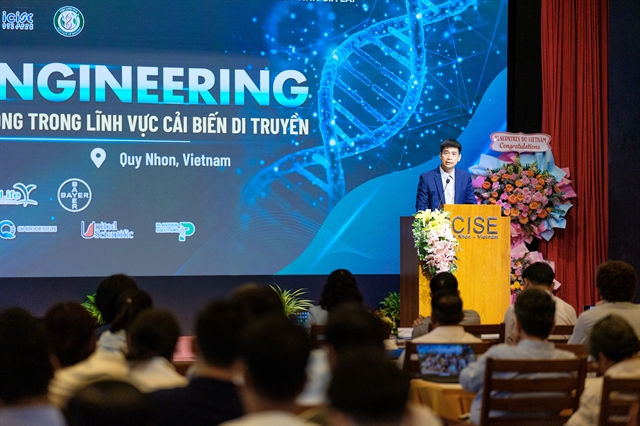
| Professor Jean Trần Thanh Vân welcomes international delegates to the conference on sci-tech's sustainable development in Quy Nhơn in early October. — Photo courtesy of the International Centre for Interdisciplinary Science and Education |
Khánh Dương
HÀ NỘI — Scientific and technology diplomacy often begins with a conversation — a researcher crossing borders, an idea exchanged across disciplines, or a meeting that sparks a lasting collaboration.
Việt Nam is stepping up its science and technology diplomacy in various ways, including by welcoming international scientists to conferences, workshops and training programmes to exchange knowledge and explore opportunities for cooperation.
According to Associate Professor Lê Bộ Lĩnh, former vice chairman of the National Assembly’s Committee for Science, Technology and Environment, science and technology diplomacy plays an important role in mobilising intellectual resources from international experts and overseas Vietnamese scientists.
Beyond tapping into global expertise, science and technology diplomacy can help establish international hubs for knowledge exchange, positioning Việt Nam as a regional meeting point for scientific collaboration through international conferences and research activities.
Efforts to build an internationally-recognised centre for science, innovation and artificial intelligence in the coastal area of Quy Nhơn of the central province of Gia Lai are helping turn this vision into practice.
Nestled amid lush greenery, with mountains rising behind it and a river winding through the surrounding landscape, the International Centre for Interdisciplinary Science and Education (ICISE) has welcomed tens of thousands of scientists from more than 60 countries and territories over the past 13 years, including 19 Nobel laureates and leading researchers from around the world.
Their engagement in Quy Nhơn has extended beyond conferences, workshops and training sessions to building relationships that can pave the way for scientific joint research.
ICISE grew out of the vision of Vietnamese-French physicist Professor Jean Trần Thanh Vân, president of the Rencontres du Vietnam Association, who sought to create a space where scientists from Việt Nam and around the world could meet, exchange ideas and advance interdisciplinary research.
Professor Vân said the initiative was built on his faith in scientists and his vision of welcoming young researchers to Việt Nam, where “they could take root and grow as scientists”.
The value of ICISE lies not only in the number of conferences it has hosted but also in the lasting connections it has helped foster among scientists.
Nobel Prize-winning physicist Sheldon Lee Glashow was among the prominent international scientists who visited Việt Nam for scientific exchanges at the centre.
In August 2013, he attended the Windows on the Universe conference in Quy Nhơn, held shortly after ICISE’s inauguration, and delivered a presentation on fundamental science.
Having returned to Việt Nam several times, Glashow developed a relationship with ICISE that extended beyond individual academic exchanges. In December 2020, he agreed to join the centre’s International Scientific Advisory Board.
He said, “ICISE has become and will remain an invaluable treasure, an indispensable asset not only for Vietnamese scientists and students, but for scientists, technologists, students and educators everywhere.”
Glashow described the centre as a place that should be regarded as a World Heritage Scientific Site.
While Glashow’s involvement with ICISE has spanned years, other international scientists are discovering the centre for the first time.
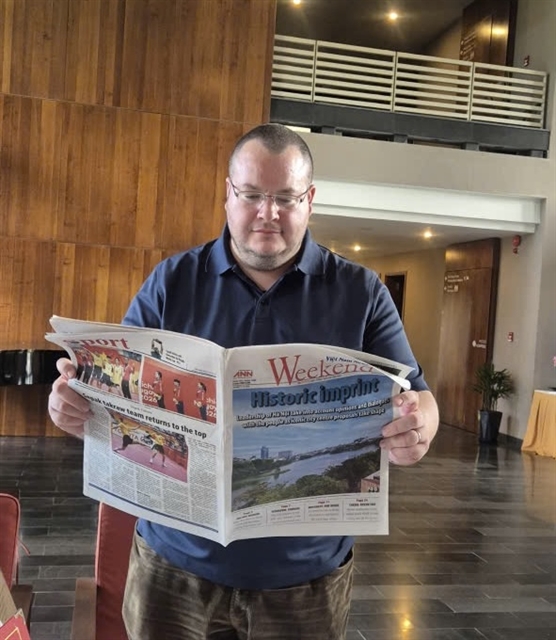 |
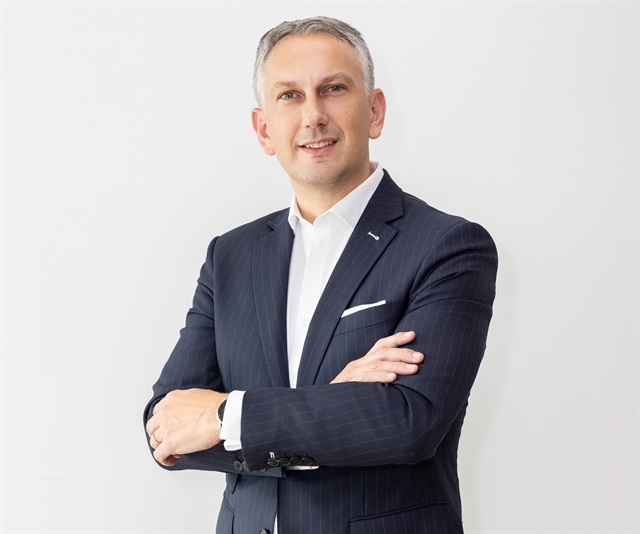
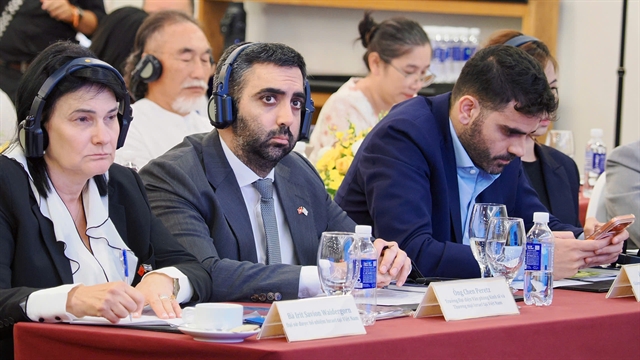
| Patrick Glauner, a professor of AI at Germany’s Deggendorf Institute of Technology, attended a conference in Quy Nhơn in early October. — VNS Photo Thanh Tuệ |
Patrick Glauner, a professor of AI at Germany’s Deggendorf Institute of Technology, visited Việt Nam for the first time in early October to attend an ICISE conference on science and technology for sustainable development.
Chairing a panel discussion on AI alongside Vietnamese experts, Glauner said he was impressed by the quality of the scientific exchanges, particularly the collaboration between international experts and Vietnamese researchers.
He also praised AI research conducted by a Vietnamese colleague he met during the discussion, saying it reflected the growing capabilities of Việt Nam’s AI research community.
Glauner expressed hope that the visit will mark the beginning of further scientific partnerships.
Associate Professor Trần Tuấn Anh, vice president of the Việt Nam Academy of Science and Technology, said the international conferences organised by Professor Trần Thanh Vân had served as a bridge connecting domestic and international scientists. They provided a platform for researchers to share their findings, experience and propose solutions to support development in Việt Nam and the wider region.
He also expressed hope that Professor Vân would continue to expand this model beyond Quy Nhơn to other localities, creating more opportunities for international scientists to work, conduct research and exchange academic knowledge with Vietnamese scientists and universities.
Integrating local initiatives with national priorities
Not only Professor Vân’s initiative, but other State agencies are also working to strengthen these connections.
According to Trần Tuấn Anh, the Việt Nam Academy of Science and Technology has proposed measures to develop programmes that attract young researchers and invite renowned international scientists to collaborate with the academy on research and training.
The Ministry of Science and Technology considers attracting international scientists and experts to Việt Nam for academic exchanges, knowledge and experience sharing, and engagement with the domestic scientific community not merely as a form of professional cooperation but also as an important channel for promoting science and technology diplomacy, fostering mutual understanding, building trust and expanding international cooperation networks.
Through scientific conferences, seminars, forums and research cooperation programmes, Việt Nam could gain access to advanced knowledge and technologies, management experience and emerging development trends, while promoting its research capabilities, innovation potential and the image of its scientific community, a representative of the ministry’s Department of International Cooperation told Việt Nam News.
According to the department, Việt Nam should shift from event-based networking to deeper, continuous cooperation. Conferences and seminars should be linked to specific cooperation programmes, such as joint research, technology transfer and mastery, human resource training, scientist exchanges and the development of international research groups, particularly in strategic technology fields and areas identified as priorities by Việt Nam.
Science and technology diplomacy should be aligned with the country's development goals and foreign policy priorities.
The ministry will coordinate with ministries, sectors, research institutions, educational establishments and businesses to turn opportunities for exchanges and dialogue into concrete cooperation programmes, making practical contributions to the development of science, technology and innovation and enhancing Việt Nam’s standing in the global science and technology network. — VNS
Sci-Tech
 Sci-Tech
 Sci-Tech
 Sci-Tech
 Sci-Tech
 Sci-Tech
 Sci-Tech
 Sci-Tech
 Sci-Tech
 Sci-Tech
 Sci-Tech
 Sci-Tech
 Sci-Tech
 Sci-Tech
 Sci-Tech