 Sci-Tech
.jpg)
SABECO wins three honours at Asia Pacific Enterprise Awards 2026
1.
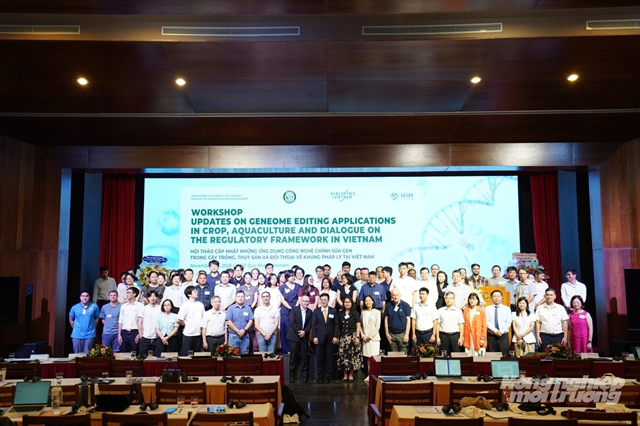 |
| Participants at the seminar pose for a photo. VNS Photo Diệp Ngô |
GIA LAI — Gene-editing technology offers significant opportunities to develop crop varieties, livestock and aquatic species with higher productivity, improved quality and greater resilience to climate change, according to experts at a seminar on the technology.
However, the experts said to facilitate the effective application of this technology in agricultural production, Việt Nam needs to further strengthen its legal framework, particularly regulations governing the assessment, official recognition and commercial release of gene-edited organisms.
These issues were among the key topics discussed at a seminar entitled 'The Application of Gene Editing in Crops and Aquaculture: A Dialogue on the Legal Framework in Việt Nam' held in Quy Nhơn, Gia Lai Province on Tuesday.
The seminar was co-organised by the Ministry of Agriculture and Environment, the International Centre for Interdisciplinary Science and Education and the Institute of Biology.
Dr Nguyễn Văn Long, director of the ministry's Science and Technology Department, told the seminar that gene-editing technology is an important tool for developing crop varieties, livestock breeds and input materials for agricultural production.
In particular, CRISPR/Cas technology enables targeted genetic modifications, facilitating the development of improved varieties with desirable traits, Long said.
This technology has considerable application potential across a wide range of key agricultural commodities, including rice, coffee and bananas, as well as in livestock production and aquaculture, he said.
According to experts at the seminar, gene editing technology helps support the development of crops, livestock and aquatic species that are disease resistant and capable of adapting to drought, saltwater intrusion and high temperatures.
It can also enhance yields, nutritional quality, shelf life and efficient use of resources.
Globally, research and applications of this technology are expanding beyond crops to include livestock, aquaculture and microorganisms, with the goals of increasing resilience, reducing post-harvest losses and boosting product value.
Alongside its application potential, the management of risks associated with gene-edited products has become a matter of significant concern for many countries.
Dr Michael Leader, representing the Plant Breeding Innovation Working Group at CropLife Asia, said that the current general trend is to evaluate the characteristics of the final product rather than focusing solely on the method used to create it.
The approach ensures biological safety and also creates favourable conditions for research, innovation and product commercialisation.
Forming clear regulations helps research institutions and businesses further develop and bring products to the market.
In Việt Nam, the legal framework for biodiversity has established an initial management mechanism for gene-edited organisms. Under this system, organisations and individuals may self-determine whether a gene-edited product is free of foreign DNA and report this finding to the relevant State regulatory authority.
Law 146/2025/QH15, passed by the National Assembly in 2025, distinguishes between genetically modified organisms and gene-edited organisms, providing a legal basis for management tailored to the specific characteristics of each category.
Decree 43/2026/NĐ-CP, which amends and supplements certain regulations on nature conservation and biodiversity, further elaborates on these provisions.
However, the self-determination and reporting of products as free of foreign DNA represent only one stage in the regulatory process.
Further procedures such as field testing, official recognition and the commercial release of gene-edited varieties still require clearer guidance within the specialised legal framework.
This constitutes a policy gap that must be addressed so that research findings can be promptly translated into products for practical production.
Long said that the Ministry of Agriculture and Environment has been studying and building up a a controlled testing mechanism (sandbox) for certain types of crops developed using gene-editing technology, for the purpose of reporting and submission to the Government for consideration.
This is also a foundation to promote international cooperation and technology transfer to shorten gaps between research and production and introduce crop, livestock and aquatic species with superior traits into practical use, contributing to enhanced productivity, quality and competitiveness in Vietnamese agriculture. VNS
Sci-Tech
 Sci-Tech
 Sci-Tech
 Sci-Tech
 Sci-Tech
 Sci-Tech
 Sci-Tech
 Sci-Tech
 Sci-Tech
 Sci-Tech
 Sci-Tech
 Sci-Tech
 Sci-Tech
 Sci-Tech
 Sci-Tech