 Sci-Tech
Việt Nam, US seek to deepen defence cooperation, war legacy remediation
1.
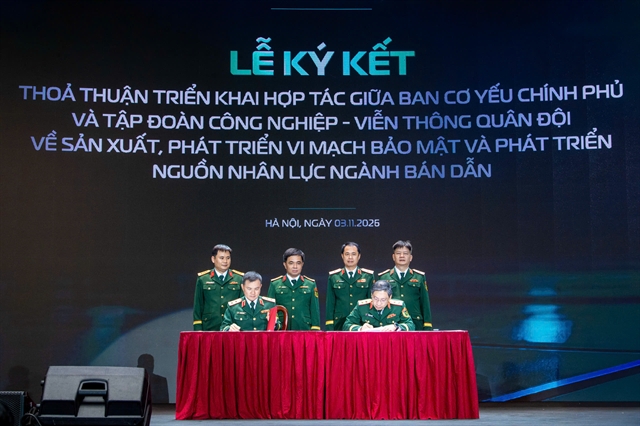 |
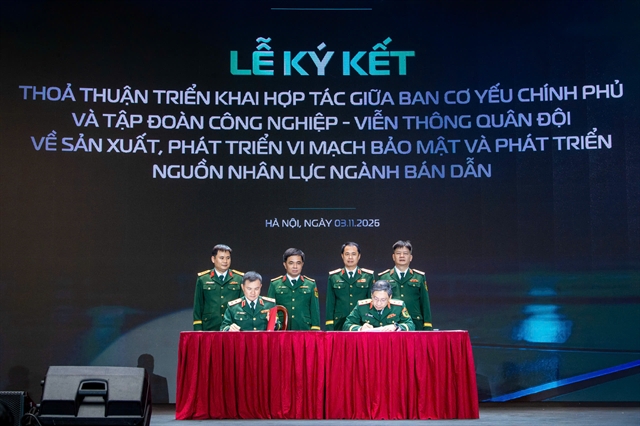
| The November 3 launching and signing ceremony of VGC v1.0 security chip and Việt Nam’s first domestically designed secure semiconductor platform. —Photos courtesy of Viettel |
HÀ NỘI — The Government Cipher Committee and military-run telecom group Viettel on Tuesday unveiled the VGC v1.0 security chip and Việt Nam’s first domestically designed secure semiconductor platform, marking a step forward in mastering core technologies for national cybersecurity and digital sovereignty.
The launch ceremony was attended by General Phan Văn Giang, Politburo member, Deputy Secretary of the Central Military Commission, Deputy Prime Minister and Minister of National Defence, along with representatives of ministries, government agencies, research institutes and technology businesses.
The development supports the implementation of Politburo Resolution No 57-NQ/TW on breakthroughs in science and technology, innovation and national digital transformation, and the Government’s semiconductor industry development strategy.
For more than 80 years, Việt Nam’s cipher sector has mastered software-based cryptographic algorithms to protect state secrets. However, the growing security risks associated with imported chips have highlighted the need to embed national cryptographic algorithms directly into hardware.
Under the cooperation, M2, a unit of the Government Cipher Committee, develops security requirements, cryptographic algorithms and evaluation criteria, while Viettel’s Semiconductor Centre handles chip design and development.
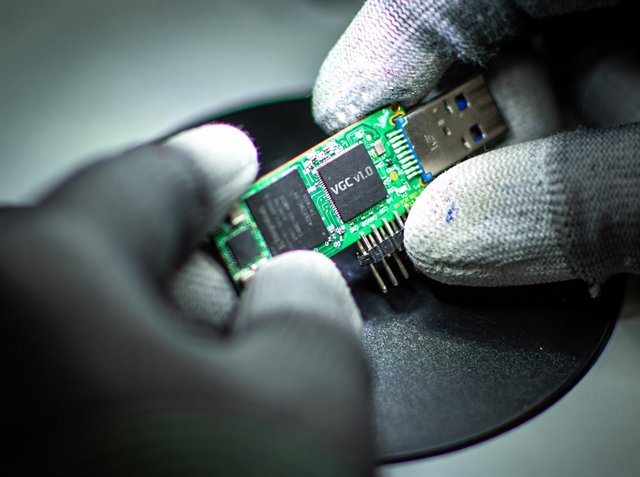 |
| The VGC v1.0 security chip. |
VGC v1.0 measures 10 x 10 mm in package size, contains 300 million transistors and is manufactured using 28-nanometre CMOS technology. Test results show that it can encrypt and decrypt data approximately 15 times faster than software-only solutions performing the same tasks.
Engineers have also introduced measures to protect chip designs before they are sent for manufacturing, helping prevent information leaks and reverse engineering.
The first batch passed technical testing in the first quarter of 2026 and received certification for use in socio-economic applications.
Speaking at the ceremony, General Phan Văn Giang said semiconductors had become a strategic resource, describing chips as the “heart” of digital devices and cryptography as the “shield” protecting information.
“Without mastering chips, it is difficult to fully master cryptography. And without mastering cryptography, it is difficult to firmly safeguard digital sovereignty and protect the Fatherland,” he said.
He stressed that mastering secure semiconductor technology was not merely a scientific and technological task but also a political mission.
“We may start behind others, but we will not move slowly. We move forward to catch up and surpass,” he said.
Platform for future chip development
Based on the open RISC-V instruction set architecture, the secure semiconductor platform allows engineers to customise processor designs and master the design and verification processes, providing a foundation for future generations of Vietnamese-designed chips.
Viettel Chairman and General Director Lieutenant General Tào Đức Thắng said semiconductor chip development was a complex field requiring long-term investment in technology, knowledge and skilled personnel.
“Being a latecomer does not mean accepting dependence. With the right strategy, focused resources and persistent efforts, we can gradually narrow the gap and move towards mastering the country’s strategic technologies,” he said.
VGC v1.0 is initially being integrated into secure USB storage devices for Party, State and defence agencies. The next step is to deploy it in the national digital signature authentication system, which has more than two million digital certificates in circulation.
Other potential applications include protecting financial records, contracts and customer data, securing connected devices such as surveillance cameras and environmental sensors, and safeguarding critical infrastructure in electricity, water, oil and gas, and telecommunications.
Lieutenant General Vũ Ngọc Thiềm, head of the Government Cipher Committee, said VGC v1.0 was only the starting point, with further testing and certification required for different operating environments.
“Technological capabilities only have real value when demonstrated through safety, reliability and effectiveness in practical applications,” he said.
The Government Cipher Committee and Viettel also signed a cooperation agreement covering four areas: moving VGC v1.0 towards mass production, developing multi-core secure semiconductor platforms, training specialists in chip design and hardware security, and testing and evaluating products before deployment.
Together with Viettel’s high-tech semiconductor fabrication plant under construction in Hòa Lạc, the partnership is expected to strengthen Việt Nam’s capabilities across the semiconductor value chain, from design and manufacturing to packaging, and improve supply chain security. — VNS
Sci-Tech
 Sci-Tech
 Sci-Tech
 Sci-Tech
 Sci-Tech
 Sci-Tech
 Sci-Tech
 Sci-Tech
 Sci-Tech
 Sci-Tech
 Sci-Tech
 Sci-Tech
 Sci-Tech
 Sci-Tech
 Sci-Tech