 Sci-Tech
Eximbank shareholders approve board expansion, changes to foreign ownership rules
1.
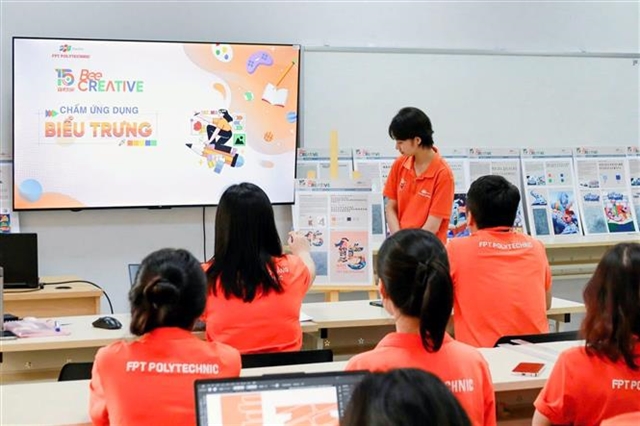 |
| Students at FPT Hà Nam School practise lessons using digital technology applications. — VNA/VNS Photo Đại Nghĩa |
Mai Hương
HÀ NỘI — As artificial intelligence (AI) becomes more widely used in workplaces and education, the ability to think critically, judge information and make decisions remains essential, education and industry experts said.
AI can help people work faster and handle tasks that previously required more time, but people still need to understand the problem, check the output and decide what to do with it.
Yashinta Bahana, head of APJ Market Expansion & Strategic Partnership at T&C AWS, said AI adoption in Việt Nam was growing rapidly, with about 75,000 businesses already using AI, representing 44 per cent year-on-year growth, making it one of the fastest growing markets withing the region.
But as businesses adopt AI, the skills they expect from employees are also changing.
“It’s no longer that it’s only about knowing what AI can do, but what is actually you can do with AI,” she said.
Critical thinking and judgement were increasingly important, she said, while fresh graduates appeared to have high confidence in using AI without the same level of capability.
The focus should therefore move beyond simply using AI tools to employing them to solve real problems.
“Instead of only using the technology, you need to become a builder,” she said.
Eklavya Bhave, head of Higher Education, APAC & Japan at Pearson, said the gap between students’ confidence and employers’ assessment of their readiness was a global trend.
The problem was partly caused by confusing AI adoption with capability, he said.
Universities might look at whether students were using new technologies, while employers were more interested in whether they could use those technologies to solve real-world problems.
“Employers care more about how a student can use that particular tool or technology to solve a real-world problem,” Bhave said.
He said students also needed to combine technical capabilities with human skills such as critical thinking, judgement and communication.
A student might know how to use an AI tool, but if they could not apply it to a real-world problem, assess whether its output was reliable or work with others, that knowledge had limited value, Bhave said.
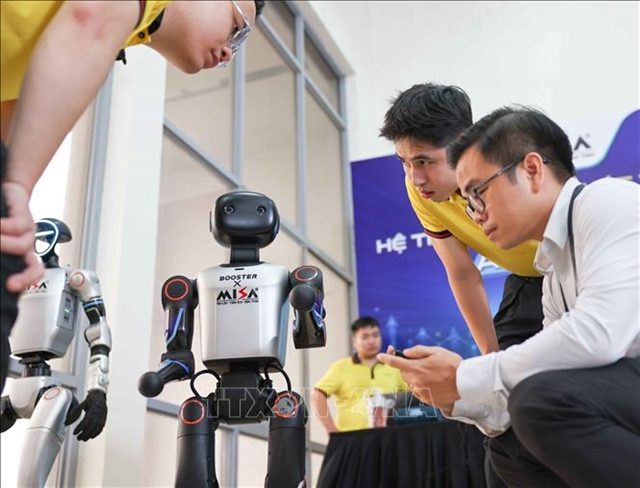 |
| The exhibition area showcasing products at AI Day 2026. — VNA/VNS Photo:Thanh Tùng |
Keeping humans in the lead
Associate Professor Nguyễn Danh Nguyên, dean of the School of Economics and Management at the Hanoi University of Science and Technology, said students needed to learn how to challenge AI-generated answers rather than simply accept them.
Students could now use chatbots to obtain answers quickly, but they still needed the knowledge to decide whether those answers were correct, he said.
This is becoming more important as AI is used for more tasks at workplaces.
AI can generate an answer, but it does not remove the need for people to understand the subject, assess the information and make the final decision.
Bahana from the AWS said the company was encouraging students to start with the problem rather than the technology.
The company’s approach is to work backwards from the problem that needs to be solved, rather than looking for ways to use technology simply because it is available.
She said this mindset should also be developed among students, together with a willingness to keep learning even after graduation as technology changes.
Critical thinking, judgement, evaluation and decision-making can remain useful even when specific technologies change. Knowledge also gives students the basis to judge whether information generated by AI is reliable.
Resolution No. 57-NQ/TW, which sets out Việt Nam’s direction for breakthroughs in science, technology, innovation and national digital transformation, also places emphasis on developing high-quality human resources for the new development period.
The policy direction reinforces the need for education and training to equip people not only with technology skills but also with the capacity to adapt to rapid technological change.
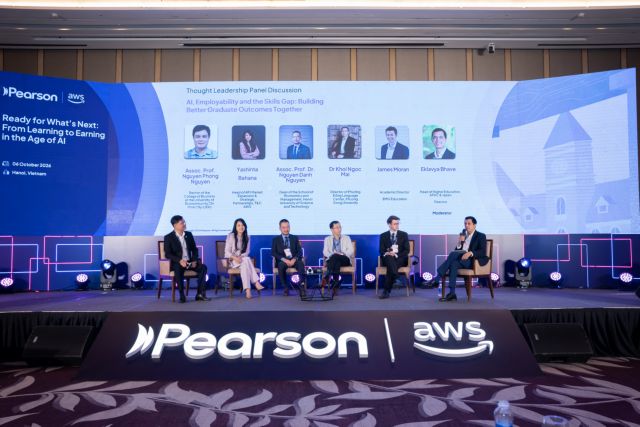 |
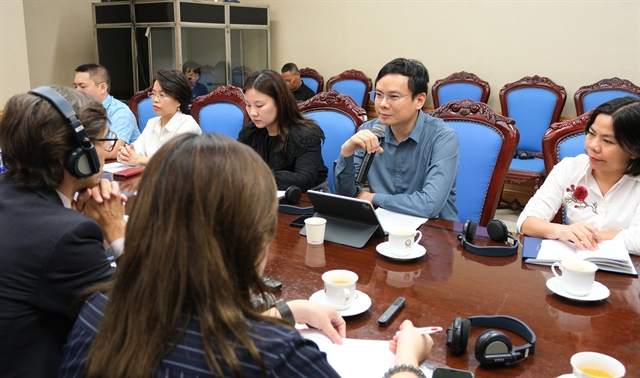
| Education and industry experts at a recent panel discussion on AI, employability and graduate outcomes. — Photo courtesy of Pearson |
Learning through real problems
Universities are responding by giving students more opportunities to apply what they learn to real-world problems.
Associate Professor Nguyễn Phong Nguyên, rector of the College of Business at the University of Economics Ho Chi Minh City (UEH), said project work and applied research were important in helping students develop skills needed by employers.
At the college, about 80 per cent of master's theses are applied research, while bachelor's training is fully oriented towards applied research, he said.
The university works with companies to identify problems and bottlenecks that can be turned into projects for students. Students and lecturers can then work with companies and take part in internships linked to those projects.
“Students need to develop leadership skill, communication, working in a team, and problem-solving skill,” Nguyên said.
The approach is moving beyond the traditional model in which students mainly gain exposure to companies towards the end of their studies.
UEH's six schools work with business partners to identify problems and areas where students can contribute. Students and lecturers can then work with companies on problem-solving projects.
Nguyên said universities also needed to create an environment where lecturers could work with industry.
At UEH, applied research groups bring students, professors and practitioners together to work on projects, helping academics gain more practical experience while students work on real business problems.
The challenge for education is that no one can predict exactly how AI will change the workplace. That makes it difficult for schools and universities to keep adjusting their curricula to each new technology.
Bhave said the pace of technological change was making this challenge more urgent. Instead of waiting until students reached their final years to gain practical experience, universities should expose them to real-world projects from the beginning of their studies.
The aim should not be to keep changing curricula every few years to catch up with new AI models, but to give students continuous exposure to how technology is being used in the workplace, he said.
For students, a strong foundation in knowledge and the ability to think critically may therefore matter as much as learning how to use the latest AI tools. — VNS
Sci-Tech
 Sci-Tech
 Sci-Tech
 Sci-Tech
 Sci-Tech
 Sci-Tech
 Sci-Tech
 Sci-Tech
 Sci-Tech
 Sci-Tech
 Sci-Tech
 Sci-Tech
 Sci-Tech
 Sci-Tech
 Sci-Tech