 Sci-Tech

Hà Nội breaks ground on 299-ha safari park
1.
 |
| More than 800 delegates attend the International Conference on Education Cooperation in the Digital Era. — Photos moet.gov.vn |
HÀ NỘI — More than 800 delegates from 40 countries and territories gathered in Hà Nội on October 8 for an international conference on education cooperation in the digital era, exploring how AI and digital technologies can be applied safely, equitably and in a human-centred manner.
The conference provided a forum for educational institutions, international organisations and technology companies to share experience and explore partnership models as AI transforms how people teach, learn and manage education systems.
The event was held to advance major policy priorities on breakthroughs in science and technology, innovation and national digital transformation, educational development and international integration in the new era.
Teachers and schools must change
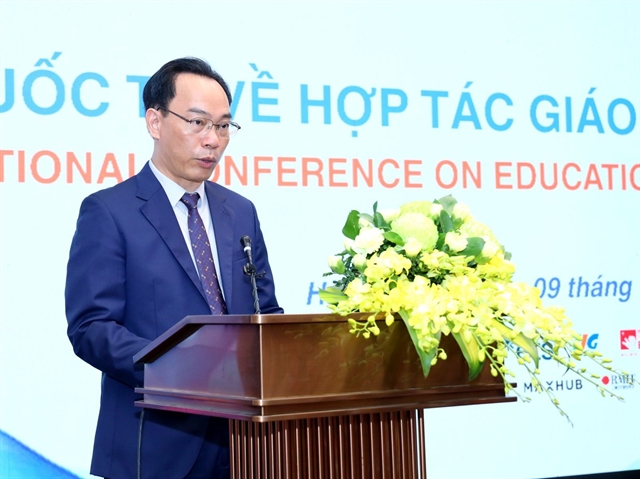 |
| Minister of Education and Training Hoàng Minh Sơn delivers the opening address at the conference. |
Minister of Education and Training Hoàng Minh Sơn said in a speech to open the conference that digital technologies and AI offer significant opportunities for education, but also pose challenges related to information reliability, ethics, copyright, data security, academic integrity and the digital divide.
These are not challenges unique to Việt Nam, but global issues requiring a concerted response, he said.
In the face of these changes, education can no longer focus solely on what additional skills learners need to acquire, according to Sơn. Teachers, schools and the entire education system also have to change, moving beyond adaptation towards gradually mastering and guiding the use of AI for human development.
Amid this new learning environment, students need to develop self-learning skills, independent and critical thinking, creativity and the ability to work alongside AI.
Meanwhile, teachers must move beyond simply imparting knowledge to designing learning activities, providing guidance, inspiring students and helping them develop values. Schools and education authorities also need to reform how they organise and manage education, assess learning outcomes and ensure quality.
Sơn stressed that human development remains the overarching goal of educational reform in Việt Nam. The value of technology does not lie in how extensively it is used, but in whether it helps students make progress, enables teachers to perform their roles more effectively, improves school operations and expands equitable access to learning.
Four priorities for education
 |
| The Government of the Socialist Republic of Việt Nam and the Government of the United Kingdom of Great Britain and Northern Ireland sign a memorandum of understanding on education cooperation. |
From this human-centred perspective, the education sector has identified four priorities for digital transformation, according to the minister.
The first is to develop a unified and secure digital infrastructure and data platform that enables connectivity and data sharing. Data should become a resource serving learners and teachers while supporting education management.
Next is to renew teaching and learning while strengthening the ability of both students and teachers to master technology. The goal is not to let AI think for people, but to use it to help them learn better, become more creative and generate greater value. Digital and AI competencies should also become integral to teachers' continuing professional development.
The third priority is to reform education management and promote the safe, transparent and responsible use of AI. This requires a clear understanding of both the technology's potential and its limitations, alongside safeguards for privacy, copyright, academic integrity, learners' rights and human accountability.
Strengthening international cooperation, particularly in the application of digital technologies and AI, is the fourth main priority.
Sơn noted that the opportunities and challenges presented by AI transcends national borders. No education system can fully address on its own the issues surrounding technology, data, ethical standards, personnel and the digital divide, he said.
Countries thus need to pursue more substantive cooperation, going beyond knowledge transfer and technology adoption to jointly research, develop, test and share solutions that deliver practical value.
“The success of the conference will not be measured only by the number of ideas or agreements, but by the programmes carried out, the solutions tested and the tangible changes in schools,” the minister said.
Technology must ensure equal learning opportunities
At the opening session, Stefaan Hermans, Director for Competitiveness, Talent Mobility and International Cooperation at the European Commission’s Directorate-General for Education, Youth, Sport and Culture, said digital transformation in education is about more than platforms, devices or AI.
At its core are people, institutions and the ways knowledge is created, shared and applied. This requires appropriate policies, digitally capable teachers, innovative teaching and learning methods, and meaningful cooperation with businesses and society.
Hermans said the European Union is implementing various programmes to promote cooperation with Việt Nam in education, research and skills development.
Since 2021, the Erasmus+ programme has supported more than 6,800 student and staff exchanges between Europe and Việt Nam, while Vietnamese educational institutions have participated in nearly 100 capacity-building projects.
Vietnamese organisations and researchers are also involved in 29 projects under Horizon Europe, the EU's research and innovation programme with a budget of more than 90 billion euros (US$100.9 billion).
Noting that the EU's priorities share common ground with Việt Nam's development orientations under Resolutions 57, 59 and 71, Hermans confirmed the bloc's readiness to work with Việt Nam, connecting Europe's strengths with the country's development priorities and translating shared goals into concrete cooperation programmes and results.
To ensure that every child has access to learning opportunities, UNICEF Representative in Việt Nam Silvia Danailov said education would play a central role in the country's next stage of development, as growth increasingly depends on innovation, technology, the green transition and a highly skilled workforce.
For technology to genuinely improve educational quality, investment must first be directed towards people and systems, not technology alone, she said. Teachers, education managers and the capacity of the education system will ultimately determine whether technology leads to better learning outcomes.
Equity also needs to be built into digital transformation from the design stage, with priority given to children in disadvantaged areas, ethnic minority children, children with disabilities and other groups at risk of being left behind.
The success of digital transformation should not be measured simply by the number of schools connected or students using technology, but more importantly by its ability to narrow learning gaps.
UNICEF also emphasised that children's rights, safety and protection must be integrated into digital systems and AI applications from the outset. This includes protecting data, ensuring age-appropriate AI use and maintaining human oversight of decisions affecting children.
Applying AI to real-world challenges
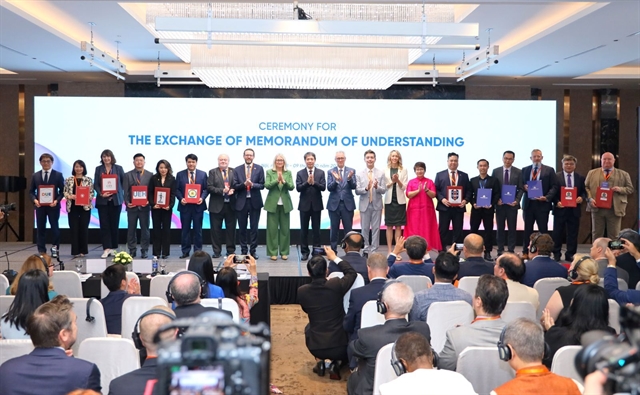 |
| The signing and exchange of memoranda of understanding take place on the sidelines of the conference. |
Held from October 8 to 9, the conference featured thematic sessions on international cooperation, digital transformation in general education, internationalisation and digital transformation in higher education, the development of digital ecosystems in vocational education and the Global Alliance Initiative for Children.
Delegates discussed the use of AI, big data and emerging technologies to personalise learning, improve teaching effectiveness and develop digital competencies. They also examined ways to ensure and assess educational quality in a technology-driven environment.
The discussions aimed to identify solutions for building a flexible education system capable of adapting to rapid changes in science, technology and the labour market, while expanding opportunities for lifelong learning.
On the sidelines of the conference, Government agencies, educational institutions and businesses also signed agreements and exchanged memoranda of understanding, linking training and research needs with domestic and international expertise, resources and technological solutions. — VNS
Sci-Tech
 Sci-Tech
 Sci-Tech
 Sci-Tech
 Sci-Tech
 Sci-Tech
 Sci-Tech
 Sci-Tech
 Sci-Tech
 Sci-Tech
 Sci-Tech
 Sci-Tech
 Sci-Tech
 Sci-Tech
 Sci-Tech