 Sci-Tech

Đà Nẵng aims to rank among Asia’s leading cities by 2075
1.
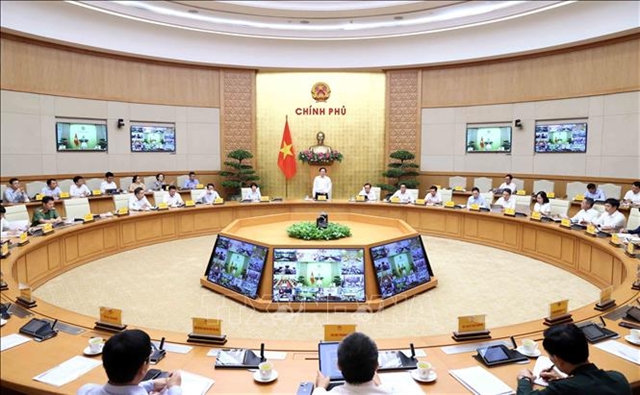 |
| Deputy Prime Minister Hồ Quốc Dũng (standing) chairs a national online conference to improve science and technology collaboration between research institutes, universities and the business community from Hà Nội on Friday. — VNA/VNS Photos An Đăng |
HÀ NỘI — Deputy Prime Minister Hồ Quốc Dũng has called on research institutes, universities and businesses to work together to address the challenges in turning research projects into real products and services that support economic development.
He made the request while chairing a national online conference to improve collaboration among these entities to improve the practicality of scientific and technological research projects.
Minister of Science and Technology Vũ Hải Quân and leaders from 10 ministries and Government agencies attended the conference, as well as representatives from research institutes, universities, major corporations and enterprises.
Reviewing the Government's efforts to enable innovation, Deputy PM Dũng said that despite the issuance of several policies and mechanisms to promote science, technology, innovation and digital transformation, the application of these policies remains slow, particularly when it comes to turning research into specific, meaningful outcomes.
"A major 'bottleneck' is the lack of strong, substantive connections between the State, research institutions, the business community and the market, which has lead to many research projects and initiatives failing to address the actual requirements of the economy and the market," he said.
Citing data from the 2021-25 period, Dũng stressed that businesses took part in only about 12 per cent of national-level science and technology projects, and 11 per cent of local-level projects.
Only about six per cent of businesses nationwide took part in establishing funds to finance research in 2023.
Business investment in research and development remains low, equivalent to just 0.3 per cent of GDP, compared to 2.1 per cent in China and 4.2 per cent in the Republic of Korea.
The distribution of research personnel is imbalanced, with only 333 researchers with doctoral degrees work within the corporate sector while about 21,000 are employed by research institutes and universities.
Vietnamese enterprises have been granted over 700 patents while foreign enterprises have received about 24,000, which is roughly 35 times higher.
About 62,000 technological solutions have been offered for sale across markets, but only 750 investors and enterprises have shown interest, resulting in only 72 completed transactions.
"These figures indicate that corporate involvement in research activities remains limited, and many research outcomes have yet to be applied or commercialised," the Deputy PM said.
“If this situation persists, it will be difficult to leverage science, technology, innovation and digital transformation as drivers for the nation’s growth.”
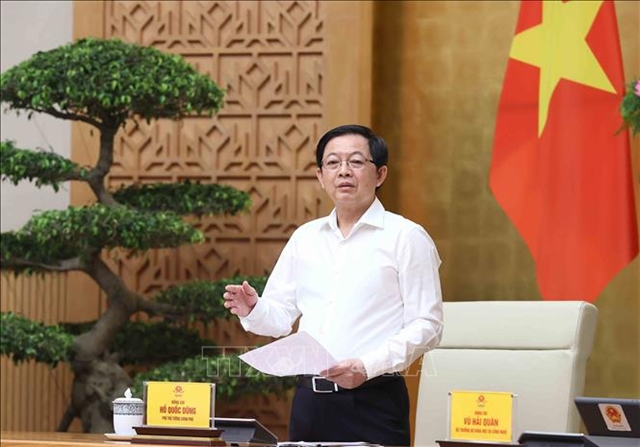 |
| Deputy Prime Minister Hồ Quốc Dũng addresses the conference. |
He urged ministries, research institutes, universities and enterprises to be straightfoward in pointing out inadequate regulations and mechanisms that require further reform, spanning from research, financial arrangements to the application and commercialisation of research outcomes.
"It's necessary to clearly explain why businesses remain unenthusiastic about research findings from institutes and universities, why they have yet to adopt research results that cost significant efforts and resources to produce," Dũng said.
He urged the conference to propose solutions to strengthen the collaboration between the State, research institutes, universities and businesses to build an ecosystem that applies and commercialises research outcomes, and create products and services that contribute directly to economic growth.
"The Government is open to feedback regarding unreasonable regulations to create favourable conditions to foster research, development, and the application of science and technology," he said.
Deputy Minister of Science and Technology Lê Xuân Định proposed that from later this year, the ministry will focus on refining mechanisms to evaluate the effectiveness of collaboration between research institutes, universities and businesses, and commercialisation of research outcomes.
He suggested establishing a set of 10 indicators to assess the level of collaboration, slated for inclusion in the Science and Technology White Paper from next year, to serve as a standardised basis for measuring the results and efficiency of partnerships.
Regarding human resource development, the ministry proposed officially recognising the time academics spent working within enterprises, and increase the development of 'spin-off' companies based on research findings.
The ministry also encourages the State and State-owned enterprises to take on a proactive, facilitative role in sharing risks and acting as the initial customers for new technological products, helping shape markets and accelerate the commercialisation of research outcomes, Định said. — VNS
Sci-Tech
 Sci-Tech
 Sci-Tech
 Sci-Tech
 Sci-Tech
 Sci-Tech
 Sci-Tech
 Sci-Tech
 Sci-Tech
 Sci-Tech
 Sci-Tech
 Sci-Tech
 Sci-Tech
 Sci-Tech
 Sci-Tech