 Sci-Tech

Vietnamese Vice President’s visit opens new opportunities for bilateral ties: Georgian Deputy PM
1.
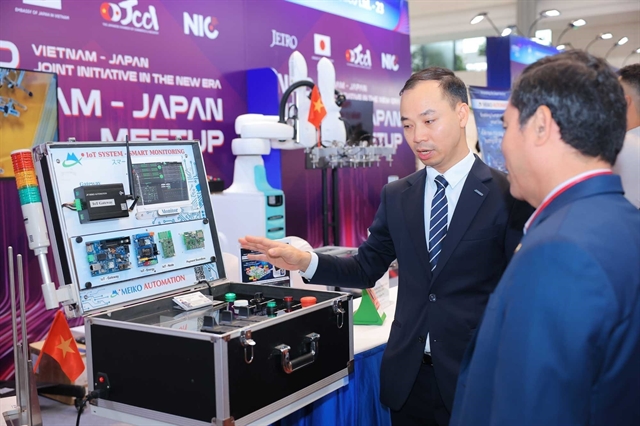 |
| Businesses showcase science, technology and innovation products at a ceremony marking National Innovation Day 2026, themed 'Innovation – A Driving Force for the Development of Society as a Whole'. — VNA/VNS Photo Hoàng Hiếu |
HÀ NỘI — Việt Nam will reorganise its national science, technology and innovation programmes for 2026–2035 into six groups, giving businesses a stronger role and placing greater emphasis on commercialising research results. The move aims to use resources more efficiently and better align research with practical needs.
Deputy Prime Minister Hồ Quốc Dũng signed Decision No. 1951/QĐ-TTg on October 8, approving a project to restructure the programmes.
The project aims to address fragmentation, overlap and dispersion, improve resource efficiency, and strengthen links between research, application, technology transfer and commercialisation.
Six groups of national programmes
Under the project, existing national programmes that remain in effect will be reviewed alongside newly approved programmes. These include programmes approved by the Prime Minister, the Minister of Science and Technology, other ministers or heads of central-level agencies within their respective authority.
The programmes will be organised into six groups: science, technology and innovation capacity development; basic research; national priorities; national innovation; special national programmes; and national digital transformation.
The structure is designed to connect the entire process, from basic and applied research to technology development, application, transfer, innovation and commercialisation.
The capacity development group will support human resources, research organisations and shared infrastructure. The basic research group will generate new knowledge, provide scientific evidence for policymaking and lay the foundations for technological development.
The national priorities group will address major interdisciplinary and cross-sectoral issues related to socio-economic development, national governance, culture, people, defence and security.
The national innovation group will support technology application, transfer and commercialisation, develop the science and technology market, and promote innovative entrepreneurship.
The special national programmes group will focus on large-scale objectives, strategic technologies and products, using specific mechanisms in accordance with the law.
The national digital transformation group will promote the development of digital government, the digital economy and digital society in line with national strategies and programmes.
The project stipulates that organising programmes into six groups will not create new project categories, intermediate management levels, application dossiers or administrative procedures. Nor will it change the legally prescribed authority for project formulation, appraisal, approval, management and implementation.
Businesses at the centre of technology application and commercialisation
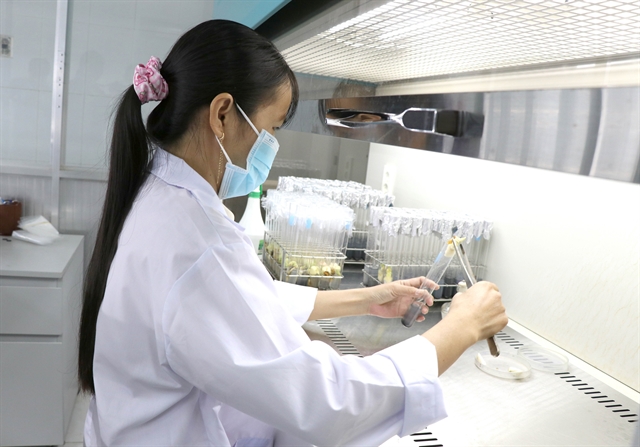 |
| A researcher at Trà Vinh University transplants coconut embryos in a laboratory, helping bring research results into production and commercialisation. — VNA/VNS Photo Thanh Hòa |
A key direction of the project is to place businesses at the centre of technology application, transfer, innovation and commercialisation, with market demand and practical development needs guiding research activities. Research institutes and higher education institutions will play a leading role in generating knowledge, developing core and strategic technologies, and training human resources.
Businesses will be encouraged to propose, commission, fund or co-fund, lead or collaborate on science, technology and innovation tasks.
Greater autonomy will be accompanied by accountability and acceptance of controlled risks in line with the specific nature of research.
Programmes will be assessed using an Input–Output–Efficiency–Impact framework, alongside sector-specific indicators. The assessments will inform adjustments to objectives, content and resource allocation, as well as decisions on whether programmes should continue, be revised, merged or terminated by the competent authorities.
Targets set for each phase
For 2026–2030, the project aims to ensure that 100 per cent of programmes covered by the project have their progress, results and efficiency monitored and evaluated through the national digital platform for science, technology and innovation management.
At least 40 per cent of tasks must produce results that are protected by intellectual property rights or published in reputable international journals or publications indexed in Web of Science (WoS) or Scopus.
Business-led or business-coordinated commissioned tasks are expected to account for at least 50 per cent of the total, with businesses contributing matching funds equivalent to at least 40 per cent of the total funding for these tasks.
The project also aims to establish 30 research groups meeting regional standards, complete at least 20 key national products and strategic technology products, and develop at least 20 businesses capable of mastering strategic technologies and products. Of these, at least five are expected to have products integrated into global value chains.
At least 250 innovative start-ups are also expected to be established through the testing and refinement of technologies, product development and the commercialisation of research results and intellectual property.
Backing start-ups and commercialising research
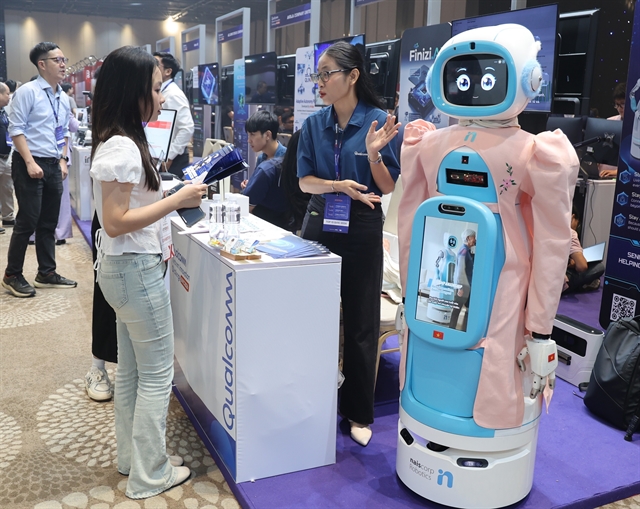 |
| Visitors learn about a robotic elderly care model at Qualcomm’s booth at the International Innovation Forum and Exhibition 2026 (InnoEx). — VNA/VNS Photo Hứa Chung |
For 2031–2035, the project aims to maintain digital monitoring and evaluation for 100 per cent of programmes and raise the share of tasks that produce results protected by intellectual property rights or publications in reputable international outlets to at least 50 per cent.
Business-led or business-coordinated commissioned tasks are expected to account for at least 60 per cent of the total, with businesses providing at least 50 per cent of their funding.
The number of research groups meeting international standards is expected to reach at least 50. This includes groups established in the previous phase that continue operating and upgrade their capabilities.
The project also targets the completion and industrial-scale commercialisation of at least 50 key national products and strategic technology products that are internationally competitive.
At least 30 businesses are expected to master strategic technologies and products, with at least 10 having products integrated into global value chains. The project also aims to support the establishment of at least 500 innovative start-ups.
Promoting innovative start-ups and research commercialisation
For 2026–2030, the project aims to support the testing, application and scaling up of at least 150 innovative start-up products, services and solutions. It will also support 150 businesses in refining production processes and developing manufacturing prototypes. Both targets are set to rise to 300 for 2031–2035.
Investment attracted by innovative start-ups in the two phases is expected to reach at least 100 per cent and 120 per cent, respectively, of the total state budget allocated to the National Project on Innovative Entrepreneurship.
The project also calls for support to refine technologies, assess their readiness, establish and protect intellectual property rights, and develop their commercial value. It encourages the development of intermediary organisations, platforms connecting technology supply and demand, and technology transaction platforms. — VNS
Sci-Tech
 Sci-Tech
 Sci-Tech
 Sci-Tech
 Sci-Tech
 Sci-Tech
 Sci-Tech
 Sci-Tech
 Sci-Tech
 Sci-Tech
 Sci-Tech
 Sci-Tech
 Sci-Tech
 Sci-Tech
 Sci-Tech