 Sci-Tech

Việt Nam's top leader sends condolences to Spain over deadly train accident
1.
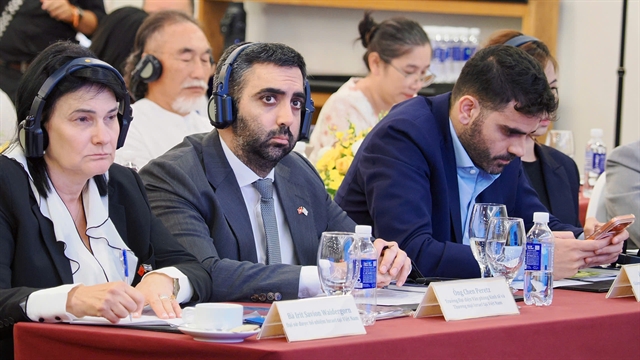 |
| Israeli delegates attend a seminar on technology cooperation under the Việt Nam-Israel Free Trade Agreement (VIFTA). — Photo courtesy of the organisers |
HCM CITY — The Việt Nam-Israel Free Trade Agreement (VIFTA) is opening up opportunities for deeper technological cooperation, with experts urging businesses to move beyond purchasing equipment towards joint research, technology development and commercialisation.
The issue was discussed at a seminar entitled “From Technology Cooperation to Value Chain Development: Promoting VIFTA’s Role in Enhancing Việt Nam’s Manufacturing Capacity”, organised by Industry and Trade Magazine on October 29.
With the agreement in force since November 17, 2024, bilateral cooperation has expanded beyond goods trade to investment, innovation and manufacturing development. However, participants said the long-term benefits would depend on Việt Nam’s ability to absorb, adapt and gradually master advanced technologies.
According to Lê Thái Hòa, commercial counsellor in charge of the Việt Nam Trade Office in Israel, bilateral trade has maintained strong growth since VIFTA took effect.
Trade between the two countries reached US$3.25 billion in 2024, up nearly 21 per cent year on year, before rising to $3.63 billion in 2025.
In the first 10 months of 2026, two-way trade totalled $3.5 billion and was projected to reach approximately $4.4 billion for the full year.
Việt Nam’s exports to Israel also increased, from $795 million in 2024 to $865 million in 2025. Export turnover exceeded $1 billion in the first 10 months of 2026 and was expected to reach around $1.3 billion for the year.
Beyond tariff preferences, the implementation plan for VIFTA, approved by the Prime Minister in early 2026, provides a framework for authorities and businesses to undertake specific measures, including making better use of rules of origin and meeting technical requirements in the Israeli market.
Despite these positive developments, investment cooperation remains modest.
Israel has invested approximately $155 million in around 45 projects in Việt Nam, while Vietnamese investment in Israel has exceeded $78 million, focusing mainly on new technology research and venture capital.
Hòa said Israel’s challenging natural conditions, limited resources and relatively small domestic market had encouraged the country to place science, technology and innovation at the centre of its development strategy.
Israel hosts research and development centres operated by more than 400 multinational corporations, including Intel, Microsoft, Apple and Google.
Its strengths in artificial intelligence (AI), semiconductors, biotechnology, advanced agriculture and new energy offer potential areas for cooperation with Việt Nam.
In agriculture, Israeli technologies such as drip irrigation, soil-moisture sensors and precision farming could help Vietnamese producers conserve water, improve productivity and adapt to climate change.
In manufacturing, cooperation in electronics, automation and semiconductor components could help domestic businesses increase technological content and improve their position in global supply chains.
From buying technology to mastering it
Ngô Trí Long, an economic expert, said VIFTA’s value extended beyond tariff reductions and market expansion to opportunities for Vietnamese businesses to access, absorb and gradually master advanced technologies.
Israel has strengths in knowledge and innovation, while Việt Nam offers manufacturing capacity, a large business community and a growing demand for industrial modernisation.
These complementary advantages provide a foundation for cooperation beyond conventional goods trading.
However, Long stressed that purchasing machinery, equipment or software did not necessarily mean a company had mastered the underlying technology.
While imported technologies could improve productivity and product quality, they might not provide businesses with the capabilities to design, modify or develop new products independently.
“Free trade agreements between Việt Nam and Israel create opportunities, but those opportunities do not automatically translate into competitiveness,” he said.
To achieve sustainable improvements in manufacturing, cooperation should include joint research, product development, workforce training and the commercialisation of research results.
Long also called for greater participation by small and medium-sized enterprises (SMEs), research institutions and domestic suppliers.
The application of new technologies can generate demand for locally supplied components, technical services and maintenance.
Meanwhile, digital management systems, improved quality control and more efficient material use can help SMEs enhance their competitiveness.
Strengthening these domestic links would enable the benefits of technology cooperation to spread beyond individual businesses to supporting industries and the wider economy.
 |
| Israeli Minister of Economy and Industry Nir Barkat (right) and Lê Thái Hòa, Vietnamese Commercial Counsellor in Israel. — VNA/VNS Photo |
Building long-term partnerships
Chen Peretz, commercial counsellor and head of the Israel Economic Office in Việt Nam, said Israeli companies were showing increasing interest in the Vietnamese market.
Some had employed Vietnamese information technology teams to develop products, while others were exploring Việt Nam’s manufacturing capabilities and consumer market.
The longer-term objective, he said, should be to connect these activities, enabling businesses from both countries to jointly develop products, manufacture them in Việt Nam and serve domestic, regional and global markets.
VIFTA provides a useful starting point, but building substantive partnerships will require sustained efforts and patience, he added.
Hòa proposed three priorities for translating the agreement’s potential into practical results.
First, Việt Nam and Israel should improve the implementation of VIFTA and make fuller use of tariff preferences while improving logistics and transport routes to reduce trade and investment costs.
Second, the two countries should strengthen scientific and technological cooperation through intergovernmental mechanisms and the joint committee established under the agreement.
The focus should shift from selling technology products to joint research, co-development, commercialisation and technical training in Việt Nam.
Third, both sides should build stronger business networks and introduce more flexible financing mechanisms.
Joint research funding, leasing arrangements and usage-based payment models could help companies access suitable technologies without facing excessive upfront costs.
Long also emphasised the need to link technology transfer with workforce training, joint research and the development of domestic suppliers.
Stronger cooperation between businesses, universities and research institutions would help address gaps in research capacity and commercialisation.
Overcoming barriers to cooperation
Despite the potential, Vietnamese businesses remain cautious about entering the Israeli market because of security and political uncertainties in the Middle East, as well as differences in business culture and cooperation practices.
Hòa noted that Vietnamese companies often preferred proven technologies that could be applied immediately, whereas Israeli businesses were more inclined to offer integrated solutions or seek partners for joint research and development.
Intellectual property rights, technical standards, legal procedures and technology-transfer requirements also present challenges.
To address these issues, the Việt Nam Trade Office in Israel will continue supporting businesses in making use of VIFTA preferences, expanding exports of agricultural and processed seafood products, coffee and consumer goods, and improving logistics connections.
In technology cooperation, the priority will be to connect Vietnamese businesses with Israeli partners for joint research, commercialisation and workforce training, particularly in AI, cybersecurity, semiconductors, medical technology and advanced agriculture.
More flexible financing and closer collaboration between the private sector, academia and government agencies will also be important in reducing costs and encouraging long-term investment.
Ultimately, the success of Việt Nam-Israel cooperation under VIFTA will depend not only on trade growth or the number of imported machines, but also on how many Vietnamese businesses can improve their technological capabilities, create greater domestic value and participate more deeply in global supply chains. — VNS
Sci-Tech
 Sci-Tech
 Sci-Tech
 Sci-Tech
 Sci-Tech
 Sci-Tech
 Sci-Tech
 Sci-Tech
 Sci-Tech
 Sci-Tech
 Sci-Tech
 Sci-Tech
 Sci-Tech
 Sci-Tech
 Sci-Tech