 Sci-Tech

HKSTP Partners with Leading Science and Technology Company Merck to Open a New Chapter in I&T Collaboration
1.
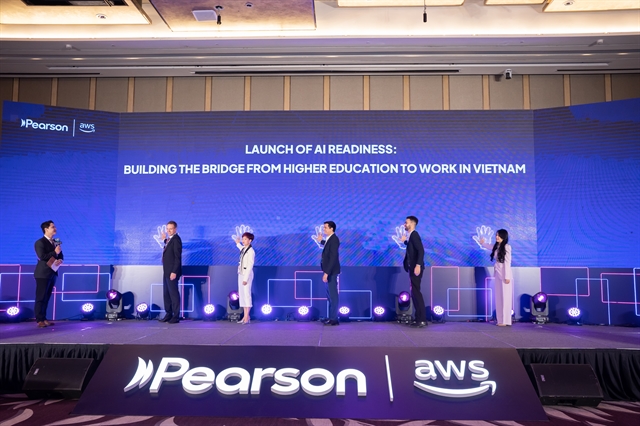 |
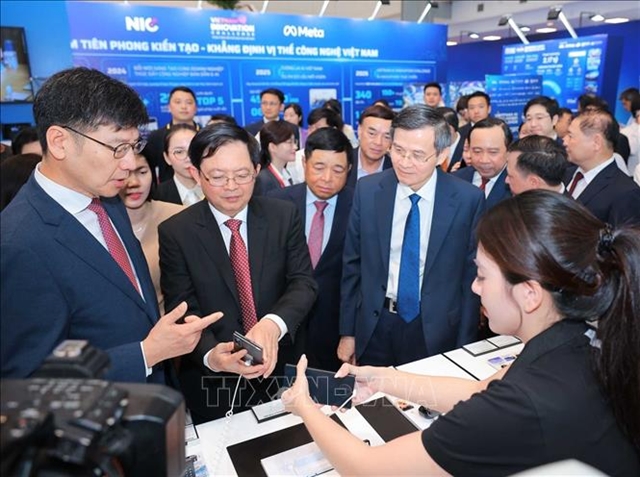
| Participants at the report launching on Tuesday in Hà Nội. — Photo courtesy of Pearson |
HÀ NỘI — Việt Nam is accelerating the adoption of artificial intelligence (AI) in higher education, but a significant gap remains between students’ confidence in using AI and employers’ assessment of their ability to apply it effectively at work, according to a new study by Pearson and Amazon Web Services (AWS).
The Pearson-AWS AI Readiness Report, launched in Hà Nội on Tuesday, found that 96 per cent of surveyed higher education leaders in Việt Nam said their institutions were investing in AI, while more than 52 per cent of students rated their readiness to work in an AI-enabled environment at 8-10 out of 10.
However, only 15 per cent of employers rated recent graduates as “excellent” in eight key areas, including technical knowledge, adaptability, AI tool use, creativity, practical application of academic knowledge, continuous learning, communication and collaboration and critical evaluation of AI outputs.
The study surveyed 402 respondents in Việt Nam – including 301 students, 50 university leaders and faculty members, and 51 employers and business leaders – as part of research covering six markets, including Brazil, Malaysia, Saudi Arabia, the UK, the US and Việt Nam.
From AI access to AI application
Việt Nam was classified as a “High-Velocity Strategist”, a group of markets treating AI as a strategic priority and investing heavily in the technology.
The pace of AI-driven change is particularly striking. Some 90 per cent of Vietnamese university leaders surveyed said workplace changes driven by AI were happening “extremely fast” or “very fast”, 23 percentage points above the global average of 67 per cent. All surveyed academic leaders expected the pace to accelerate over the next two years.
Yet investment alone has not ensured that universities are keeping pace.
Brett Blumenthal, Pearson’s Regional Teacher Development Manager for Southeast Asia, said only 28 per cent of institutions surveyed were keeping up with all AI developments.
“The question is not whether AI deserves attention,” he said, but what learners should be able to do with AI, how they can practise those skills and how meaningful work can be assessed.
The report defines an AI-ready graduate through four connected capabilities: functional AI proficiency, critical human skills, ethical stewardship and strategic intelligence. This means graduates need not only to use AI tools, but also to communicate and collaborate, think critically, assess limitations and bias, and understand where AI can add value in real-world tasks.
The findings point to a clear difference between students’ confidence and employers’ expectations.
Among Vietnamese employers surveyed, 43 per cent cited poor AI habits, including over-reliance on AI outputs and weak verification and fact-checking. Another 37 per cent pointed to limited practical experience among recent graduate hires, while 35 per cent cited over-reliance on AI tools.
Only 8 per cent of employers rated graduates as “excellent” at critically evaluating AI outputs.
The challenge is not unique to Việt Nam. Globally, 53 per cent of employers surveyed said they struggled to find recent graduates with AI skills that meet workplace requirements.
“Employers are increasingly looking for graduates who can combine technical knowledge with critical thinking, communication skills, adaptability, and the ability to apply what they’ve learned in real-world settings,” said Joshua Ashworth, head of Trade and Investment at the British Embassy in Việt Nam.
Closer university-business links
The report identifies university-business cooperation as an important starting point. Some 84 per cent of higher education leaders surveyed said their institutions regularly engaged with employers to understand market needs.
The next step, however, is to involve employers more directly in curriculum and assessment design.
Blumenthal suggested that universities and businesses could jointly develop authentic workplace tasks, such as requiring students to use AI to prepare a proposal, verify its claims, identify limitations and explain their recommendations.
The report recommends three practical priorities – co-designing learning outcomes and assessments with employers, creating more opportunities for students to practise AI through realistic workplace tasks, and strengthening faculty capacity to teach and assess applied AI use.
The report therefore suggests that the next challenge for Việt Nam is not simply expanding access to AI tools, but ensuring students can use them responsibly and effectively to solve real-world problems. — VNS
Sci-Tech
 Sci-Tech
 Sci-Tech
 Sci-Tech
 Sci-Tech
 Sci-Tech
 Sci-Tech
 Sci-Tech
 Sci-Tech
 Sci-Tech
 Sci-Tech
 Sci-Tech
 Sci-Tech
 Sci-Tech
 Sci-Tech