 Society
Ninh Bình establishes world's largest Delacour's langur sanctuary
1.
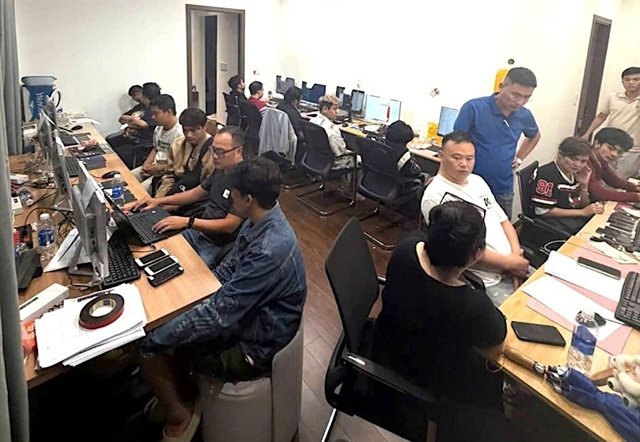 |
| A group of foreigners running a scam was uncovered shortly after they arrived in Đà Nẵng to carry out their operations. — Photo from the police |
ĐÀ NẴNG — Police in the central city Đà Nẵng have uncovered an alleged online fraud operation run from a rented villa, arresting 13 foreign nationals suspected of targeting victims in Indonesia through romance scams and fake online shopping tasks.
The group comprised two Chinese nationals and 11 Indonesians, who allegedly used dozens of mobile phones and computers, along with messaging applications WhatsApp and Telegram, to approach Indonesian victims, establishing romantic relationships and the persuading them to invest money or complete online tasks.
The city’s Criminal Police Division said on November 4 that it had coordinated with relevant units to investigate the operation after receiving information from Điện Bàn Đông Ward Police about suspicious activities at a villa in the Regal Victoria urban area.
A joint inspection found the 13 foreigners using computers and electronic devices for activities showing signs of online fraud.
Preliminary investigations identified Xiong Zhouhua, born in 1993 and a Chinese national, as the ringleader.
He allegedly assigned Adity Aldi Pratam, an Indonesian national born in 2001, to supervise and manage the 10 other Indonesian members. Another Chinese national, Huang Shuo, born in 1992, was reportedly hired to handle cooking, shopping, and other logistical and daily needs for the group.
Investigators said Xiong entered Việt Nam from China in late August 2026 before travelling to Đà Nẵng City to establish the online fraud operation.
On September 9, he rented a villa in the Regal Victoria urban area, equipped it with an internet connection, 12 desktop computers, and 87 mobile phones.
He subsequently recruited 11 Indonesian nationals to work in Việt Nam, arranging their accommodation at the villa while seizing their passports.
The initial investment in personnel, equipment, customer data, accounts and operational expenses was estimated at around US$60,000, according to investigators.
To motivate the recruits, Xiong offered a monthly salary of US$700 and an additional $200 attendance bonus. However, workers who failed to meet revenue targets faced fines ranging from $400 to $1,000.
Those generating revenue of at least $10,000 were promised commissions of between 5 and 13 per cent, with remuneration directly linked to the amount of money obtained from victims.
The Indonesian members were divided into five teams of two, operating under Adity's supervision.
Following a script devised by Xiong, they used WhatsApp and Telegram to contact potential victims, strike up conversations and build trust. Some allegedly impersonated women to establish romantic relationships with their targets.
Once trust had been established, the victims were encouraged to visit websites, register accounts, and deposit money to complete online shopping orders in exchange for commissions.
The scheme initially allowed victims to recover their deposits along with small commissions, creating the impression that the platform was legitimate and encouraging them to invest larger sums.
When victims increased their deposits, the scammers allegedly introduced various excuses to demand additional payments. They also interfered with the system to prevent victims from withdrawing their money, eventually appropriating the funds.
Investigators said Xiong had established two separate Telegram groups to manage the flow of money.
One group supplied Indonesian bank accounts to receive transfers from victims, while the other handled purported refunds to maintain the appearance of legitimate transactions.
Adity acted as an intermediary, distributing bank account details to team members, collecting transaction receipts and reporting directly to Xiong.
After victims transferred money, transaction details were uploaded to an internal group. Members whose identities have not yet been established allegedly used automated Telegram tools to convert Indonesian rupiah into the cryptocurrency USDT.
At the end of each day, the group's receipts and expenditures were consolidated, converted into USDT and transferred to a cryptocurrency wallet controlled by Xiong.
The Criminal Police Division is continuing its investigation into the case and handling of those involved. — VNS
Society
 Society
 Society
 Society
 Society
 Society
 Society
 Society
 Society
 Society
 Society
 Society
 Society
 Society
 Society