 Society
Đồng Tháp promotes OCOP products to boost rural economy
1.
 |
| Children in Bồng Lai Village, Quảng Trị Province's Bố Trạch Commune. Since the village was connected to the national power grid in 2020, life has been much improved thanks to power stability. Photo courtesy of the EU |
Nguyễn Khánh Chi
QUẢNG TRỊ - Hoàng Văn Thảo hopped off his electric motorbike and hurried inside to welcome a group of visitors at his home in Bồng Lai Village, in Quảng Trị Province’s Bố Trạch Commune.
Instead of crouching over a charcoal stove to boil water for tea, he walked to an automatic hot-water dispenser in a corner of his spacious two-storey concrete house and filled the cups within seconds.
“Now that the electricity supply is stable, we can use them all,” Thảo said, gesturing around the house.
“We have a washing machine, refrigerator and air conditioner, along with everyday appliances such as a television, gas stove and induction cooktop.”
The 56-year-old's family is among 412 households, representing up to 1,571 residents in the village, that have benefited from a rural electrification project implemented in Quảng Trị Province between 2014 and 2020.
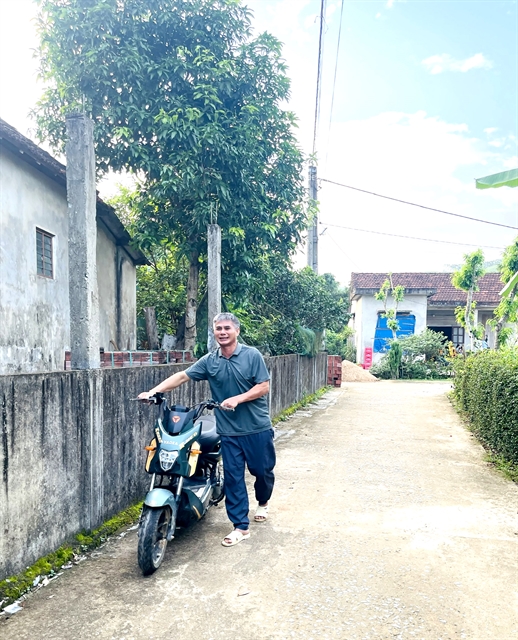 |
| Hoàng Văn Thảo, 56, with his family's electric bike. Stable electricity supply has enabled him to equip the family with multiple electrical devices. VNS Photo Khánh Chi |
Under the sub-project, which had a total investment of nearly VNĐ73 billion (US$2.83 million), around VNĐ60 billion was provided through non-refundable EU funding, with the remainder contributed by the provincial government as counterpart capital.
Implemented in 2019–2020, the project supported the expansion and upgrading of electricity infrastructure in six communes across former Bố Trạch and Minh Hòa districts. Key investments included 10.35km of medium-voltage power lines, 84.91km of low-voltage lines, 16 new transformer substations with a combined capacity of 2,200 kVA, and the upgrading or relocation of five existing substations.
“Through the Vietnam – EU Sustainable Energy Transition Programme, the province has achieved many positive results in renewable energy development and the expansion of electricity supply infrastructure in rural and mountainous areas,” said Deputy Chairman of the Provincial People’s Committee Lê Đức Tiến.
“Extending the national power grid and bringing clean energy sources to villages and hamlets have significantly improved local people's living conditions and livelihoods while laying a solid foundation for green economic development and greenhouse gas emission reduction in line with the Government's overall objectives.”
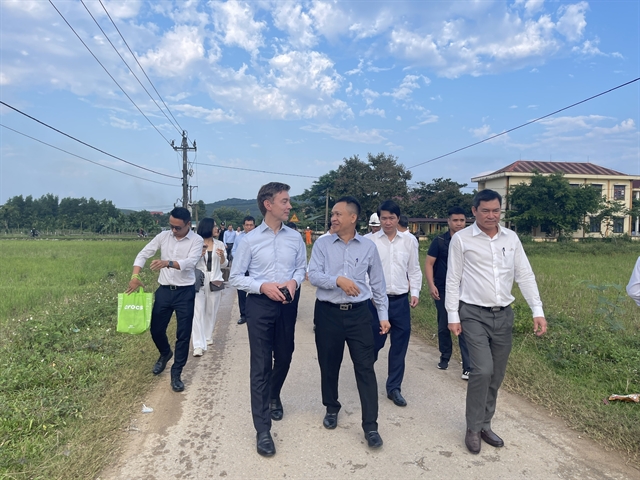 |
| EU Ambassador to Việt Nam, Julien Guerrier (front, left) and Deputy Minister of Industry and Trade Nguyễn Việt Sơn conduct a site visit to Bồng Lai Village in October, 2026 to examine electricity supply there. VNS Photo Khánh Chi |
Over the years, the EU and Team Europe have been key partners in supporting rural electrification in Việt Nam, particularly in remote, mountainous and island areas.
In the 2018-2020 period, the EU has invested in the Energy Sector Policy Support Programme 108 million euros ($120.8 million) to provide sustainable energy in rural Việt Nam in the 2018 – 2020 period.
“This programme aimed to provide electricity access for up to 1.2 million Vietnamese households, including in particular in remote areas, and to expand electrification to around 750 villages across the country,” said the EU Ambassador to Việt Nam, Julien Guerrier, during a recent site visit to Bồng Lai Village.
“It's a very rewarding project because we can see the happy faces of the villagers who have now access to electricity in a stable manner. It's benefiting their daily life, but also their businesses and their farming capacity.
“I think we can be proud of what has been achieved here in Quảng Trị and in so many other provinces. Through the electrification of the countryside, we've been able to improve the life of communities, including in rural areas and in remote parts of the country.”
For father of three Thảo, quality of life has been much improved not only thanks to electricity but also to the advanced economic development and transport system in the locality.
“The electricity is very reliable, and we can use it comfortably," he said.
"Since electricity became available in 2020, our quality of life has improved because the economy has also developed, and transportation has become more convenient.”
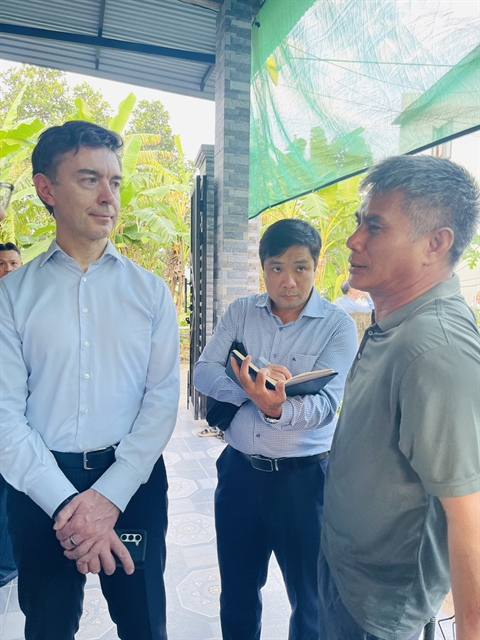 |
| Hoàng Văn Thảo (right) speaks to the EU Ambassador to Việt Nam, Julien Guerrier about his living standards which have been much improved thanks to stable electricity supply. VNS Photo Khánh Chi |
“In the past, the electricity supply was unstable, and life was very difficult. Often we could only use lamps because the power kept going on and off. Now that we have reliable electricity, it is much easier for the children to study at night.
"The family can also enjoy watching television every evening, which broadens our knowledge.
“Before, we used to go to bed around 8 or 9pm. Now, with electricity, we watch TV or use our phones until 10 or 11pm.”
In addition to household use, his family also uses electricity to power two water pumps for agricultural production, mainly for irrigation of their pepper, tea, acacia and melaleuca plantations. With all these devices, the family spends about VNĐ700,000-800,000 ($27-31) on electricity each month.
As head of Bồng Lai Village, Nguyễn Văn Sơn, has witnessed firsthand life before and after local power was connected to the national grid.
"Before the project, local communities faced many challenges due to an unstable electricity supply," said Sơn.
"Since being connected to the national power grid, residents have gained access to a safer, more stable, and more reliable source of electricity. This has significantly improved both living conditions and economic opportunities throughout the area."
According to the village head, the power supply has enabled households to purchase and use modern appliances such as televisions, refrigerators and other electrical equipment with greater confidence.
At the same time, stable electricity has supported the expansion of agricultural production, livestock farming, and small businesses, encouraging residents to invest in income-generating activities.
Sơn added: "In the past, power outages were frequent, often caused by tree branches coming into contact with the power lines, leaving entire communities without electricity overnight.
"Today, thanks to the upgraded electricity network, such disruptions have become rare, providing residents with a much more dependable source of power."
These improvements have translated into tangible economic benefits. Average annual income has increased from approximately VNĐ38 million ($1,476) to around VNĐ65 million ($2,520) per person, reflecting the positive impact of reliable electricity on local livelihoods and economic development.
Despite these efforts, provincial authorities have reported that electricity is still out of reach in some parts of Quảng Trị Province due to terrain challenges.
The locality is calling for the Ministry of Industry and Trade to allocate certain funds for projects to help connect these areas to the national power grid.
According to the Quảng Trị Department of Trade and Industry, currently, 19 villages and hamlets in Quảng Trị have no connection to the national grid, while 18 villages and hamlets have electricity supply that does not meet the requirements.
That equates to 832 households without grid electricity, and 243 households supplied by systems that do not meet the requirements. VNS
Society
 Society
 Society
 Society
 Society
 Society
 Society
 Society
 Society
 Society
 Society
 Society
 Society
 Society