 Society

Việt Nam always attaches importance and gives top priority to relations with Laos: Key leader
1.
|
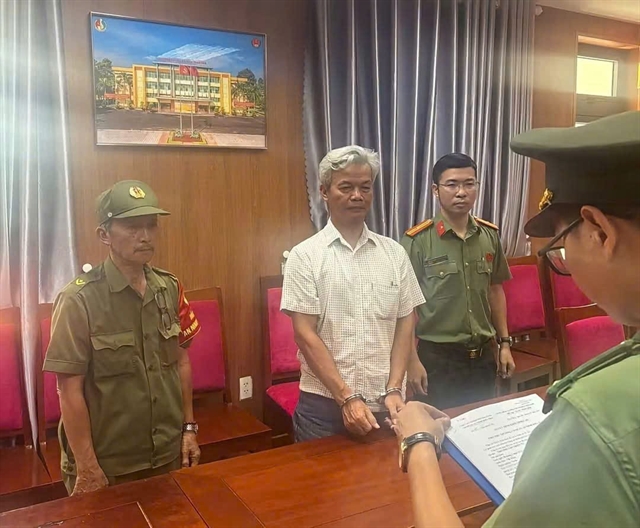
| 56-year-old Trương Văn Thiên Tư, director and investor of Thiên Lập Nhân English Centre, was detained on October 14. — Photo from the police |
ĐÀ NẴNG — Đà Nẵng's authorities said they are reviewing the operations of foreign language centres across the central city after the director of Thiên Lập Nhân English Centre was arrested for allegedly defrauding parents through an unauthorised full-time education programme marketed under the name of a United States-based international school.
The city’s Department of Education and Training said on Tuesday that it would step up inspections of foreign language and IT centres, while working with local authorities to ensure that 200 children previously enrolled at Thiên Lập Nhân centre could return to mainstream education.
Trương Văn Thiên Tư, born in 1970, director and investor of Thiên Lập Nhân English Centre, was arrested and placed in temporary detention on October 29 for investigation into alleged property appropriation through fraud, under Article 174 of the Penal Code, according to the Đà Nẵng Police's Security Investigation Agency.
Initial investigation findings showed that the centre, which was licensed to provide English language training for children and teenagers, had no authorisation to teach the national general education curriculum or conduct education and training partnerships with foreign institutions.
However, investigators said Tư had organised full-time schooling under the name Prinberk Academy, following a homeschooling model, for more than 200 children aged between five and 16 from 2019. Tuition fees ranged from VNĐ7 million to VNĐ8 million (US$270–310) per student per month.
Tư allegedly introduced himself as the principal of Prinberk Academy, which he claimed was based in Huntington Beach, California, and promoted the programme through commitments concerning its curriculum, academic records and opportunities for students to transfer to overseas education institutions.
Investigators said he provided misleading information to gain parents' trust, persuading a number of families to withdraw their children from regular schools and enrol them in the programme.
To conceal the unauthorised educational activities, Tư allegedly instructed that receipts be issued under descriptions such as “educational support” and “physical development and recreational activities”.
Centre previously inspected and penalised
According to Đà Nẵng's education department, Thiên Lập Nhân English Centre was established in 2017 under a licence to provide English language programmes for young learners. It operated three facilities on Hải Phòng, Văn Tiến Dũng, và Nguyễn Tất Thành
The department received a public complaint on August 28, 2024, concerning the Nguyễn Tất Thành site, where it was allegedly operating without the required authorisation.
Following a meeting with Tư, the department examined issues including the use of the Prinberk Academy curriculum, the teaching of lower and upper secondary school students, and the organisation of full-day schooling and boarding services.
Inspections conducted on October 16 and November 15, 2024, at the centre's facilities found violations, prompting the department to require it to stop assigning teaching duties to teachers who did not meet the required qualifications, make its operational information public, protect the rights of employees and learners, and discontinue boarding activities.
The centre was also subject to administrative penalties and subsequently completed the required corrective measures and complied with the penalty decision.
On November 29, 2024, the department coordinated with Đà Nẵng Police to work with Tư, requesting that he clarify to parents the relationship between Thiên Lập Nhân English Centre and Prinberk Academy, which were separate entities, and review written commitments to avoid confusion over the programmes and teaching content.
In January 2025, the department again instructed the centre to disclose relevant information, revise its commitments to parents and ensure its operations complied with regulations.
The department issued a decision to dissolve the centre on January 7, 2026, following a proposal from the establishment.
Measures to safeguard students' education
In response to concerns over the educational rights of children previously attending the centre, the department said it would instruct commune- and ward-level authorities to review school-age children living in their localities, particularly primary and lower secondary school pupils who were not enrolled in mainstream educational institutions.
Local authorities would advise parents and guide them through enrolment procedures at schools near their residences to ensure children's right to education and compliance with compulsory education requirements.
The department also said it regularly coordinated with local authorities and relevant agencies to monitor foreign language and IT centres, detect violations and take appropriate action.
Such centres are required to submit reports every six months on enrolment, training activities, teaching staff, curricula and tuition fees.
In 2024, the department inspected 16 foreign language centres, handled complaints involving four foreign language centres and one life-skills centre, temporarily suspended two centres and dissolved 10 establishments that failed to meet operating requirements.
In 2025, it inspected 18 centres, addressed complaints involving two centres and dissolved 19.
As of October 30, 2026, the education sector had inspected 10 centres, handled seven complaints and dissolved 122 centres that did not meet the required operating conditions.
The department said strengthened inspections and supervision were aimed at bringing non-public educational establishments into compliance, protecting learners' interests and ensuring parents had adequate information when choosing educational programmes and providers. — VNS
Society
 Society
 Society
 Society
 Society
 Society
 Society
 Society
 Society
 Society
 Society
 Society
 Society
 Society