 Society
Construction ministry proposes investment in equipment to counter illegal UAVs near airports
1.
|
|
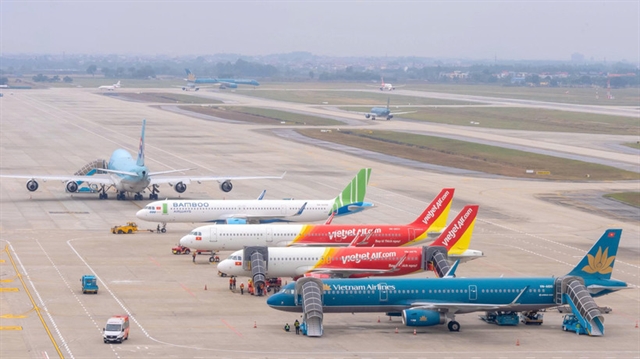
| Airplanes at Nội Bài International Airport, Hà Nội. — VNA/VNS Photo |
HÀ NỘI — The Ministry of Construction has proposed investing in equipment to detect and suppress unauthorised unmanned aerial vehicles (UAVs) near airports, as illegal drone operations continue to pose potential threats to aviation safety.
In a document sent to the Ministry of Public Security reviewing the implementation of aviation security regulations, the ministry said unauthorised UAV activities around airports had become increasingly complex, with violations of restricted and prohibited flight zones potentially bringing drones into aircraft operating areas.
Such incidents could threaten aircraft during take-offs and landings, disrupt airport operations and potentially lead to serious consequences.
The forms of violations have also become more diverse. Besides unmanned aircraft, kites and illuminated kites have posed additional challenges for detection, locating those responsible and handling violations.
Disruptions caused by such incidents can last for extended periods, reaching up to four hours in some cases. Airports affected include Cát Bi, Nội Bài, Đà Nẵng, and Tân Sơn Nhất international airports, where flights have had to circle in holding patterns, conduct go-arounds, divert to alternative airports or delay departures while remaining on the ground.
These incidents not only disrupt aviation operations and cause concern among passengers but also result in financial losses for airlines.
Coordination mechanisms strengthened
To address the risks, the Civil Aviation Authority of Việt Nam issued Decision No. 824 on April 24, 2026, providing guidance on coordination in receiving and verifying reports and handling aircraft operating in prohibited and restricted zones around airports.
The guidance establishes unified reporting channels, coordination mechanisms and response procedures. It also specifies conditions for temporarily suspending airport operations and the criteria for resuming normal services.
The measures are intended to help aviation authorities and relevant units respond more proactively and coordinate effectively, minimising the time airports must suspend aircraft arrivals and departures while maintaining safe and continuous flight operations.
Further coordination efforts were introduced on August 29, 2026, when agencies and enterprises under the ministries of public security, construction and finance issued regulations on detecting, handling and suppressing unmanned aircraft and other flying devices around airports.
The regulations aim to improve coordination and strengthen the responsibilities of agencies at both central and airport levels in carrying out their assigned duties.
They are also intended to help relevant forces address practical difficulties in detecting and responding to UAV incidents, while strengthening security and public order around airports and preventing related criminal activities and legal violations.
Under the Government's direction, ministries, sectors and localities hosting airports have also introduced a range of preventive measures.
These include public awareness campaigns through mass media and social media platforms, tighter management of UAV equipment in localities, and the deployment of equipment to detect unauthorised drones at an early stage and from a distance.
Police and military forces have also stepped up efforts to identify and track individuals operating UAVs in violation of regulations.
According to the Ministry of Construction, these measures have produced positive results and received public support. No recurrence of unauthorised UAV activities around airports has been recorded recently.
However, the ministry stressed that preventive measures, detection and enforcement must be maintained on a regular and continuous basis to sustain these results.
Investment in detection and suppression equipment proposed
Despite the progress, the ministry acknowledged several shortcomings in implementation.
The involvement of multiple forces in handling incidents has sometimes prolonged response times. Kite-flying activities, including the use of illuminated kites and sky lanterns, also remain a concern and require further public awareness efforts.
Meanwhile, existing equipment and facilities for detecting and handling UAV violations have yet to fully meet practical requirements.
To improve the effectiveness of prevention and response, the ministry proposed continuing to implement existing regulations while reviewing and revising coordination procedures for handling unauthorised UAV activities.
It also called for specific response protocols to be developed for individual airports, taking into account their geographical characteristics, natural conditions and the capabilities of locally deployed forces.
Local authorities were urged to intensify communication campaigns on UAV management regulations and aviation security requirements, targeting organisations, businesses and residents.
Particular attention should be given to schools and residential communities surrounding airports, with regular and continuous awareness campaigns to prevent violations before they occur.
The ministry also proposed that relevant authorities invest in equipment to detect and suppress UAVs and other flying devices entering prohibited flight zones.
Police forces should work closely with relevant agencies to investigate violations and strictly handle those responsible, it said. — VNS
Society
 Society
 Society
 Society
 Society
 Society
 Society
 Society
 Society
 Society
 Society
 Society
 Society
 Society
 Society