Construction ministry proposes investment in equipment to counter illegal UAVs near airports
1.

|
| Nguyễn Khắc Lịch, head of the Department of Digital Technology and Artificial Intelligence. — Photo from the Ministry of Science and Technology |
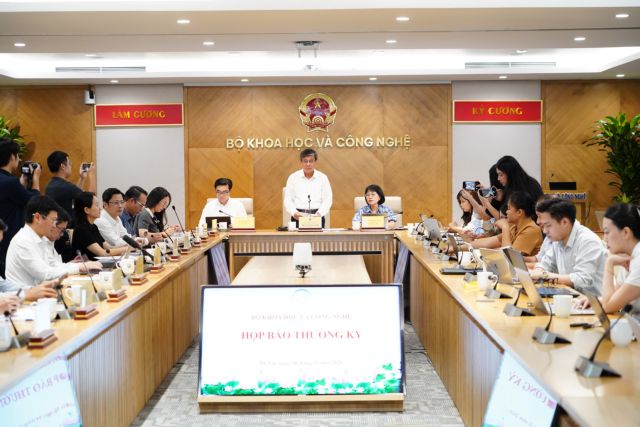
HÀ NỘI — Imports of second-hand smartphones, computers and other digital devices will be restricted from next year to prevent Việt Nam from becoming a destination for foreign electronic waste, according to an official from the Ministry of Science and Technology (MST).
Nguyễn Khắc Lịch, head of the ministry's Department of Digital Technology and Artificial Intelligence, made the statement at the MST's regular press briefing on Wednesday.
The ban also aims to mitigate risks to information security and personal data leaks from hardware devices of unknown origin that may have been technically modified, reduce fire and explosion hazards posed by degraded components and batteries and ensure compliance with national technical standards and radio frequency regulations, he said.
A circular recently issued by the MST details a list of used digital technology products banned from import and will take effect from 2027.
The list covers a wide range of familiar electronic devices, including computers, smartphones and equipment for transmitting or receiving voice, images and data over wired or wireless networks.
It also includes many devices used for work and entertainment, such as microphones, speakers, headphones, digital cameras, television cameras, radio or television transmitters and receivers, radars, navigation equipment and radio remote-control devices.
The list also covers monitors, projectors and electronic components and materials, including printed circuits, integrated electronic circuits, electronic tubes, electrical wires, power cables, fibre optic cables, telephone cables and telegraph cables.
Printers, copiers, fax machines and their accessories are also subject to the import ban, with certain exceptions.
Lịch said the regulation was introduced to protect consumers and develop the domestic market.
According to Lịch, the new regulations are not intended to restrict manufacturing and business activities, but rather to control the quality of imported equipment, protect consumers, ensure information security and promote the healthy development of Việt Nam's domestic digital technology market.
Amendments to measurement law
At the press conference, Trần Hậu Ngọc, vice chairman of the Commission for Standards, Metrology and Quality, said that after 15 years of implementation, the Law on Measurement had made important contributions to socio-economic development.
However, practical requirements now necessitate amendments and supplements to several provisions to keep pace with digital transformation, technological development and administrative reform.
The draft law amending and supplementing a number of articles of the Law on Measurement aims to promote digital transformation by developing a shared metrology database, recognising the legal validity of electronic certificates, gradually shifting from pre-inspection to post-inspection, and introducing risk-based management, he said.
It seeks to develop national metrology infrastructure, prioritising strategic technologies, the digital economy and the green economy. Businesses will be encouraged to voluntarily carry out measurement assurance programmes and may be considered for exemptions from or reductions in State inspections, he said.
The draft law also looks to accelerate decentralisation and simplify administrative procedures, reducing compliance costs for businesses while ensuring effective State management, preventing commercial fraud and protecting consumer rights, he said. — VNS
 Politics & Law
 Politics & Law
 Politics & Law
 Politics & Law
 Politics & Law
 Politics & Law
 Politics & Law
 Politics & Law
 Politics & Law
 Politics & Law
 Politics & Law
 Politics & Law
 Politics & Law