 Politics & Law

A taste of life as a pilot
1.
|
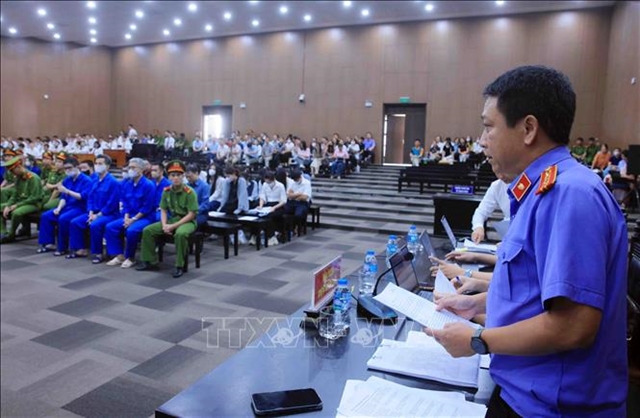
| A representative from the People’s Procuracy presents the indictment and proposes sentences for 188 defendants in the case involving Phó Đức Nam and his accomplices. — VNA/VNS Photo Phạm Kiên |
HÀ NỘI — The first-instance trial of 188 defendants in the case involving Phó Đức Nam, known as Mr Pips, and his accomplices moved into its adversarial phase on Wednesday, after more than a week of trial proceedings.
Prosecutors recommended that Nam be sentenced to life imprisonment for fraudulent appropriation of property and 11 to 12 years’ imprisonment for money laundering.
It was also recommended that Lê Khắc Ngọ, known as Mr Hunter, receive the same sentence: life imprisonment for fraudulent appropriation of property and 10 to 11 years’ imprisonment for money laundering, with a combined sentence of life imprisonment.
Defendant Nguyễn Thanh Phong, from Bến Cầu Commune, Tây Ninh Province, was recommended to receive eight to nine years’ imprisonment for fraudulent appropriation of property and five to six years for money laundering, with a combined sentence of 13 to 15 years’ imprisonment.
Nguyễn Thị Thủy, from Tam Thắng Ward, HCM City, was recommended to receive five years and eight months to seven years’ imprisonment for the two offences of money laundering and tax evasion.
Defendant Nguyễn Hòa Bình, also known as Shark Bình, was recommended to receive nine to 10 years ' imprisonment for money laundering.
Separately, defendant Phó Đức Tuấn, a cousin of Phó Đức Nam, was recommended to receive five to six years’ imprisonment for receiving property obtained through another person’s criminal act.
The remaining 177 defendants were recommended to receive sentences ranging from 30 months suspended to 20 years for the same offence of fraudulent appropriation of property.
Sophisticated fraud scheme
According to the People’s Procuracy, the defendants used tactics to lure victims into investing in international stocks and Forex, under a structured fraud process.
At the initial stage, the marketing department ran advertisements on social media platforms with appealing content designed to exploit viewers’ psychology, such as high-return investments, making money from home, and one-to-one support from international experts, in order to collect customer data.
People who left their details were screened and assessed for potential by sales staff, then passed to the business department.
After receiving this data, despite having no knowledge of finance or securities, the sales staff were trained using prepared scripts and posed as employees of major stock or Forex trading platforms.
The staff prepared carefully crafted, sophisticated communication content to lure victims, using a 168-question manual distributed to employees by the ringleaders.
Within these groups, numerous fake accounts posing as experts or successful investors continuously posted images of large trading profits, screenshots of transactions, money-transfer receipts, and videos of successful withdrawals, in order to create a herd effect and reinforce victims’ trust.
Victims were instructed to deposit a small amount of money to try the platform and were allowed to win; they could even withdraw funds quickly, creating the impression that the platform was reputable.
Once victims’ trust had been reinforced, defendants in the sales department guided them to create accounts on the trading platform and deposit money for investment. The support department then passed victims’ information to the customer-care department.
At this stage, the defendants continued to impersonate experts, urging victims to increase their capital with offers of investment opportunities and insider information.
As soon as victims deposited a large sum, the script for 'crashing' their accounts was put into action. When victims attempted to withdraw their profits, the advisers encouraged them to keep the money in the account to participate in larger investment opportunities, or used various tactics to delay withdrawals.
The defendants then exploited victims’ fear of losing money to continue manipulating and reassuring them, demanding further deposits to recover losses.
At the same time, they imposed fictitious fees, such as withdrawal fees, order-processing fees and taxes.
Victims became trapped in a cycle of continuous deposits until their finances were exhausted. When they could no longer deposit money, their accounts were rendered unable to place trades or were locked, while the supposed advisers cut off contact.
Devastating consequences
The indictment assessed that Mr Pips’s entire trading-platform system operated as a money-making machine, with each employee receiving one per cent to four per cent of the amount deposited by customers, creating an incentive to recruit and retain victims.
Through the sophisticated tactics described above, the defendants appropriated an especially large sum of nearly VNĐ1.5 trillion (US$60.8 million) from 919 victims.
The prosecutors assessed that the consequences of the defendants’ criminal acts were not limited to the money appropriated, but also included economic damage and the destruction of victims’ family happiness.
Many victims fell into debt, sold all their assets and homes, yet still remained in debt. Many marriages broke down and children lost opportunities for education. In particular, a number of victims had contemplated suicide as a way to escape their situation.
Given the serious and dangerous nature of the offences, the People’s Procuracy argued that bringing the defendants to trial rigorously was necessary to ensure deterrence and general prevention. — VNS
Politics & Law
 Politics & Law
 Politics & Law
 Politics & Law
 Politics & Law
 Politics & Law
 Politics & Law
 Politics & Law
 Politics & Law
 Politics & Law
 Politics & Law
 Politics & Law
 Politics & Law
 Politics & Law