 Politics & Law

Medicine prices must be controlled from imports to distribution
1.
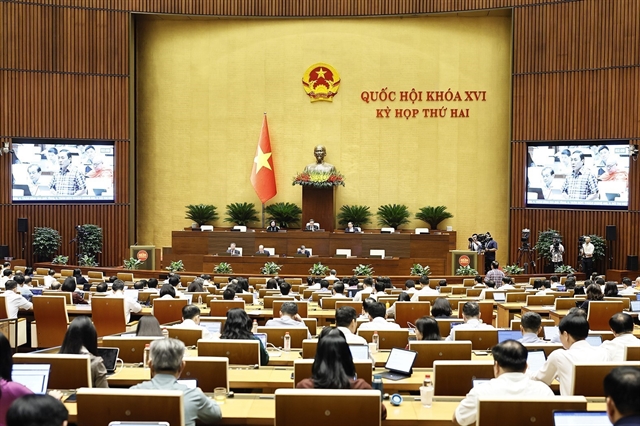 |
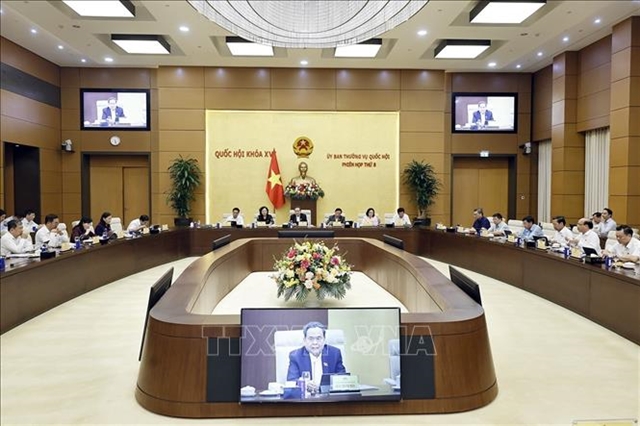
| Lawmakers attend a plenary session of the National Assembly on Tuesday. — VNA/VNS Photo Doãn Tấn |
HÀ NỘI — Lawmakers on Tuesday discussed amendments to four laws covering electricity, intellectual property, property auctions and compulsory asset requisition, calling for clearer emergency powers and stronger safeguards for property owners.
Proposed changes to the Law on Electricity aim to remove bottlenecks in power planning, investment and market operations, strengthen energy security and ensure reasonable, transparent electricity prices.
Amendments to the Law on Intellectual Property seek to simplify registration procedures, reduce business conditions and streamline state management.
During debate on the asset requisition law, National Assembly (NA) deputies called for commune-level authorities to be given clear powers to mobilise vehicles and equipment during disasters and other emergencies without waiting for higher-level approval when delays could cost lives.
NA deputy Dương Khắc Mai from Lâm Đồng Province backed granting commune chairpersons limited authority to requisition assets for disaster response, epidemic control and rescue operations when higher-level authorities could not reach affected areas.
He called for immediate notification to provincial authorities and clear rules on coordination, compensation and the return of assets.
Deputy Lò Thị Luyến, representing Điện Biên Province, said commune chairpersons should be able to act promptly when waiting for approval could cause damage or loss of life, while reporting their decisions to provincial authorities afterwards. She said the draft needed to clarify when higher-level authorities would be considered unable to access an affected area.
Đào Chí Nghĩa, a deputy for Cần Thơ City, highlighted difficulties in using machinery and vehicles when disaster-hit communities are isolated and owners could not be contacted.
He proposed allowing authorities to use assets after issuing a lawful requisition decision, provided their condition and the receiving agency's responsibilities were documented and owners notified as soon as possible.
Deputies also sought clearer limits on how long requisitioned assets could be retained. The draft allows extensions of up to 15 days each but sets no limit on the number of extensions.
Luyến warned that repeated extensions could keep assets out of their owners' hands for prolonged periods.
NA deputy Trần Đình Gia of Hà Tĩnh Province said lengthy requisitions could disrupt businesses and daily life, but rigid time limits might hamper defence and security operations.
Nghĩa said disaster response and epidemic control could require assets for weeks or months. He called for authorities to reassess the need, scope and duration of each requisition before approving an extension, while avoiding unnecessary administrative procedures.
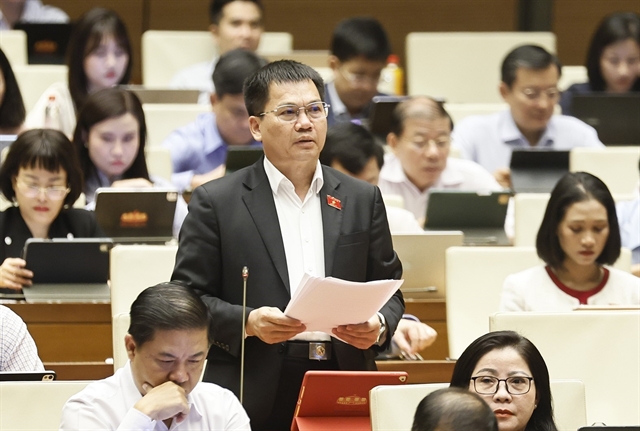 |
| NA deputy Dương Khắc Mai from Lâm Đồng Province speaking at the meeting. |
Minister of Finance Ngô Văn Tuấn said the amendments reflected changes in asset types and the shift to a two-tier local government model. Article 32 of the Constitution allows compulsory purchase and requisition only when absolutely necessary for national defence and security, national interests, emergencies or disaster response, with compensation based on market prices.
He said the ministry would study feedback and work with the reviewing agency to refine the draft.
In a separate debate on intellectual property, deputies called for clearer rules on copyright protection for works created with the help of artificial intelligence (AI).
NA deputy Nguyễn Trung Kiên of Đồng Nai City said AI platforms should not hold intellectual property rights, while protection for AI-assisted works should reflect the user's creative contribution.
He also called for rules distinguishing legitimate use of copyrighted material for research and AI training from unauthorised copying and commercial exploitation.
A NA deputy of Hải Phòng City, Nguyễn Ngọc Sơn, supported removing business conditions for intellectual property assessment services but said safeguards were needed to ensure reliable results, including assessor independence, conflict-of-interest controls and effective post-inspection.
In his response to lawmakers, Science and Technology Minister Vũ Hải Quân said the amendments aimed to simplify intellectual property registration and cut business conditions, while transferring oversight of plant variety rights from the agriculture ministry to his ministry.
The ministry would study proposals on AI, research commercialisation and technology transfer for possible inclusion in future revisions, he said.
He added that the removal of business conditions for intellectual property assessment services would be accompanied by post-inspection, information disclosure and greater accountability. Detailed rules on procedures, conflicts of interest and compensation would be set out in a Government decree.
The drafting agency said the changes must protect the legitimate interests of organisations and individuals without compromising the quality of intellectual property assessments. — VNS
Politics & Law
 Politics & Law
 Politics & Law
 Politics & Law
 Politics & Law
 Politics & Law
 Politics & Law
 Politics & Law
 Politics & Law
 Politics & Law
 Politics & Law
 Politics & Law
 Politics & Law
 Politics & Law
 Politics & Law
.jpg)
.jpg)