.jpg) Economy


Experts urge caution over proposed gold certificate scheme
1.
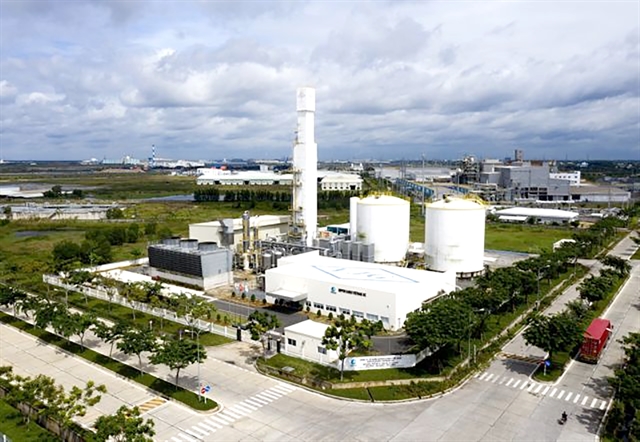 |
| A foreign-invested project in Phú Mỹ Specialised Industrial Park, Bà Rịa - Vũng Tàu Province. — VNA/VNS Photo |
HÀ NỘI — Total registered foreign direct investment (FDI) in Việt Nam reached US$54.85 billion as of October 31 this year, up 74 per cent year-on-year – the highest level since 2009, the Ministry of Finance’s National Statistics Office reported on Tuesday.
The figure comprises newly registered capital, additional investment by existing projects and capital contributions and share purchases by foreign investors.
Of the total, 3,478 newly licensed projects registered $30.73 billion, up 2.2 times from the year before. The processing and manufacturing sector made up the largest share, with $14.61 billion, accounting for 47.5 per cent of the total, followed by transportation and warehousing with $5.15 billion (16.7 per cent).
Meanwhile, 1,079 existing projects registered an additional $16.13 billion, up 33.2 per cent from a year earlier.
Combined newly registered and additional capital reached $46.86 billion, of which processing and manufacturing accounted for $24.19 billion (51.6 per cent), followed by real estate business with $7.08 billion (15.1 per cent).
Foreign investors also conducted 2,616 transactions involving capital contributions and share purchases worth a combined $7.99 billion, up 49.6 per cent year-on-year. Of these, $3.28 billion was spent on increasing the charter capital of domestic enterprises, while the remaining $4.71 billion involved share acquisitions without increasing charter capital.
Professional, scientific and technological activities attracted the largest amount through these transactions, at $2.78 billion (34.8 per cent), followed by wholesale and retail trade, and automobile and motorcycle repair with $2.17 billion (27.1 per cent).
Among 80 countries and territories with newly licensed projects in Việt Nam during the 10-month period, Singapore was the largest investor, with $9.52 billion, accounting for 31 per cent of the newly registered capital. The Republic of Korea ranked second with $5.81 billion (18.9 per cent), followed by Luxembourg with $4.99 billion (16.2 per cent), Hong Kong (China) with $3.57 billion (11.6 per cent) and mainland China with $2.77 billion (9 per cent).
Disbursed FDI also maintained positive momentum, reaching an estimated $24.08 billion in the first 10 months, up 13.1 per cent year-on-year and the highest level for the same period in five years.
The processing and manufacturing sector made up $19.96 billion, or 82.9 per cent, of the disbursed capital, followed by real estate business with $1.76 billion (7.3 per cent) and electricity, gas, hot water, steam and air conditioning production and supply with $785.2 million (3.3 per cent), according to the National Statistics Office.
Removing barriers to help Vietnamese businesses join FDI value chains
Strengthening links between domestic businesses and FDI enterprises is one of the key orientations set out in the Politburo's Resolution 68-NQ/TW on private sector development.
Resolution 68-NQ/TW emphasises the development of value chains and supply chains, while encouraging large enterprises to transfer technology and support small and medium-sized enterprises in strengthening their production capabilities. This policy direction creates opportunities for Vietnamese businesses to forge closer links with the FDI sector.
To turn these objectives into reality, Vietnamese businesses need not only policy support, but also a proactive approach to modernising management practices, improving product quality and meeting international standards.
Nguyễn Quốc Định, director of Thang Long E&C Construction Joint Stock Company, said his firm had been involved in installing fire prevention and firefighting systems at Goertek Vina and Wieson Technologies.
According to Định, the biggest difference between Vietnamese and FDI companies is not always the more stringent requirements imposed by foreign firms, but rather their stronger emphasis on standardisation and discipline.
Every work item must be supported by documentation demonstrating compliance with quality standards. Contractors are not only required to carry out the work correctly, but must also provide evidence that established procedures have been properly followed. Any changes or additional work must be mutually agreed upon and approved in accordance with established procedures.
Contractors working with FDI enterprises also face considerable pressure to meet deadlines. Construction schedules are closely linked to the overall progress of a project, meaning that delays in one work item can affect numerous other activities. Contractors must proactively arrange manpower, materials and equipment, while ensuring close coordination among different technical teams.
Định said this would require businesses to move away from management practices that rely heavily on experience towards a more systematic approach based on established procedures, detailed planning and quality control systems.
According to Nguyễn Trung Kiên, director of the Southern Hanoi Business Office at Phan Vu Investment Corporation, FDI project owners generally prioritise project schedules, quality and safety to bring factories into operation as soon as possible and recoup their investments more quickly. They are also mindful of potential legal risks if contractors fail to comply with Vietnamese regulations.
Price remains an important consideration in any business partnership. However, FDI enterprises' criteria for selecting contractors vary depending on the nature and scale of each project.
For example, in smaller projects, Korean investors tend to place greater emphasis on cost, while larger projects come with more stringent quality requirements. Japanese investors pay particular attention to safety, whereas large projects, such as those undertaken by Foxconn, place special emphasis on construction schedules.
As a result, Phan Vu may win a contract for one project, but miss out on another if its pricing is not competitive.
Drawing on these experiences, Định said businesses needed to strengthen their technical capabilities, workforce quality and management capacity, while maintaining professionalism in fulfilling contractual commitments.
"To become long-term partners of FDI corporations, businesses must demonstrate their capabilities through construction quality, timely project delivery, professionalism and credibility in honouring every commitment," he said.
Drawing from lessons learned in cooperating with FDI enterprises, Kiên said businesses must first meet their partners' specific requirements by completing construction work on schedule, ensuring quality and safety, complying with environmental protection and site sanitation requirements, and maintaining transparency in their operations.
Phan Vu has chosen to focus on market segments with stringent quality requirements, investing in its management team to improve quality and safety rather than pursuing projects in which price is the decisive factor, he said.
Nguyễn Thường Lạng, an expert in economics and international trade and senior lecturer at the School of Trade and International Economics at the National Economics University, said businesses needed to strengthen their technological and financial capabilities, management capacity and workforce quality to meet the requirements of international partners.
Building a strong brand and maintaining business credibility were also essential to establishing trust with partners.
Emphasising the importance of transparency in business operations, Lạng said: "There are many factors that can promote FDI cooperation, but businesses will certainly be able to participate if they make their operations more transparent and their performance indicators clearer."
Regarding the Government's role, Lạng stressed the importance of creating a favourable business environment through policies that encourage investment, improve the quality of public services and simplify administrative procedures.
At the same time, the Government should create favourable conditions for domestic businesses to strengthen their capabilities, gradually take on larger projects and participate more deeply in supply chains.
An important strategic direction, he said, would be to build an "enabling and developmental State", including supporting the development of construction enterprises with the capacity to compete internationally and expand into overseas markets. — VNS
Economy
 Economy
 Economy
 Economy
 Economy
 Economy
 Economy
 Economy
 Economy
 Economy
 Economy
 Economy
 Economy
 Economy
 Economy
.jpg)



