 Economy


Hội An to host the artistic Asia-Europe Dialogue
1.
|
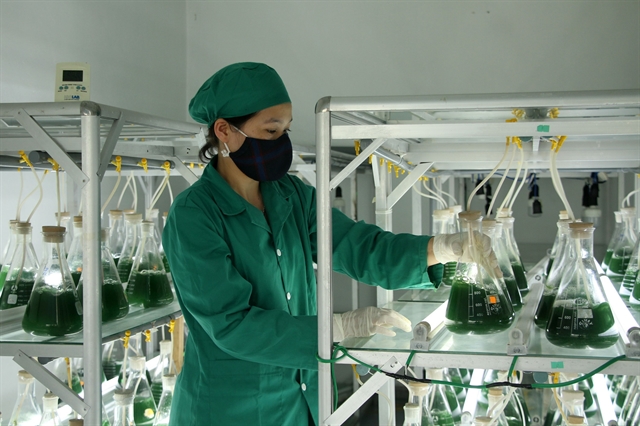
| Spirulina algae successfully cultivated at scale in Nghệ An Province. The Ministry of Agriculture and Environment has launched a programme to promote the development of the biotechnology industry. — VNA/VNS Photo Văn Tý |
HÀ NỘI — Việt Nam is stepping up efforts to develop biotechnology into an industrial-scale economic sector to promote agricultural productivity, environmental protection and green growth, under a programme recently launched by the Ministry of Agriculture and Environment.
Part of the effort to carry out the national plan for biotechnology development in line with the Politburo’s Resolution 57 on breakthroughs in science, technology, innovation and digital transformation, the initiative aims to accelerate research, technological applications and the commercialisation of biotechnology products.
It seeks to strengthen domestic capabilities and improve the competitiveness of Việt Nam’s agricultural and environmental industries by gradually mastering core and strategic technologies, developing a robust ecosystem of biotechnology enterprises to support green, circular and sustainable agriculture.
A key priority is developing and mastering advanced technologies, including next-generation genetic technologies and gene editing, to support agricultural production and environmental management.
The programme targets the development of 10-15 new-generation crops, livestock and aquatic varieties with higher productivity, improved quality, disease resistance and greater resilience to climate change, while contributing to lower emissions.
Việt Nam also aims to develop and produce five to 10 new-generation vaccines and biological products for livestock, veterinary medicine, aquaculture, crop production and plant protection to strengthen disease prevention, pest management, quality assessment and the inspection and certification of agricultural and aquatic products.
Biotechnology applications will also be expanded in plant health management, soil improvement, irrigation water treatment and post-harvest preservation, supporting the development of safer and organic agriculture.
The initiative also prioritises technologies for preventing pollution, reducing environmental degradation, restoring ecosystems and conserving biodiversity while encouraging the production of biofuels and environmentally friendly biomaterials, alongside the more efficient use of agricultural by-products, as part of efforts to promote a circular and low-carbon economy.
The ministry will strengthen the regulatory framework governing biotechnology products, particularly those involving genetic engineering. It will work to improve risk assessment and management procedures, standardise systems for detecting and identifying genetically modified organisms, and establish post-licensing monitoring mechanisms to prevent and respond to biosafety incidents.
National technical standards and regulations for biotechnology products in agriculture and the environment will also be reviewed and updated.
The programme places considerable emphasis on developing personnel and research infrastructure, with a target of training 500 highly qualified biotechnology researchers and specialists. It also aims to develop five key biotechnology laboratories to reach advanced standards within the ASEAN region.
Under the initiative, a national database and information system covering biotechnology in agriculture and the environment will also be developed and connected to the national and sectoral databases to support research, assessment, management, product traceability and commercialisation.
Việt Nam aims to increase the number of enterprises applying biotechnology by at least 50 per cent to create a market for biotechnology products. — VNS
Economy
 Economy
 Economy
 Economy
 Economy
 Economy
 Economy
 Economy
 Economy
 Economy
 Economy
 Economy
 Economy
 Economy
 Economy