 Economy

Hà Nội and five localities sign police pact against cross-provincial crime
1.
|
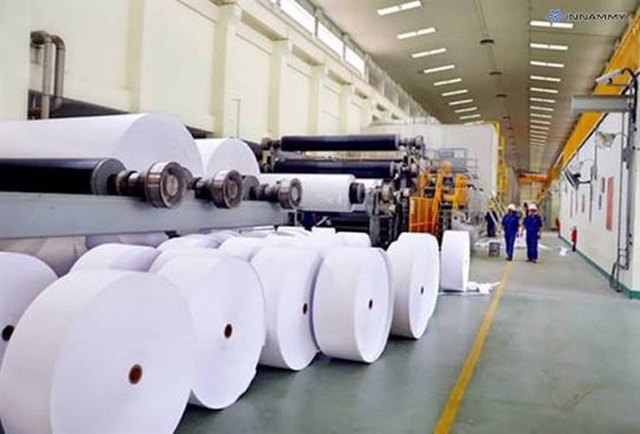
| By 2030, the paper industry aims to achieve average annual growth of at least 10 per cent and increase export turnover by at least 4 per cent. — Photo baochinhphu.vn |
HÀ NỘI — Việt Nam has approved its Paper Industry Development Strategy to 2030, with a vision to 2045.
Under Decision No. 2082/QĐ-TTg dated November 2, 2026, signed by Deputy Prime Minister Phạm Gia Túc, the strategy aims to develop a modern, competitive and environmentally sustainable paper industry capable of meeting domestic demand and expanding exports, while promoting advanced technologies, resource efficiency, circular economy practices and digital transformation.
By 2030, the industry targets average annual growth of at least 10 per cent in paper and pulp production, while export turnover is expected to increase by at least 4 per cent annually.
The strategy also calls for developing at least three key raw material areas in Northern Việt Nam, Central Việt Nam and the Central Highlands, with domestic waste paper recovery targeted at over 60 per cent to reduce reliance on imported raw materials.
Investment will be encouraged in at least three centralised paper industrial parks across the North, Central and South, alongside five to 10 new paper mills with annual capacity exceeding 250,000 tonnes each, two to five pulp mills with capacity of at least 200,000 tonnes each and two to five high-quality or specialty paper mills.
From 2030, smaller-scale producers will be encouraged to restructure, merge or relocate to centralised industrial parks. From 2040, restrictions will apply to production lines below specified capacity thresholds.
By 2045, Việt Nam aims to establish a green and sustainable paper industry with modern technology, greater raw material and energy self-sufficiency, lower emissions and stronger international competitiveness.
Key priorities include improving industry policies, expanding markets, developing skilled human resources, promoting technological innovation and accelerating the green transition. Priority will be given to environmentally friendly investment projects and the development of sustainable raw material and recycling systems. — BIZHUB/VNS
Economy
 Economy
 Economy
 Economy
 Economy
 Economy
 Economy
 Economy
 Economy
 Economy
 Economy
 Economy
 Economy
 Economy
 Economy