 Society

Techcombank CEO upbeat about Việt Nam’s growth prospects amid global uncertainty
1.
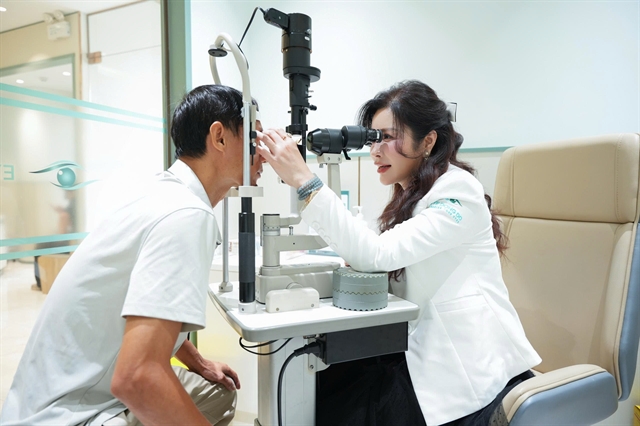 |
| Đông Đô Hospital Director Dr Đinh Thị Phương Thủy examines a patient's eyes. — Photo courtesy of the hospital |
HÀ NỘI — Presbyopia occurs when the eye's ability to focus gradually declines with age, typically beginning around the age of 40. Tasks such as reading, looking at a phone or working at close range become increasingly difficult.
However, many Vietnamese people who experience blurred vision choose to go to a local optical shop for an eye exam and new glasses, rather than seeking a professional medical consultation. Eye doctors warn that this is a dangerous mistake.
At a seminar on reducing reliance on reading glasses for individuals over 40 on November 3, Đông Đô Hospital Director Dr Đinh Thị Phương Thủy said that presbyopia is a natural physiological process that typically emerges once a person reaches their 40s. At this stage, the eye’s ability to focus declines, particularly when viewing objects at close range.
Based on her clinical experience, Dr Thủy notes that a significant issue today is that many people are reluctant to visit hospitals or specialised eye clinics, fearing that it will be time-consuming and costly.
“This subjective mindset also stems from the belief that presbyopia is a normal part of ageing and nothing to worry about. However, determining the correct prescription is not as simple as just measuring refractive error with a machine and dispensing glasses,” said Dr Thủy.
According to a study published in the journal Ophthalmology in 2015, presbyopia affects approximately 25 per cent of the global population, equivalent to approximately 1.8 billion people, with 826 million of them experiencing impaired near vision due to a lack of correction or inadequate correction. The prevalence of presbyopia increases with age. Among individuals over 50 years old, the proportion of those experiencing this decline in near-vision ability is very high.
In Việt Nam, the number of middle-aged and elderly individuals is rising rapidly, with those over 65 now accounting for more than eight per cent of the population. As a result, an increasing number of people are experiencing presbyopia.
 |
| Presbyopia is a natural part of the ageing process. However, advancements in ophthalmology are creating new opportunities to improve vision for those reaching this stage of life. — Photo courtesy of the hospital |
Presbyopia is a natural part of the ageing process. However, advancements in ophthalmology are creating new opportunities to improve vision for those reaching this stage of life.
According to Dr Thủy, prescribing an accurate pair of glasses requires a multi-step examination process to assess the patient’s accommodative capacity and overall visual status.
“Wearing glasses with an incorrect prescription for an extended period can lead to eye strain and compromised visual quality. Furthermore, the eyes may adapt to an inappropriate level of correction, making it more difficult to determine the correct prescription in the future,” she said.
Given this reality, ophthalmologists advise individuals over the age of 40, if they experience blurred vision or difficulty reading, not to automatically assume they have presbyopia and proceed to get glasses on their own. Instead, they should undergo an eye examination to determine the underlying causes, assess their eyes' focusing ability and receive professional guidance on the most appropriate type of eyewear.
For individuals with presbyopia who prefer not to wear glasses, ophthalmologists may consider laser surgery to reshape the corneal surface. This procedure adjusts the optical power across different zones of the cornea, enabling the patient to see clearly at near, intermediate and far distances.
However, Dr Thủy said this surgery is not suitable for everyone. Before the procedure, patients must undergo a thorough examination to assess their accommodative capacity and check for any corneal conditions. The vision-correcting effects of this method can last for approximately 10 years, depending on the individual's specific eye condition.
Experts say presbyopia cannot be entirely prevented, but early detection and appropriate vision correction can minimise the inconveniences it causes in daily life.
They recommend that individuals over the age of 40 have regular eye examinations every one or two years to facilitate the early detection of presbyopia and other eye conditions.
In addition, ensure sufficient lighting when reading or doing tasks at close range. When using electronic devices, users should give their eyes regular breaks by following the 20-20-20 rule: every 20 minutes of close-range work, take 20 seconds to look at an object at least six metres away. Increasing the font size on phones, tablets and computers can also help reduce visual strain.
 |
| Đông Đô Hospital’s High-Tech Eye Centre has been recognised as the leading ophthalmic facility in Asia for the number of successful SmartSight surgeries for three consecutive years. — Photo courtesy of the hospital |
At the event, Đông Đô Hospital’s High-Tech Eye Centre was recognised as the leading ophthalmic facility in Asia for the number of successful SmartSight surgeries for three consecutive years (2024-2026).
Dr. Đinh Thị Phương Thủy, Executive Director of Đông Đô Hospital, shared: “Being recognised as a leader in Asia is significant to us, primarily because it represents thousands of Vietnamese people who can now see more clearly—without the need to travel abroad for treatment.”
SmartSight is a refractive surgery technology that utilises a femtosecond laser on the SCHWIND ATOS system. In 2024, Đông Đô Hospital was the first facility in Việt Nam to implement SmartSight refractive surgery technology, marking a significant milestone in bringing world-class medical techniques to patients in the country. — VNS
Society
 Society
 Society
 Society
 Society
 Society
 Society
 Society
 Society
 Society
 Society
 Society
 Society
 Society