 Society
.jpg)
SHB unveils sustainable finance framework to expand green and social lending
1.
|
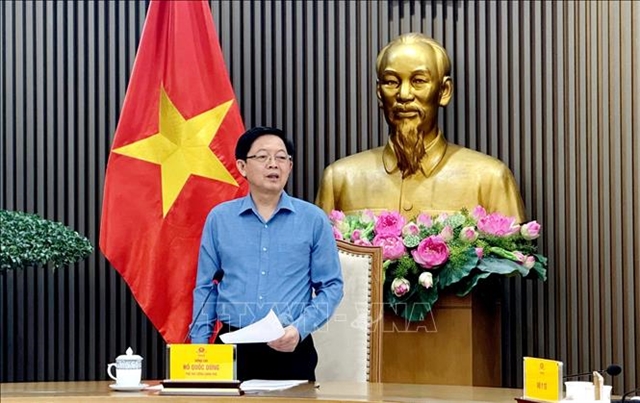
| Deputy Prime Minister Hồ Quốc Dũng gives instruction at the meeting. — VNA/VNS Photo Diệp Trương |
HÀ NỘI — Deputy Prime Minister Hồ Quốc Dũng has called for concentrating resources to form national key laboratories and research and testing centres with the capacity to meet regional and international standards.
He also required urgently building a database and capability map of the system of laboratories and research centres, to be completed in November this year.
He gave the order on Tuesday when he chaired a meeting on laboratories, research and testing centres; mechanisms for investment, operation, maintenance and servicing of laboratories.
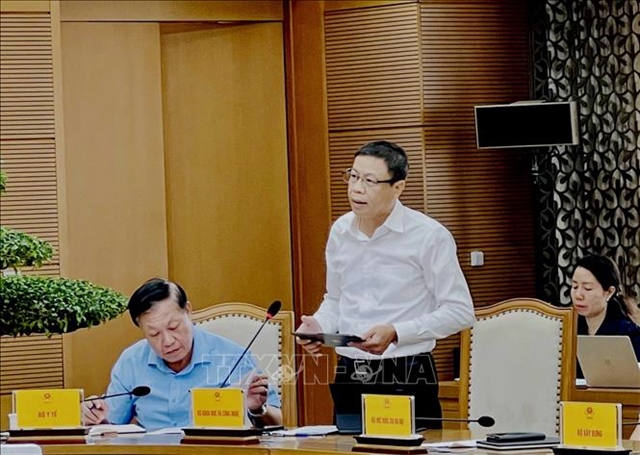
Deputy Minister of the Ministry of Science and Technology Lê Xuân Định said the system had been formed from many sources, including the State budget, serving multiple objectives, from basic research, applied research to serving state management work and production and business.
Through a practical survey at 113 key facilities belonging to 23 major hubs, including three leading training and research centres, Việt Nam National University, Hà Nội; Hà Nội University of Science and Technology; and Việt Nam National University, HCM City (accounting for about 75 per cent of the survey sample), positive results were recorded.
The laboratory system has a workforce of over 1,200 dedicated personnel, with over 5,500 scientific publications in the past five years and over 600 service and technology transfer contracts.
But, according to Deputy Minister Định, if viewed from the perspective of macro-management and efficiency of public investment, the system is revealing inadequacies that need to be promptly remedied.
Specifically, there remains differentiation and dislocation in the segments. Infrastructure is still fragmented; many units own individual pieces of equipment but lack synchronisation across the entire value chain, from research, design, prototype fabrication to measurement and testing, conformity and standards certification.
For the 16 national key laboratories invested in during the period 2000–2013, with total capital of over VNĐ966 billion (US$37.2 million), currently up to 78 per cent of equipment is over 10 years old; most is outdated and lacks synchronised spare parts.
Exploitation efficiency has not met requirements. Although most surveyed facilities reported exploitation capacity above 80 per cent, there are still about 30 per cent of facilities operating below 50 per cent capacity or not achieving efficiency, due to lack of regular maintenance funding and lack of connections with orders from the market.
Main bottlenecks
In the process of summarising practical experience, the Ministry of Science and Technology (MoST) found that the causes of the limitations stem from four main bottlenecks.
Investment is dispersed by line ministries, programmes and projects: information on equipment, capacity, technical standards and usage needs has not been connected to screen projects. Investment needs are large but the lack of coordination tools leads to duplicate investment or investment not matching the country’s capability gaps.
Financial mechanisms still focus on initial investment capital and are not fully linked to operating costs throughout the life cycle, including human resources, materials, calibration, software, safety, maintenance, repair and upgrade.
Governance models and operating personnel are not uniform. At some facilities, the rights and responsibilities of the line ministry, the asset management unit and the directly operating department are not clearly defined and the rights to sign contracts, provide services, use revenue, hire experts, procure materials and carry out maintenance remain dispersed.
Exploitation, sharing and joint use are still limited and the common cause is that the system is mainly managed by individual asset-owning units, not managed as a capability network.
Regarding solutions in the coming time, the MoST proposed five solutions.
Complete the review and build a laboratory capability map; shift from investing in individual equipment to investing by capability; clearly identify management and operating units and delegate authority commensurate with responsibility; form a network of shared research and testing infrastructure at national, regional, sectoral and specialised levels; stratify and restructure the network, avoiding scattered investment.
|
| Deputy Minister of the Ministry of Science and Technology Lê Xuân Định speaks at the meeting. — VNA/VNS Photo Diệp Trương |
Map of laboratory system
Concluding the meeting, Deputy PM Hồ Quốc Dũng emphasised that science and technology, innovation and digital transformation are identified as new growth drivers.
To enable science and technology to bring into play its effectiveness, it is necessary to candidly identify and remove obstacles in terms of institutions, investment, management and organisation of implementation.
The Deputy PM required the MoST, relevant ministries and agencies to concentrate resources to form a number of truly capable national laboratories.
By 2030, strive to form eight national key laboratories and four national research and testing centres reaching regional and international standards, especially in strategic technology fields.
To realise this goal, Deputy PM Dũng required units to have concrete plans and progress and determination to complete the set goals.
To create a shift from mindset to organisation of implementation, Deputy PM Dũng directed ministries and sectors to focus on four tasks.
First, review and build a science and technology capability map. The MoST was assigned to take the lead, coordinating with ministries, sectors and localities to urgently build a database and capability map of the system of laboratories and research centres nationwide, to be completed in November this year. This is an important basis for accurately assessing the current situation and the position of Việt Nam’s science and technology capability compared to the region and the world.
Second, concentrate investment in shared research infrastructure. Shift from a dispersed investment model to developing shared research infrastructure along the chain, from research, prototype fabrication, testing, measurement to pilot production and commercialisation. In the immediate term, piloting at the Việt Nam National University, Hà Nội and Việt Nam National University, HCM City.
Third, remove obstacles in financial mechanisms and technology commercialisation. The MoST, in coordination with the Ministry of Finance, will review regulations on investment, procurement, maintenance and equipment operation; build an open financial mechanism, ensuring resources throughout the equipment life cycle, linking autonomy with accountability.
Fourth, innovate governance models, strengthen enterprise connections. The MoST, in coordination with the Ministry of Home Affairs and the Ministry of Finance, will study modern governance models for national key laboratories; clearly define powers, responsibilities and mechanisms for sharing and exploiting shared infrastructure.
Deputy PM Dũng required ministries and sectors to implement resolutely, shifting from individual investment to shared research infrastructure, creating synchronous, modern research capacity and genuinely contributing to the country’s growth. — VNS
Society
 Society
 Society
 Society
 Society
 Society
 Society
 Society
 Society
 Society
 Society
 Society
 Society
 Society
 Society