 Society

Việt Nam fosters comprehensive cooperation with Uruguay
1.
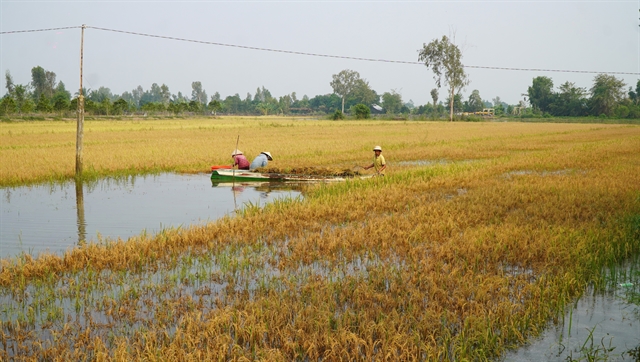 |
| Farmers in Đồng Tháp harvest flooded rice fields. The province's water levels have risen rapidly since mid-July. — VNA/VNS Photo |
ĐỒNG THÁP — Rapidly rising water levels have caused localised flooding in several areas of the Mekong Delta province of Đồng Tháp, particularly low-lying areas, damaging more than 60ha of rice.
According to the provincial Department of Agriculture and Environment, water levels have risen rapidly since mid-July due to upstream flooding combined with high tides in the East Sea and widespread heavy rains.
At times, high water levels have caused localised flooding in several communes and wards, disrupting residents’ daily activities and affecting infrastructure, facilities and agricultural land.
Since the beginning of the flood season, the southern province has recorded 61.9ha of rice damaged by flooding. Of this, 56.3ha suffered losses of 30-70 per cent, while 5.6ha suffered losses of more than 70 per cent.
Local authorities have proactively reinforced vulnerable sections of dykes, drained water and implemented measures to respond to rising water levels, helping minimise damage.
In Cái Tre Hamlet, Ba Sao Commune, a section of a surrounding dyke broke, allowing water to flood about 3ha of rice fields that were approaching harvest.
Phan Duy Khánh, a local farmer, said the recent high tide, combined with heavy rain, caused water levels to rise sharply. Although the dyke had previously been reinforced, one section could not withstand the water pressure and broke.
About 2,500sq.m of Khánh’s rice field was ready for harvest, but remained flooded for several days. His family members worked together in the field to salvage as much rice as possible.
The provincial Hydro-Meteorological Station forecasts flood peaks of Alert Level 1 or 0.1-0.2m above in upstream areas around mid-October, and Alert Level 2-3 in Đồng Tháp Mười around late October.
High tides are expected to peak in mid-October in the southwest and in late November and December downstream, potentially exceeding Alert Level 3 by 0.2-0.4m.
During the final months of 2026, about four to five storms and tropical depressions are forecast to develop over the East Sea, with one to three potentially making landfall in Việt Nam.
Seven high-tide periods are also forecast, with the high tides expected on October 10 and 24 (the first and 15th days of the ninth lunar month) potentially coinciding with periods of widespread heavy rain.
The combination of high tides and heavy rain could increase the risk of flooding in low-lying areas, residential areas, agricultural production zones and locations where dyke systems have yet to be fully enclosed.
In response, the Đồng Tháp People's Committee, the provincial Civil Defence Command and the Department of Agriculture and Environment have issued directives on proactively responding to heavy rain, floods, high tides and hazardous weather.
The Department of Agriculture and Environment is coordinating with local authorities to inspect dyke and embankment systems, sluice gates, dams and key irrigation works, with a focus on vulnerable locations in southwestern and downstream areas.
It is also working with the provincial Hydro-Meteorological Station and relevant agencies to provide timely forecasts and warnings of rain, floods and high tides, particularly for areas at risk of flooding and landslides, enabling residents to take preventive measures.
Relevant agencies are also operating irrigation and flood-control infrastructure appropriately and taking measures to drain water.
They are closely monitoring water levels, operating drainage systems and pumping out excess water to limit flooding in residential areas, agricultural production zones and low-lying areas.
Local authorities have reviewed areas of agricultural production, aquaculture and fruit cultivation at risk of being affected, while guiding residents on harvesting, reinforcing embankments, pumping out water and protecting production.
They have also prepared personnel, materials, vehicles and equipment, as well as assigning local-level disaster response forces and preparing mobilisation plans for emergencies. — VNS
Society
 Society
 Society
 Society
 Society
 Society
 Society
 Society
 Society
 Society
 Society
 Society
 Society
 Society
 Society