 Society
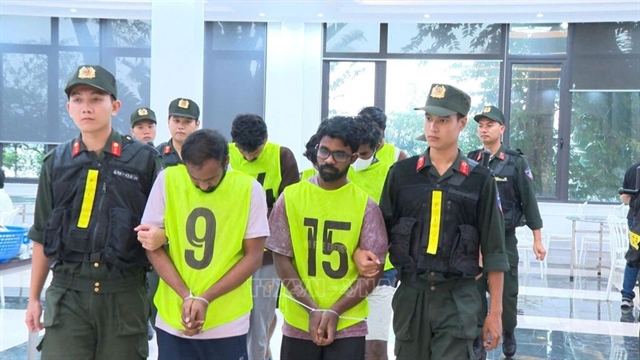
84 individuals investigated for transnational online frauds
1.
|
| Police seized members of the criminal organisation after a hotel raid on October 17 in Nghi Sơn Ward in the central province of Thanh Hóa. — VNA/VNS Photo |
HÀ TĨNH — Investigative police in the central province of Hà Tĩnh on Wednesday announced they had initiated criminal proceedings against 84 individuals, most of whom are foreigners, for two offences under the Penal Code.
They were charged with using computer networks, telecommunications networks, or electronic means to misappropriate property, and organising or facilitating the illegal entry, exit or stay of others in Việt Nam.
Among them, Zhao Xuefeng (known by the Vietnamese name Đông), a Chinese national born in 1987, has been identified as the mastermind and ringleader of the criminal organisation.
These 84 individuals are part of a group of 118 people seized by Thanh Hóa Province police after they raided a hotel on October 17, comprising 113 foreign nationals and five Vietnamese citizens.
The foreign nationals are 74 Chinese, 28 Indians, nine Cambodians, one Malaysian and one Burmese.
The police found that most of them had previously resided in Laos or Cambodia, 18 entered Việt Nam illegally, and one is currently wanted by authorities abroad.
They also seized various pieces of machinery and electronic equipment used to facilitate online frauds.
Prior to the raid, through intelligence-gathering efforts, the immigration management division of Thanh Hóa Province police discovered that the group had rented out the entire Văn Hoa Hotel, located in Nghi Sơn Ward.
Upon arrival, they brought in a large quantity of computers and telecommunications equipment, disguised as used goods.
The group maintained a closed-off lifestyle, enforced strict surveillance with guards, restricted access to outsiders and showed signs of engaging in illegal activities.
They were divided across six rooms, each focusing on different markets and types of fraud, primarily involving financial and cryptocurrency investment schemes, online sports betting, fake job recruitment, and tasks that promised monetary rewards.
The group targeted people across various countries and territories, including Taiwan (China), the Republic of Korea, Japan, India, the US and mainland China, employing tailored scripts to establish contact, build trust and coerce victims into transferring money.
Specifically, in Taiwan (China), they befriended women over the age of 40 through messaging applications, then lured them into investing in foreign exchange through the MGX platform.
In the Republic of Korea, they acted as representatives of 'Nexuswh Investment' company, offering stock investment advice and instructing victims to download an application, deposit funds and execute trades. Once victims sought to withdraw their funds or were no longer able to continue investing, the group would cut off all communication.
In Japan, they befriended women on social media, established relationships and lured them into investing in cryptocurrency through online platforms. This operation is directed by a Chinese individual, commonly referred to as 'Đại Lục' (Mainlander).
One group hosted live streams of sporting events on social media to attract viewers, then invited them to place bets on pre-established websites.
Another group employed fake Facebook accounts, posing as wealthy, successful individuals to approach Indian nationals living in various countries, built trust, then lured them into depositing funds and purchasing stocks, which they masked as 'financial investment opportunities'.
They generated artificial profits at first, allowed victims to withdraw small sums of money then coaxed them into transferring larger amounts. They then cut off all contacts once the victims’ financial resources were exhausted.
Another group carried out recruitment scams, inviting victims to apply for positions at non-existent companies and demanding 'training' or 'recruitment' fees.
Thanh Hóa Province police recognised this as a sophisticated, transnational criminal organisation operating in cyberspace and reported it to the Ministry of Public Security, after which a formal investigation was launched in coordination with the ministry's criminal police and cybersecurity departments.
The task force consisting of investigators, intelligence officers, interpreters and high-tech crime personnel was mobilised for the raid on October 17. — VNS
Society
 Society
 Society
 Society
 Society
 Society
 Society
 Society
 Society
 Society
 Society
 Society
 Society
 Society
 Society