 Society
Hà Nội student arrested after allegedly assaulting teacher in classroom
1.
HÀ NỘI — For people whose hip or knee conditions make walking increasingly difficult, the aim of surgery is not simply to replace a damaged joint - it is also to help them regain mobility, recover function and remain independent.
Advances in minimally invasive techniques, robotics and artificial intelligence (AI) are creating new treatment options, but outcomes still depend on clinical assessment and surgical judgement.

|
| Assoc Prof Dr Lê Quang Huy from Hồng Ngọc General Hospital examines a patient before surgery. — Photo Kiều Trinh |
Severe hip and knee conditions can turn everyday activities, from standing up to walking or climbing stairs, into a challenge. When non-surgical treatments no longer provide sufficient relief, joint replacement may reduce pain and improve mobility.
Yet surgery is only one part of the treatment process. Recovery afterwards, particularly among older patients, is equally important.
Professor Dietmar Krappinger, Deputy Head of Orthopaedics and Trauma Surgery and Head of the Pelvis and Hip Surgery Unit at the Medical University of Innsbruck in Austria, identifies minimally invasive hip surgery as one of the important areas of progress.
He says the approach is not simply about making a smaller skin incision. More importantly, it aims to preserve the muscles around the hip as much as possible, helping patients mobilise early and regain function.
At his hospital, many older patients begin mobilisation on the day of surgery or the following day. Prolonged immobility can lead to muscle loss and declining mobility, he says.
For older patients, therefore, the goal is not only to replace the joint successfully but also to help them return to independent living as soon as possible.
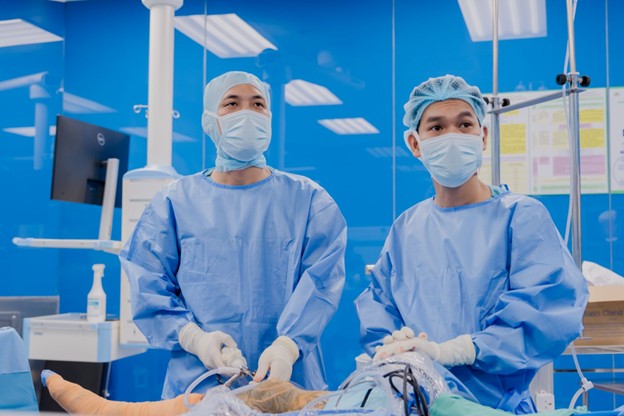
These considerations are also relevant to joint surgery in Việt Nam. At an international symposium on advances in hip and knee surgery held by Hồng Ngọc General Hospital on October 17 and 18, the hospital's surgical team performed a SuperPATH hip replacement on a 46-year-old man with stage IV osteonecrosis of the right femoral head. The procedure was carried out with technical guidance from Austrian specialist Dr Joerg Beardi.
|
| Associate Professor Dr Lê Quang Huy (left) performs arthroscopic anterior cruciate ligament reconstruction. — Photo Hồng Ngọc General Hospital. |
The operation provided an example of how international collaboration can support the exchange of surgical techniques. However, the choice of procedure must still be based on the patient's condition, anatomy and overall health, rather than applying one technique to every case.
Robotics and AI in joint replacement
Alongside minimally invasive surgery, robotic systems and AI are attracting growing interest in joint replacement.
In Viet Nam, Tâm Anh General Hospital in HCM City received approval to use the CUVIS-Joint robotic system for hip and knee replacement surgery in March 2026. The system supports surgical procedures according to a plan approved by the surgeon.
Robotic systems can help surgeons plan procedures and carry out tasks that require a high degree of precision.
However, the technology does not guarantee good outcomes for every patient. Pre-operative assessment, the choice of surgical method and decisions made when unexpected situations arise in the operating theatre still require clinical expertise and experience.
Professor Hiranaka Takafumi, Director of the Joint Surgery Centre and Head of Orthopaedics and Trauma Surgery at Takatsuki General Hospital in Japan, says the value of robotics extends beyond precision during surgery.
These systems can also collect data on factors such as limb alignment, the location and extent of bone cuts, and soft-tissue tension around the joint.
Combining pre-operative and intra-operative data with post-operative range of motion and patient-reported outcomes could give doctors a much larger evidence base for assessing different surgical approaches.
“There is no single surgical method that is optimal for every patient. A technique may suit one patient best, while another technique may yield better results for another,” he said.
Professor Hiranaka believes that, within the next five to ten years, AI and big data could help doctors identify which approaches are most suitable for individual patients. This remains a developing possibility rather than a description of routine practice in which AI independently selects a treatment.
International cooperation and clinical practice
Adopting new techniques requires more than investment in equipment.
Hospitals also need to develop clinical expertise and provide opportunities for doctors to exchange experience. A new technique is useful only when surgeons understand its indications, limitations and suitability for the patients they treat.
The Hồng Ngọc symposium brought together 13 specialists from Viet Nam, Austria, Germany, Japan, India and Taiwan (China). Across 18 presentations and two live surgical demonstrations, participants discussed primary joint replacement, revision surgery, robotic applications and the management of complex injuries.
|
|
| The conference brought together leading orthopaedic specialists from six healthcare systems worldwide. — Photo Kiều Trinh |
Associate Professor Dr Hà Kim Trung, Deputy Medical Director of Hồng Ngọc General Hospital, said international scientific conferences could build an academic bridge between Vietnamese and international specialists, giving doctors opportunities to update their knowledge and improve their professional skills.
Professor Krappinger also sees scope for Viet Nam to learn from Austria's experience in treating very elderly patients.
As demographic changes increase the demands on healthcare systems, he says, Việt Nam may face more of the challenges Austria has dealt with over several decades, including hip fractures among older people.
Progress in joint replacement therefore involves more than the operation itself. From surgical planning and the use of new technology to rehabilitation and long-term care, better outcomes depend on combining appropriate treatment, surgical expertise and recovery plans tailored to each patient. — VNA/VNS
Society
 Society
 Society
 Society
 Society
 Society
 Society
 Society
 Society
 Society
 Society
 Society
 Society
 Society
 Society