 Society

General Secretary and President Tô Lâm witnesses exchange of Việt Nam-Denmark cooperation agreements
1.
|
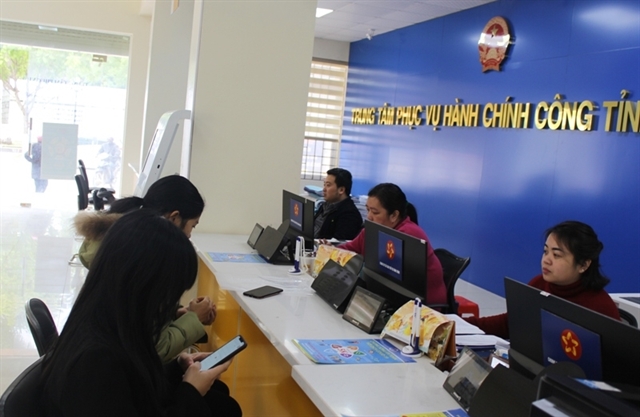
| Citizens collect the results of their administrative procedures at the Cao Bằng Public Administrative Service Centre. — Photo baocaobang.vn |
CAO BẰNG — The northern mountainous province of Cao Bằng, for the first nine months, has achieved several positive results since implementing the Politburo's Resolution 57-NQ/TW on breakthroughs in the development of science, technology, innovation, and national digital transformation.
The province has completed 168 out of 172 tasks assigned by the central government, of which mobile network coverage has reached 99 per cent with 288 5G base stations deployed.
The province has processed over 107,000 administrative procedure applications, 75.8 per cent of which were submitted online; the rate of applications resolved on or ahead of schedule stands at 94.6 per cent.
Furthermore, 100 per cent of the province’s OCOP (One Commune, One Product) items are now equipped with QR codes for origin tracing.
Scientific and technology research has been linked with production and development of local specialties.
However, the province is still facing hurdles in the process of digital transformation and scientific and technological development.
This situation requires the local authority to promptly shift its focus from merely identifying challenges to decisively resolving core "bottlenecks", thereby creating genuine momentum for economic growth.
As a border mountainous province with complex terrain and limited resources, the issue of digital transformation in Cao Bằng has faced barriers of technical infrastructure.
At present, there are still 33 hamlets without mobile network and more than 8,800 households have no access to the national electric grid or are using unqualified electricity.
Notably, more than 56 per cent of land has not yet been updated in the database. The capital disbursement rate for the digital transformation process remains low at about 13 per cent while the portion of digital economy in the province’s Gross Regional Domestic Product (GRDP) in 2025 was estimated 7.98 per cent, far below the target of 20 per cent set for 2030.
The commercialisation of scientific and technological research outcomes in the province faces numerous obstacles.
A review reveals that, although 29 scientific and technological projects have been completed – yielding products with commercial potential – only four have actually generated quantifiable economic value.
A significant gap remains between research findings on paper and their practical application in developing local specialty products, medicinal materials, crops, and livestock.
These barriers have directly affected the goal of narrowing the digital gap and making online public services available in remote and mountainous areas.
Along with infrastructure, progress in building up and standardising shared data – the heart of digital transition – is still slow.
Following an assessment of the resolution implementation and the 100-day action plan to address bottlenecks in digital transformation, the province’s leaders have identified five core "bottlenecks" that Cao Bằng must focus on resolving: institutions, infrastructure, data, human resources, and funding.
The provincial Party Secretary and People’s Committee chairman Phan Thăng An said: “For a border mountainous province with limited resources like Cao Bằng, scientific and technological application and digital transformation cannot be pursued in a scattered manner or merely as a trend.”
“The province must carefully select key priorities, address the most pressing practical issues, and use tangible results as the primary benchmark for success. Every digital transformation effort must generate substantive value, contributing directly to economic growth and the improvement of people's lives,” An said.
To address the barriers, Cao Bằng authorities have identified a series of solutions with an aim to create significant changes in the coming times.
“Cao Bằng must complete the shared database, clean and connect land and other essential data,” said An.
“The province will accelerate the administrative simplification process, improve online public services, and accelerate capital disbursement and digital human resource training,” he said.
Notably, Cao Bằng should also proactively prepare a list of tasks for 2027, ensuring sufficient resources for rapid and sustainable development he added. — VNS
Society
 Society
 Society
 Society
 Society
 Society
 Society
 Society
 Society
 Society
 Society
 Society
 Society
 Society
 Society
.jpg)