 Society

Việt Nam–Belgium partnership entering new phase of strategic significance: diplomat
1.
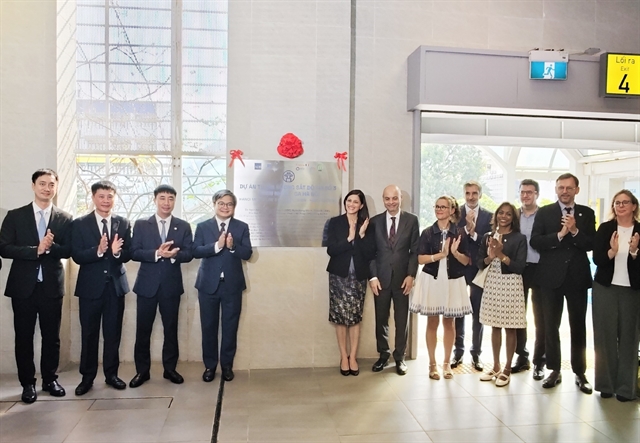 |
| The Hà Nội People’s Committee, in coordination with the French Government, the French Development Agency (AFD), the Asian Development Bank (ADB) and the European Investment Bank (EIB), held a commemorative plaque unveiling ceremony for Metro Line 3 at Cầu Giấy Station (S8) on the Nhổn–Hà Nội Station line on October 19. — VNA/VNS Photo |
HÀ NỘI — The European Union (EU) is providing EUR 10 million (US$11.22 million) to fund studies and investment preparations for an extension of Hà Nội's Metro Line 3 from Hà Nội Station to Hoàng Mai area. The proposed 11-km section is planned to run entirely underground, in conjunction with transit-oriented development (TOD).
The Hà Nội People’s Committee, in coordination with the French Government, the French Development Agency (AFD), the Asian Development Bank (ADB) and the European Investment Bank (EIB), held a commemorative plaque unveiling ceremony for Metro Line 3 at Cầu Giấy Station (S8) on the Nhổn–Hà Nội Station line, which is the second one to be operational in the capital city following the Cát Linh–Hà Đông line.
The event recognised the results of cooperation between Hà Nội, the French Government and international financial institutions in developing public transport infrastructure, while opening up prospects for further expansion of the capital’s urban railway network.
According to information released by the partners at the event, the EU has entrusted AFD with managing a 10-million-EUR grant to support preparations for extending Metro Line 3 from Hà Nội Station to Hoàng Mai.
The support programme was signed with the Hà Nội People’s Committee in 2024 and is being implemented by MRB, with preparatory activities expected to be completed by the end of 2027. The extension is planned to be approximately 11km long and run entirely underground in the southern part of the capital.
The grant will fund a feasibility study, transit-oriented development planning along the route, research into traffic organisation and multimodal connectivity solutions, and efforts to strengthen project implementation capacity.
Integrating urban railway development with TOD planning is expected to help reorganise urban space, improve access to public transport and enhance the efficiency of transport infrastructure. It will also provide a basis for studying connections between residential areas, economic centres and service hubs and high-capacity public transport networks.
According to the funding partners, investment for construction of the extension is expected to be explored through the Team Europe cooperation mechanism, with the participation of Germany’s KfW Development Bank and cooperation with ADB.
The 10-million-EUR grant is specifically intended for research and project preparation, not for the total construction cost of the extension. Construction will depend on the study findings, approval procedures and capital mobilisation plans in accordance with regulations.
At the event, Hanoi People’s Committee Vice Chairman Trương Việt Dũng stressed that the metro line is significant beyond its role as a transport project. Each new metro line not only provides a safe and convenient means of travel but also helps ease congestion, reduce environmental pollution, reorganise urban space and connect development centres.
The city expressed its appreciation for support from the French Government and international financial institutions, particularly the EU’s 10-million-EUR grant through AFD.
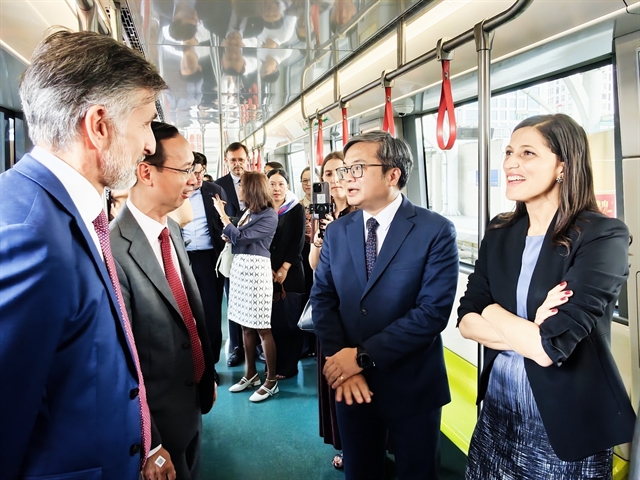 |
| Representatives riding on the metro line No.3 — VNA/VNS Photo |
France's Minister Delegate for Francophonie Éléonore Caroit described Metro Line 3 as tangible evidence of the results of cooperation under the Việt Nam–France Comprehensive Strategic Partnership. She also highlighted prospects for further cooperation between France, the EU and Việt Nam in public transport development, including preparations to extend Metro Line 3 to Hoàng Mai.
Victoire Vandeville, AFD’s Regional Director for Southeast Asia, said the millions of passenger journeys recorded during the line’s first year of operation demonstrated the effectiveness of cooperation among the partners. AFD reaffirmed its readiness to continue supporting Hanoi in studying and preparing the Metro Line 3 extension with EU assistance.
Meanwhile, Scott Roberts, ADB Country Director for Việt Nam, emphasised that urban railways do more than meet travel needs. They also connect people with employment, education and development opportunities. ADB pledged to continue working with Hà Nội and its partners to develop an integrated and accessible urban transport network that meets the capital’s development needs.
Metro Line 3 is 12.5km long and has 12 stations, including eight elevated and four underground stations. The elevated section from Nhổn to Cầu Giấy began commercial operations in August 2024, providing an additional high-capacity public transport option in western Hà Nội.
According to data from Hà Nội Metro included in a statement by the international partners, the elevated section carried approximately 6.4 million passenger journeys in its first year of operation, with an on-time performance rate of 99 per cent.
Beyond its transport benefits, international partners have also highlighted the project’s contribution to reducing greenhouse gas emissions. Estimates released by the partners indicate that the line helped avoid approximately 49,000 tonnes of carbon dioxide equivalent emissions in 2025. This figure is projected to reach around 81,500 tonnes annually by 2030.
Construction of the underground section from Cầu Giấy to Hà Nội Station, which comprises four stations, is continuing. According to the implementation schedule outlined in the October 19 statement, this section is expected to be completed and enter service in 2027.
Metro Line 3 has received support from several international financial institutions. The French Government has provided a Treasury loan of EUR 355 million, AFD a loan of EUR 159 million, ADB funding of $407.8 million and EIB financing of EUR 125.5 million, alongside counterpart funding from Hà Nội. — VNA/VNS
Society
 Society
 Society
 Society
 Society
 Society
 Society
 Society
 Society
 Society
 Society
 Society
 Society
 Society
 Society