 Society

SIM Academy Examines How Working Adults Can Build New Skills for a Changing Workplace
1.
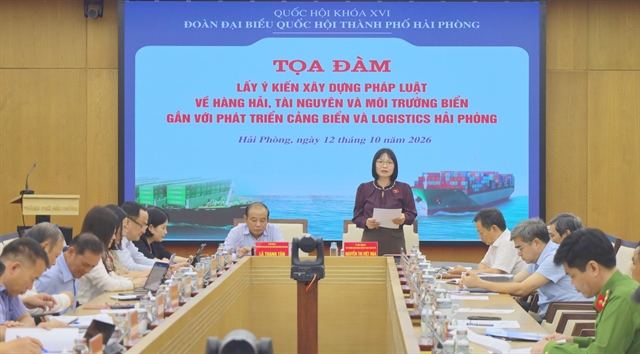 |
| National Assembly deputy Nguyễn Thị Việt Nga (standing) speaks at a seminar on laws governing maritime affairs, marine resources and the marine environment. — VNA/VNS Photo |
HÀ NỘI — For five years, Nguyễn Viết Lâm tried every official route open to him. A former small-business owner in the northern province of Tuyên Quang, he had paid into the state’s voluntary social insurance scheme, expecting a pension at the end of it.
When the time came, the social insurance office refused to pay, citing knots in the regulations. Lâm petitioned officials from the local level all the way up to the central government. When that got him nowhere, he went to court. The case stayed stuck.
What finally moved it became a conversation. Nguyễn Thị Việt Nga, a National Assembly deputy from another province, joined Lâm and several other household-business owners in the same situation for a face-to-face meeting with the Vietnam Social Security, pressing for a way through.
Back in the Assembly, she followed up with formal written questions to the agencies concerned. In the end, Lâm and many others like him received the pensions they were owed.
It is the sort of work that rarely makes headlines, and Nga would probably say that is the point. As she sees it, a lawmaker’s job does not end when the debate in the chamber does. Laws have to find their way into ordinary lives, and someone has to make sure they arrive.
Nga, the full-time deputy head of Hải Phòng’s National Assembly delegation, is in her third term, having served in the 14th and 15th legislatures before returning for the 16th.
Her path to parliament ran through classrooms and culture rather than courtrooms. Born in 1976 in the former province of Hải Dương, since merged into Hải Phòng, she taught at the Hải Dương College of Education, edited the province’s arts and literature magazine and later ran its Department of Culture, Sports and Tourism.
She has held her current post since 2020.
In the chamber, she is known for plain speaking and for arguments drawn from what she has seen for herself. When deputies debated a resolution in 2025 meant to clear bottlenecks in how Việt Nam drafts and enforces its laws, Nga backed it but argued that it did not go far enough.
She proposed a not-for-profit fund, held outside the state budget, that could draw in non-state money and get it quickly to drafting projects the government had yet to finance. She also asked the government to set clear rules on how spending would be split between the fund and the budget so that the two would not overlap. The measure was adopted as Resolution 197.
She also pushed for digital technology and artificial intelligence to play a part in making and enforcing law. Taking on board her input and that of other deputies, the prime minister directed the Ministry of Justice to build a National Law Portal. It went live on late May 2025, with a legal AI tool built in.
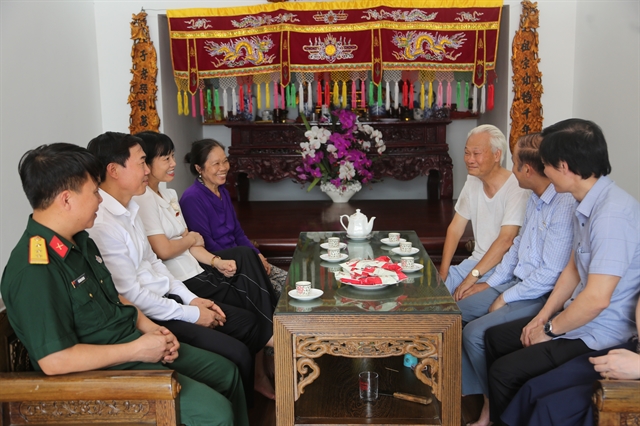 |
| National Assembly deputy Nguyễn Thị Việt Nga and members of Hải Phòng’s National Assembly delegation visit a family honoured for its service to the revolution. — VNA/VNS Photo |
Lieutenant General Nguyễn Hải Hưng, a former vice-chairman of the Assembly’s Committee on National Defence and Security who served alongside her in two legislatures, said her contributions to debate had helped sharpen the questions lawmakers face as they draft policy, above all on people’s rights and opportunities in education and culture, two fields that voters follow closely.
"Contributions like hers, constructive and rooted in reality, are essential," he said.
"They give agencies a firmer basis for refining policy, so that regulations fit life better once they are issued."
Outside the chamber, Nga’s attention returns to women, children and people in hardship. At meetings with voters she gathers complaints and petitions, then keeps track of how each one is handled.
One cause she has pursued with particular tenacity concerns children whose fathers refuse to acknowledge them, leaving them without a secure claim to care and support. Nga has urged the courts to take up the question of paternity in such cases.
Her oversight work tends to produce equally concrete demands. She has pressed for traffic lights at a dangerous stretch of National Highway 5A, the busy artery between Hà Nội and Hải Phòng, and for overhead power lines to be buried along Nguyễn Chế Nghĩa Street in the former Gia Lộc District.
Some of her help is more personal. She has organised visits and gifts for people honoured for their service to the country and for households in difficulty: 810 packages in all, worth nearly VNĐ700 million, or about $27,000.
In 2022, she took on the upkeep of Vũ Hải Dương, a child from a struggling family in the former Cẩm Giàng District, and when Dương’s studies paid off, she marked the achievement with a motorbike.
Two years later, she began supporting four orphaned siblings in Trụ Village, pledging VNĐ500,000 (about $19) for each child until they finish 12th grade.
She persuades businesses to fund Lunar New Year programmes for families in need, and through the club of women National Assembly deputies, as well as articles and interviews, she makes the case for gender equality and a larger role for women in Vietnamese life.
Then there is the writing. A member of the Vietnam Writers’ Association, Nga has published several books, including poetry collections, some of them about women and everyday life.
In 2025 she won second prize in a songwriting campaign about the National Assembly and local People’s Councils, organised by the Office of the National Assembly and the Vietnam Musicians’ Association. Perhaps it is the writer in her that refuses to treat a case file as anything less than someone’s story.
Recognition has followed. The Ministry of Justice named her among its 'Shining Examples of the Law' for 2025, and she has received certificates of merit from the National Assembly Standing Committee and from the leaders of both the former Hải Dương and Hải Phòng for her work in the 14th and 15th legislatures. — VNS
Society
 Society
 Society
 Society
 Society
 Society
 Society
 Society
 Society
 Society
 Society
 Society
 Society
 Society
 Society