 Society

Dung Quất EZ lands special free-trade zone Incentives
1.
|
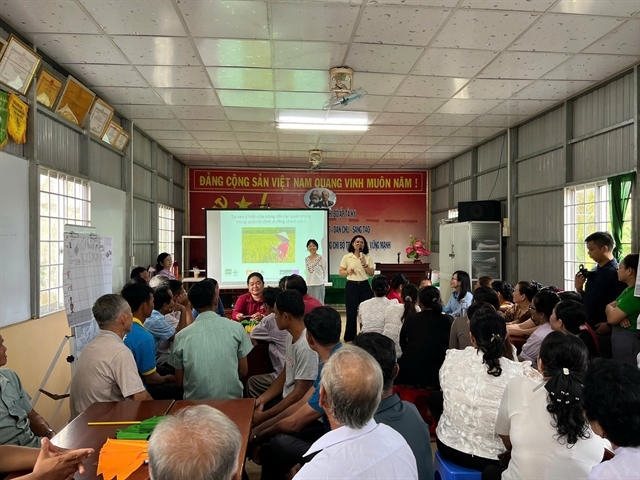
| Participants at the training programme in Hồng Dân commune, Cà Mau Province. — Photo Trà My |
CÀ MAU — A training programme in the Cửu Long (Mekong) Delta province of Cà Mau is helping Khmer women farmers access technical knowledge, reduce production costs and take a greater role in rice-shrimp farming decisions.
Held on Monday in Hồng Dân Commune ahead of Vietnamese Women’s Day on October 20, the programme focused on gender equality and farmer-centred precision nutrient management.
It was organised by the International Rice Research Institute (IRRI), the International Potato Center (CIP), Cà Mau’s Department of Agriculture and Environment and the Vietnam Rice Sector Association (VIETRISA). The initiative supports Việt Nam’s plan to develop one million hectares of high-quality, low-emission rice cultivation in the Mekong Delta by 2030.
Lê Thị Bích Ngân, a member of the 14/10 Agricultural Cooperative, said training had boosted her confidence in family farming decisions, helping her assess new techniques while weighing risks to harvests and household finances.
Precision Nutrient Management (PNM) promotes applying fertiliser at the right rate, time and place, using the appropriate product and method. When adapted to local conditions, it can reduce costs, improve fertiliser efficiency and limit environmental impacts.
Some rice-farming models in the Mekong Delta have reported reductions of up to 45 per cent in seed use and 30 per cent in nitrogen fertiliser. In certain models, yields increased by up to 12 per cent and net profits rose by around 20-25 per cent compared with conventional practices.
Results vary according to local conditions, particularly in rice-shrimp systems, where soil, water and seasonal requirements differ.
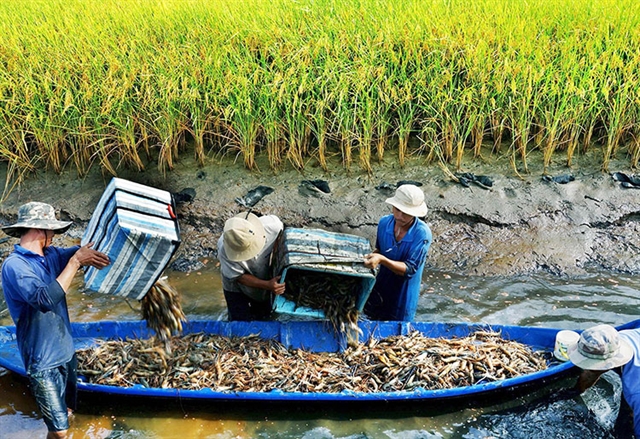
In Cà Mau Province, the area under rice-shrimp cultivation expanded from 77,266 hectares in 2020 to 88,252 hectares in 2025. Average rice yields reached about 5.1 tonnes per hectare, up nearly 26 per cent.
Profits ranged from VNĐ35 million to VNĐ40 million (US$1,350-$1,545) per hectare, depending on production conditions and market prices.
Đinh Thị Kim Dung, head of IRRI’s Việt Nam office, said the challenge was to scale up effective techniques across diverse farming conditions.
Agricultural extension services should move beyond one-way instruction and allow farmers to identify needs, test techniques and provide feedback, she said.
The programme brought together farmers from the Hòa Phát and 14/10 cooperatives, technical officials, the Hồng Dân commune Women’s Union and VIETRISA.
Participants were divided into four groups, including Kinh women, Khmer women, Kinh men and Khmer men, to discuss farming practices, information needs and barriers to adopting new techniques.
|
| A model of rice-shrimp farming in Cà Mau Province. — Photo thuysanvietnam.com.vn |
Nozomi Kawarazuka, a gender specialist at CGIAR-CIP, said decisions on nutrient management were influenced by scientific evidence as well as gender roles, social norms and cultural practices.
Understanding these differences could help experts tailor recommendations and communicate more effectively with different groups, she said.
A representative of Cà Mau’s Sub-Department of Crop Production and Plant Protection, Lê Kiều Hiếu, said listening to women, Khmer farmers and households with different circumstances would help authorities adapt agricultural extension services to local needs.
Nguyễn Thị Kiều, head of VIETRISA’s division for social affairs and women in green agriculture, said gender equality meant improving women’s access to information, strengthening their skills and giving them a greater voice in production decisions.
Participants identified preferred information channels, including face-to-face training, field demonstrations, technical officers, cooperatives and community networks.
IRRI, CIP and their partners will use the feedback to adjust training and support as the programme expands.
The programme seeks to expand farmers’ access to technical guidance and strengthen the role of women and ethnic minority groups in farm management, helping promote more efficient and sustainable rice-shrimp production across the Mekong Delta. — VNS
Society
 Society
 Society
 Society
 Society
 Society
 Society
 Society
 Society
 Society
 Society
 Society
 Society
 Society
 Society