 Society
The hidden cost for Việt Nam's ride-hailing drivers
1.
|
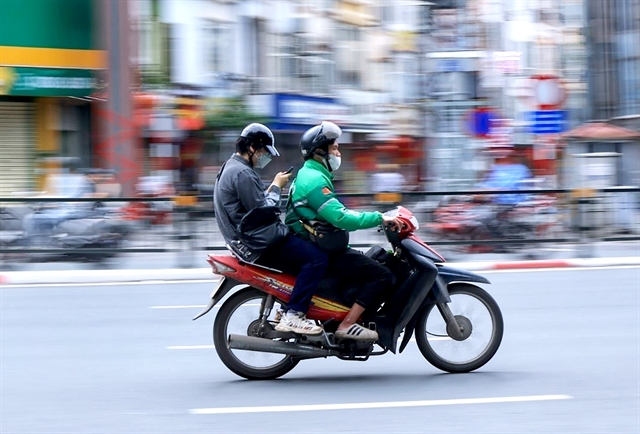
| Many ride-hailing app drivers are pushed into full-time work because they have no alternative – whether forced by limited job choices or tied to a desperate need for flexibility. — VNA/VNS Photo |
Trần Khánh An
At 6am, after spending the whole night on the road, Hiếu returned to his rented apartment in Thanh Xuân Ward, Hà Nội. His shift began at 8pm the previous evening, timed to take advantage of Grab incentives that give drivers an extra VNĐ10,000 (US$0.4) per night-time trip.
Previously a manager at a local eatery, the 29-year-old switched to ride-hailing because long shifts placed a heavy burden on his wife.
"I couldn't keep leaving my wife to do all the chores and let my child grow up without his father," he explained.
Driving offers Hiếu more flexibility, but does not necessarily give him more control over his time. Flexibility now means working whenever the platform pays most, and reorganising his day accordingly.
The price of flexibility
He found that driving at night was the most effective way to maximise his earnings.
He said: "Changing my sleep schedule is tough, but I no longer have to deal with heavy traffic, endless red lights, exhaust fumes and the constant pressure of staying alert while driving during the day.
"Driving definitely takes a serious toll on our health. When it's hot, there's dust and heat, and when it rains, working on the road becomes much colder and harder."
The risks go beyond fatigue. Hiếu said his foot once swelled badly after a motorbike accident. He stayed home briefly to recover, but he was back on the road the next day.
He added: "If I rest, how am I supposed to support my family? We drivers have a saying: 'we're just selling our health for money'."
Even so, Hiếu believes he is still far more fortunate than many of his fellow drivers. Lan, a former shop assistant in Ninh Bình, turned to ride-hailing because kidney disease required her to attend hospital appointments three times a week.
Yet, the earnings barely cover her living and medical bills. Her parents later moved to the capital, where her father also took up driving. The three squeezed into a shabby rented room of just five square metres, struggling to make ends meet.
While some see ride-hailing as a temporary gig or a way to increase their income, for many others, it is their primary livelihood. A September survey of 141 drivers by the HCM City Trade Union's Workers' Counselling and Support Centre found that 93.6 per cent relied on ride-hailing as their main income.
Like Hiếu and Lan, many drivers are pushed into full-time work because they have no alternative – whether forced by limited job choices or tied to a desperate need for flexibility.
The SocialLife Research Institute found that 64.3 per cent of 400 drivers in HCM City chose ride-hailing for its flexible working hours, while only 15.5 per cent cited high earnings as their main motivation.
However, if they work a standard eight-hour day, their monthly income would fall well below the average living wage in major cities: VNĐ6.21 million, compared with VNĐ7.5 million.
To make ends meet, they must work more than 11 hours a day and over 28 days a month to earn VNĐ9.3 million after expenses. This amounts to more than 103 hours of overtime a month, over 2.6 times the limit set by the Labour Code.
The pressure to work longer hours comes not only from low earnings but also from the platforms' algorithms.
Associate Professor Nguyễn Đức Lộc, director of the SocialLife Research Institute, said ride-hailing drivers' performance is assessed based on acceptance rates, time spent online and customer ratings.
"Drivers can choose when to start, but they cannot fully control how many hours they need to work to achieve their desired income," he said.
Hiếu confirmed this is common understanding among drivers, adding: "When a ride comes in, we have to accept it, whatever the destination or fare. Reject too many, and the app may lessen orders or suspend our accounts."
In a 2025 study, Nguyễn Thu Giang and Luke Munn of the University of Queensland, explored how GrabBike drivers in Hà Nội adapted to the platform's algorithm through a strategy termed 'rèn áp' (taming the algorithm). Their tactics included adjusting their routines, adapting to different working conditions, combining passenger rides with delivery orders, and remaining active on the platform for 60–100 days.
The study suggests that although drivers hope to be recognised as 'active drivers' and receive more orders, 'rèn áp' requires long working hours, pushing drivers towards exhaustion and self-exploitation. These tactics do not shift the power balance – they are just how drivers adapt to keep working within the system.
This also creates a vicious cycle. Drivers may be dissatisfied with the platform's policies and aware of how this job affects their health, but they cannot afford to stop working. They feel compelled to stay online, accept rides and maintain the performance they believe the algorithm rewards.
As Lộc put it: "Flexibility may exist on the surface, but it does not necessarily translate into the level of autonomy implied by the term 'partner'."
'Independent partner'
This September, some Grab drivers took to social media to call for a collective app shutdown over high deductions and Grab's flexible app-fee mechanisms, in place since 2024.
Showing a GrabBike Economy trip receipt on his phone, Hiếu pointed to a nearly 50-50 revenue split: for a fare of VNĐ18,000, he got just over VNĐ9,000 after platform fees and taxes.
"I used to make around VNĐ800,000–900,000 a day, but now I work an extra two to three hours just to reach VNĐ600,000," he said. "We don't really know how much they will deduct. They take more on some trips and less on others."
Following complaints from drivers, the Việt Nam Competition Commission reviewed Grab's pricing and fee policies and held discussions with the company. Grab announced a package of measures worth VNĐ2.95 trillion (US$113.5 million), covering fee reductions, driver refunds, incentives and passenger promotions.
Under the new measures effective November 10, Grab will maintain its flexible fee mechanism but cap the combined platform and app-use fees it receives at 32 per cent of the passenger's total payment, excluding taxes and third-party charges. The platform also plans to refund VNĐ3.9 billion for erroneous deductions and upgrade its app interface to provide clearer breakdowns of earnings and fees.
However, the changes have yet to convince Hiếu that they will make a meaningful difference.
"It's mostly for show," he said.
"At the end of the day, drivers still take home only around 60 per cent of the passenger's payment, while we still have to pay for fuel and maintenance costs."
More than half of the package will actually go towards passenger promotions and performance-based driver bonuses.
Hiếu said drivers often felt that raising complaints through the platform brought little result.
"The company only gives us general explanations based on its policies, so our complaints don't really lead anywhere," he said.
"Whenever some drivers can no longer put up with the situation, their only reaction is to turn off the app, hoping to draw attention."
His scepticism reflects a pattern of frustration among ride-hailing drivers. On several occasions between 2017 and 2024, drivers working for different platforms opposed fees and deductions, calling for collective app shutdowns or gathering outside company offices.
While such complaints have sometimes prompted platform companies to adjust their fees and commission rates, the changes have offered short-term relief rather than addressing the broader issues affecting drivers.
The repeated calls for collective app shutdowns also point to a deeper problem: drivers have few formal channels to raise concerns collectively or negotiate with platforms over the terms of their work.
Although the Competition Commission's intervention has prompted changes to Grab's pricing and fee policies, it has not addressed the wider imbalance in the relationship between platforms and drivers, who still have little say in how fares, fees and algorithms are determined.
"We don't have access to statutory benefits and protection, and I believe it's because our legal status has not been clearly recognised," said Phạm Mi Sên, Vice Chairman of the HCM City Ride-Hailing Drivers' Trade Union.
Grab, alongside some other ride-hailing platform companies in Việt Nam, classifies drivers as 'independent partners' rather than formal employees.
In practice, drivers not formally recognised as employees are excluded from certain benefits and protections available to employees while bearing the risks of their work. In turn, platform companies don't have the corresponding employer responsibilities.
"Trade unions in some localities have brought ride-hailing drivers together and established unions," said Dr Phạm Thị Thu Lan, Institute of Strategy and Policy of the Front.
However, these unions could not use the same labour-law mechanisms to consult policy or bargain collectively with companies over workers' rights and interests, she said.
Lan added that the lack of a clear regulatory framework also leaves platform workers outside certain statutory labour protections. Although some ride-hailing companies provide personal accident and health insurance, these are voluntary initiatives rather than benefits guaranteed to drivers under employment law.
A survey by the SocialLife Research Institute found that 82.4 per cent of drivers did not participate in social insurance, while 87.3 per cent lacked unemployment insurance. More than half had no accident insurance, and 33.1 per cent had no health insurance.
"However, 75.1 per cent purchased vehicle insurance themselves – the only type of insurance legally required for all," Lộc said.
"The figures suggest the system protects vehicles better than it protects drivers."
The grey area
Some ride-hailing platform companies describe themselves as technology providers connecting customers with drivers, whom they classify as independent contractors under business cooperation contracts or service agreements.
The name of a contract itself does not determine an employment relationship. Article 13 of Việt Nam's 2019 Labour Code sets out indicators to identify an employment relationship, including work performance, remuneration, and management and supervision.
Ride-hailing drivers retain some autonomy as self-employed: they can decide when to work, use their own vehicles and cover expenses. However, companies use algorithms to assign rides, set fares and fees, and penalise those violating platform rules. These forms of platform control can indicate an employment relationship.
"Therefore, the employment relationship between drivers and platform companies can be complex or unclear", said Nguyễn Hoàng Mai, Lecturer and Researcher at Trade Union University and Member of Lawyers' Association of the General Confederation of Labour.
"As technology advances, emerging forms of work in the gig economy no longer fit neatly within traditional indicators of an employment relationship," she added.
"At first, it may appear to be self-employment, but there are also signs of an employment relationship".
Việt Nam has not yet established clear, specific guidance on how to determine the employment status of people working through digital platforms and how to apply existing regulations on platform work.
Mai suggested that the State's top priority should be clarifying the employment relationships of those working through digital platforms.
"If they are identified as employees, we could strengthen existing labour laws and policies to provide them with greater protections," Mai said.
"If we classify it as a complex relationship, we could develop an open policy framework to provide platform workers with some labour protections and benefits."
Mai emphasised that policy reforms must go beyond labour laws to govern business operations, including how platform profits are distributed.
"We also need to protect the rights of platform workers," she said, highlighting minimum wage guarantees, occupational safety standards, paid leave, and social security.
To address these gaps, she suggested Việt Nam learn from international precedents, noting that the common effort across these governments is recognising algorithmic supervision as employer control.
In 2024, the European Union introduced its Platform Work Directive, establishing criteria for member states to identify employment relationships based on algorithmic control.
Spain took early action with its 2021 'Rider Law', establishing a presumption of employment for digital platform delivery workers as employees because platform companies control delivery schedules and geographic dispatch through algorithms.
Meanwhile, following a landmark 2021 Supreme Court ruling against Uber, the UK recognised platform drivers as 'workers', entitling them to minimum wage and paid leave.
In October, Việt Nam Government proposed expanding mandatory social insurance coverage to platform workers, including ride-hailing drivers. Under the draft law, people working outside formal employment relationships or through digital platforms with regular work and stable income could be brought under mandatory social insurance coverage.
"Ultimately, extending social protection to ride-hailing drivers is more than social and health insurance," said Associate Professor Lộc.
He proposed a three-pillar approach to protect ride-hailing drivers: legal clarification of employment status, collective representation, and platform companies' contributions to social security.
"It is also about ensuring that digital transformation creates jobs without shifting the risks of the business model entirely onto drivers." — VNS
Society
 Society
 Society
 Society
 Society
 Society
 Society
 Society
 Society
 Society
 Society
 Society
 Society
 Society
 Society